Visegrad (originally Višegrad) is not a metropolis. In fact, there are few tourist attractions here. There is only or as much as a beautiful UNESCO-listed bridge, an eclectic settlement dedicated to a famous writer and…. that’s it.
If someone asks for memories of a place in the world, and we can’t remember much, it’s a sign that we haven’t been to the tourist navel of the world. That’s what Visegrad is in Bosnia and Herzegovina, specifically in Republika Srpska. Because it is worth mentioning that Bosnia and Herzegovina is still a powder keg and the mix of nationalities here still do not like each other.
I should also mention that my second memory is dining in the best restaurant in Visegrad. You can decide for yourself whether these tourist attractions are worth a visit.
Bridge on the Drina. The sheer beauty of stone
The bridge over the Drina is basically a manifestation of the fact, that if someone has influence, they can get anything. That’s the way it is today, that’s the way it was a few hundred years ago, and it’s sure to remain that way.
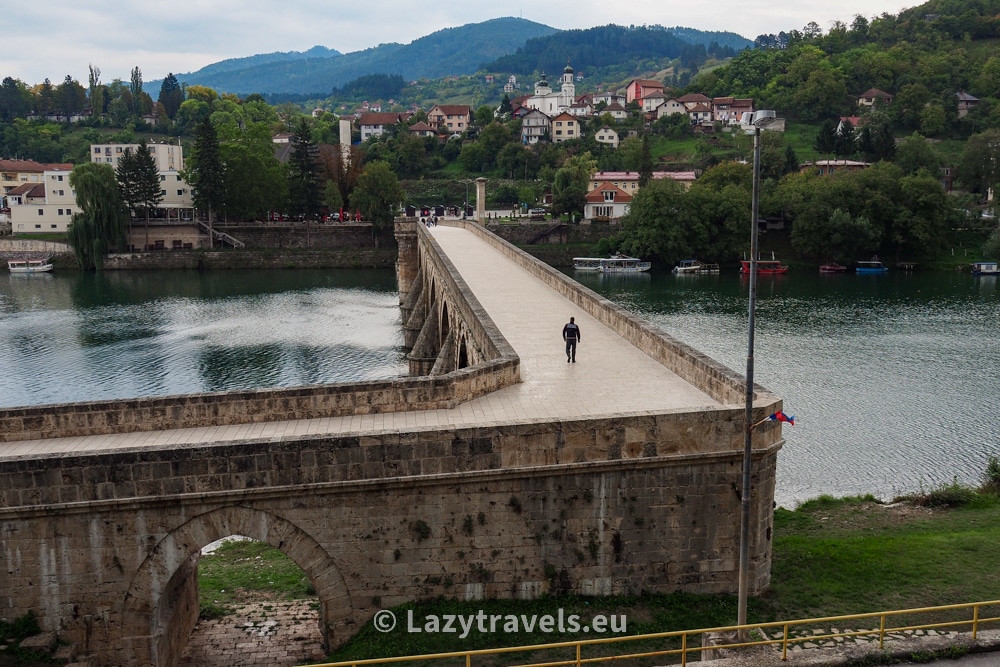
As a child, Mehmed Pasha Sokolovic was taken away from his parents and, like many other children in the Ottoman Empire, took up education and training as a Janissary. He must have been a devilishly talented kid and even more intelligent and clever. Because only with this can it be explained that he reached the highest available office in the country. He became the Grand Vizier. And as the highest official, he had only the Sultan and Allah above him. Of which the latter he had to fear only in the hereafter. Mehmed also had to rule well, as he served under as many as three sultans who trusted him. He ended miserably, as he was assassinated by conspirators.
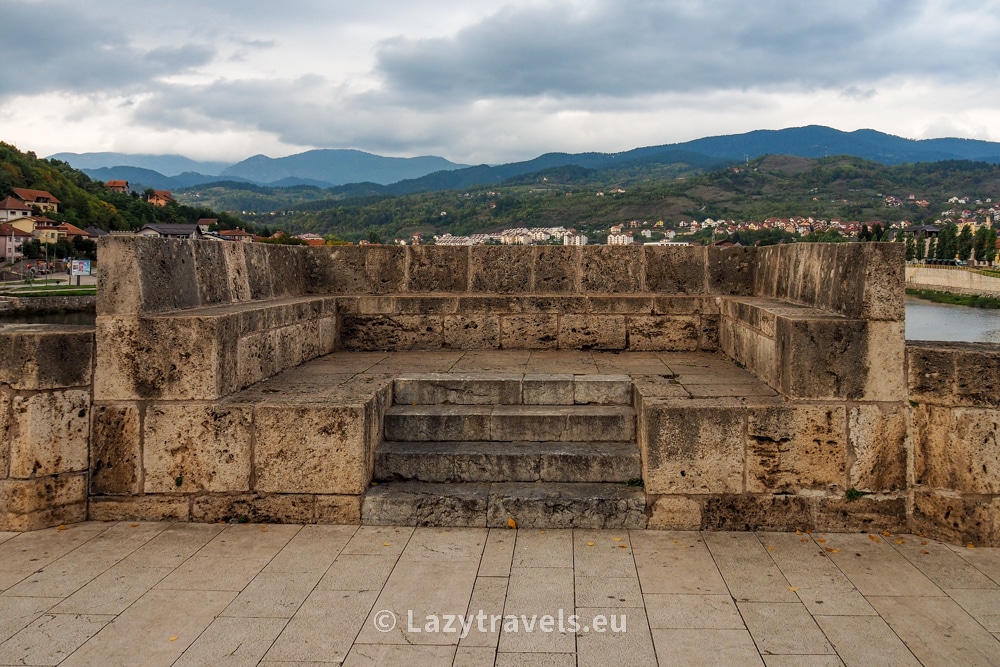
Mehmed Pasha must also have been sentimental, because how else to explain the fact that he decided to build such a huge and complex engineering structure as a bridge very close to his home village of Sokolovići. For the time, this bridge was something magnificent, unprecedented and awe-inspiring. Pride, because how not to be proud of the pinnacle of technology? Of the time, of course.
The bridge – a marvel of ancient technology
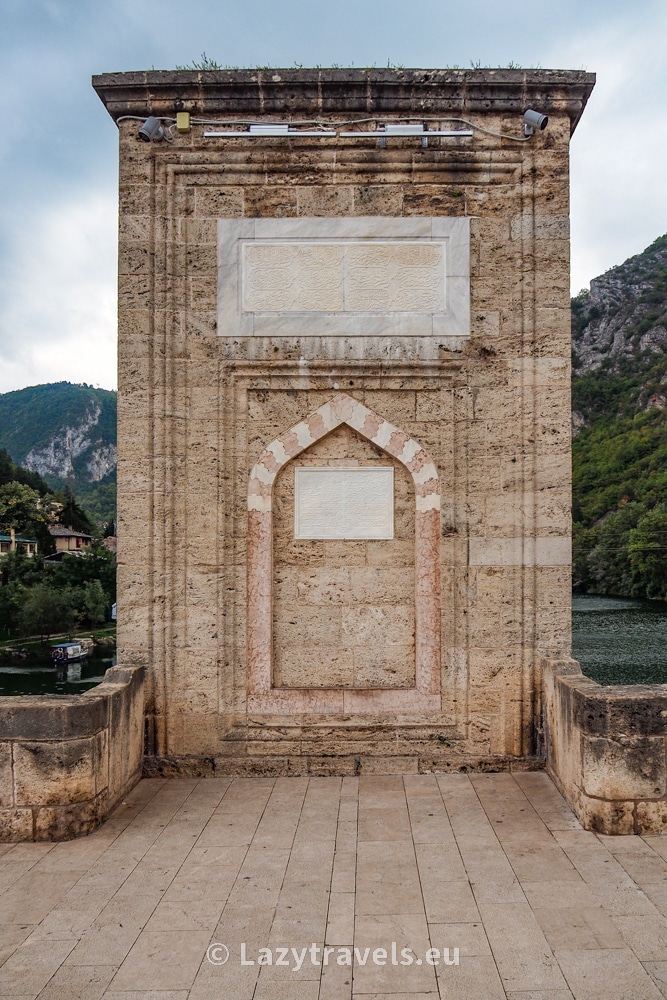
The bridge was built really quickly, between 1571 and 1577, and it’s not just any structure! The 179.5-meter-long bridge was based on 11 arches, with a width of 7.25m so carts with goods could pass over it. There is also an entrance ramp, located at a 90-degree angle. The ramp is 49.2 meters long and rests on four consecutive arches. At normal water levels, the bridge floats about 15 meters above the water table. In the middle of the bridge is a cupriya. Terrace, which in the old days was the social heart of the bridge. Here people met, here they drank tea, here they made decisions. If you want to imagine this more vividly, read Bridge on the Drina, by Nobel Prize winner Ivo Andrić. The bridge of the title is the very structure under discussion in Visegrad. A marvel of technology and engineering of the time.
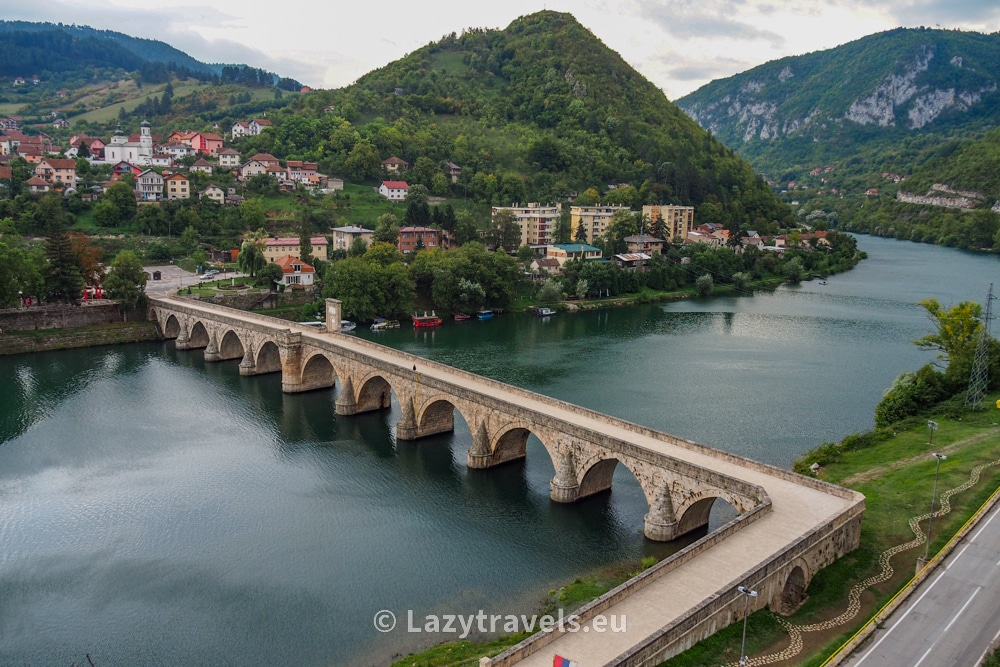
If you want to fully appreciate and marvel at the Bridge on the Drina, be sure to climb to the vantage point, located on a rock overlooking the thoroughfare. The climb is short and the view is magnificent. From here you can best appreciate the power of the structure and its delicacy at the same time. Despite being made of stone, it winds over the current of the Drina like an outstretched airy ribbon. I wish I had this view in front of me on a beautiful sunny day. But unfortunately, clouds have pulled the sky, and forecasts say that it will only get worse, the wind is increasingly making its presence known. That’s why we don’t take the offer of a river cruise and go to visit another Visegrad attraction. The destination is Andrićgrad.
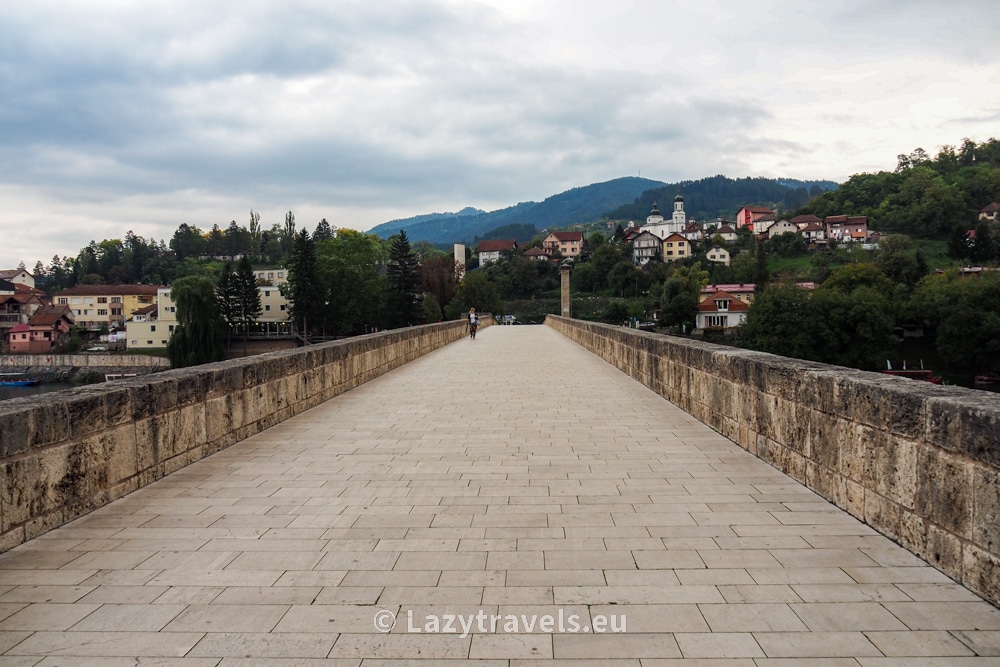
Andrićgrad. A combination of everything
Andrićgrad, as soon as I saw it, brought back memories of Morocco, specifically of Warzazat. And this town is home to two film museums and countless films were shot here. Huge sets were shot and built, which, of course, can be visited today in the aforementioned museums. And just such a huge artificial set for filmmakers is Andrićgrad. Everything here is so artificial and so incongruous. Out of context and taste, it’s all the way beautiful and entertaining. And that’s the only way to treat it.
The creator and originator is the famous Emir Kusturica. The director of such film works as, for example, “Underground” or “Black Cat, White Cat.” Andrićgrad is nothing else but in Polish “Miastoandricia.” It’s named after Travnik-born Ivo Andricia, a famous Yugoslav writer and Nobel Prize winner.
And even with the construction of Andrićgrad, politics comes into play. Well, the construction began on June 28 – the anniversary of perhaps the greatest national myth of the Serbs, that is, the battle with the Ottomans on Kosovo Field. A battle lost by the Serbs, in which a significant part of the Serbian nobility was killed.
Here a small digression: the battle was on June 15, but the 28th of that month is adopted due to the change of the calendar from Julian to Gregorian. However, returning to this fascinating site, it was completed three years later. On June 28, 2014, on the same day. Of course, not everything was finished and still isn’t, but who cares. The construction reportedly cost $14 million!
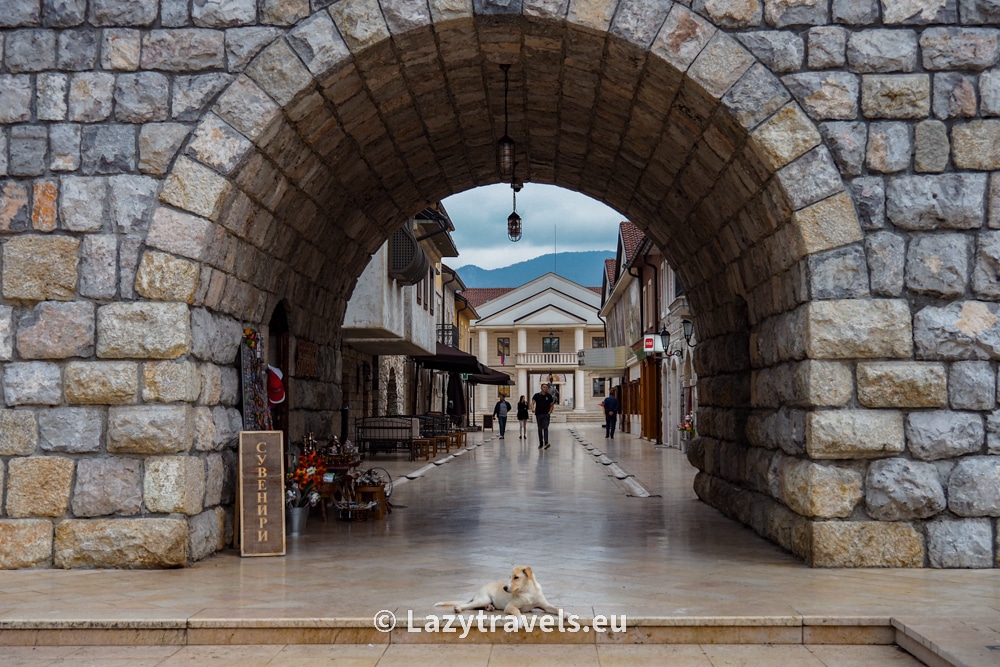
Andrićgrad: Funny place
It’s not easy to say what this architectural premise is. Because it was basically decided to build a small city within a city here. On a promontory located in the forks of the Drina and Rzav rivers, hotels, an academy of fine arts, a city hall, hotels, a cinema for several auditoriums, a theater, the Ivo Andricia Institute, an institute of Slavic languages and much more were built. And of course, many places and decorations refer either to the work of Ivo Andricia or to the history of Visegrad.
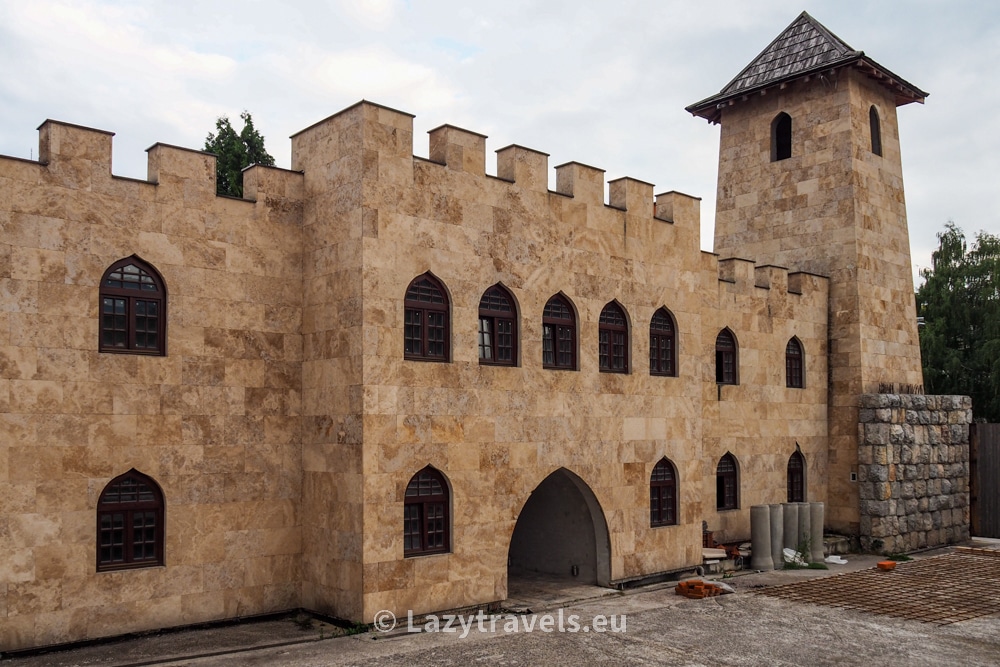
It is really impossible to tell the story of this place. It has to be seen. Because, on the one hand, we enter the city, as if it were a stone fortress, a castle with castellations. But such a castle more out of Kajek and Koosk. More made of dicta than stone – that’s the impression it gives. But inside, once we pass the gate we are greeted by Ottoman houses, and across the street there is a statue of Ivo Andricia himself. However, walking down the main street, we also come across a cinema, and further on a café in a style perfectly out of step with the rest.
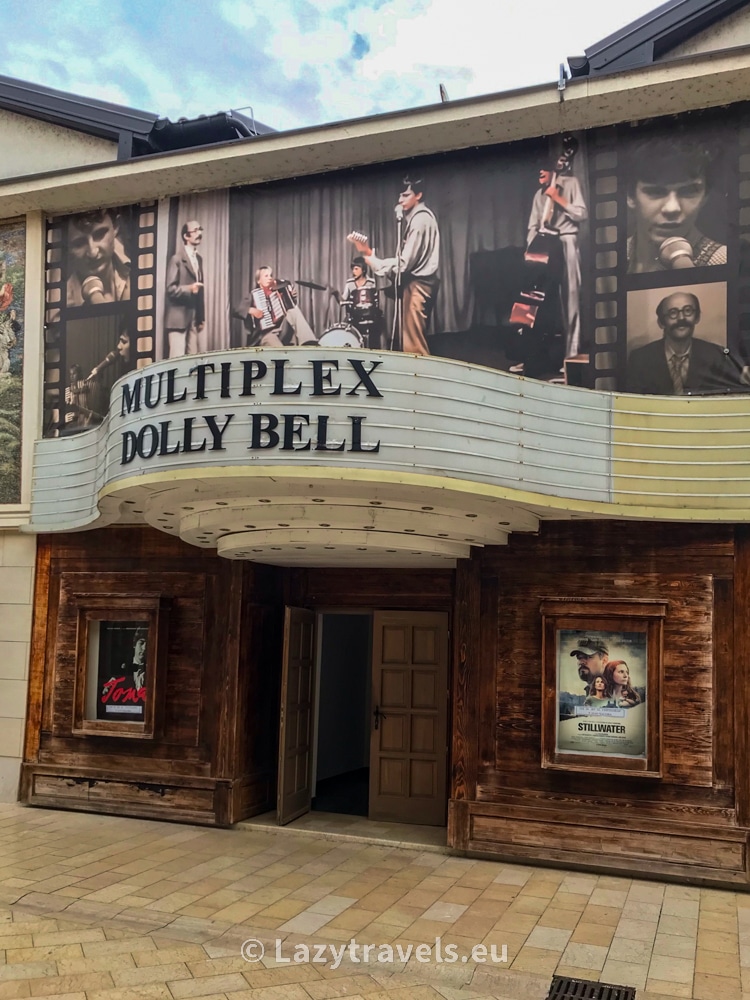
But right next door you have to raise your eyes, because the mosaic above us is simply fabulous! Ok, there are two mosaics. One depicting Gavrilo Princip, yes the same one from the assassination of Archduke Ferdinand in Sarajevo. I will not dwell on this art. However, the second one is overstunning. Behold, a ludic landscape, verging on kitsch, has been placed on a large mosaic. Here are apples hanging on an apple tree, under the apple tree some grandmother is playing the harmonium, a young girl is dancing in front of her. And in her succor also come dancing geese!
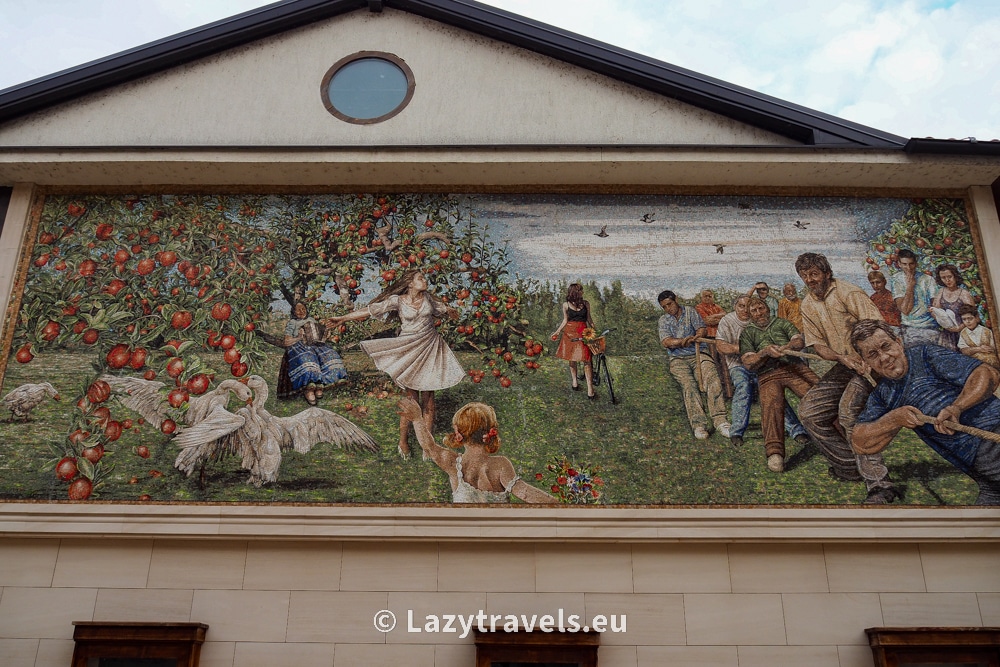
From afar, in the middle of the work comes a girl with a bicycle, and on the right…. Yep, here is an example of megalomania! Here pulling the rope you can see Emir Kusturica himself. But to suck up to the sponsor, the president of the Republic of Serbia, i.e. Milorad Dodik, is also in the picture. And the happy scene is closed in the background by the famous tennis player Novak Djokovic himself chewing on nuts. He has a chance to relax after a murderous struggle on the court.
What else is there to see?
Let’s be honest: basically not much anymore. You can, for example, sit on the lap of the aforementioned grand vizier Mehmed Pasha Sokolovic, whose monument is close to the river. With a picturesque vegetable store in the background. But these are 2-minute attractions, so after that it is worth going to probably the last tourist attraction of Visegrad.
I’m referring to the station of the narrow-gauge railroad connecting Visegrad with Mokra Gora in Serbia. Unfortunately, as far as I know, this connection is currently closed due to a pandemic, but hopefully this will change. All the more so because this railroad can be used to reach the Szarganska Eight, which is a beautifully scenic tourist railroad right on the border of Serbia and Bosnia and Herzegovina.
The bridge – a witness to a tragic history
Over the centuries, the only fixed bridge across the river in the area has seen a lot. Armies have passed over it. Twice part of its spans were blown up (in the First and Second World Wars). People were hanged on it, the bodies of villains were put on display for all to see as a warning. The bridge was the center of the city, connecting the banks and, for a long time, the people. Until the breakup of the former Yugoslavia. Then hell began.
Before 1992, Visegrad was home to about 60 percent of Boshnians, while Serbs were about 33 percent. . Why am I writing about this? Well, because after the ethnic cleansing that took place here, the city is now inhabited by 90 percent Serbs. And now to the substance…
Murders, rapes and robberies took place over a large territory of the former Yugoslavia, here almost every nation was fighting with another. Old animosities and demons of the past were revived. Dubrovnik was burning, the besieged Sarajevo was flowing with blood, the Old Bridge in Mostar collapsed under tank fire , several thousand people were murdered in cold blood in the not so distant Srebrenica. People were dying everywhere. But about what was happening in Visegrad one looks in vain for spectacular
And here, too, inconceivable things were happening. Serbs locked the local ethnic majority in houses, which they threw grenades at, only to set the house on fire later. Whoever was lucky enough to be killed by a grenade was “lucky.” The rest were burned alive. Few escaped the massacre alive. There was a special hotel for raping local women, a lot of things happened here. But spectacular things also happened on the Mehmed Sokolovic Bridge…. For people were thrown into the water and shot in flight, their throats were cut and thrown into the water, or they were simply killed on the bridge and also thrown into the water. Let the scale be evidenced by the fact that the bodies clogged the inlets to the hydroelectric power plant downstream. When the water was drained from the lake many years after the war, 300 bodies of victims of the past massacres were found.
Well, the history of these lands is difficult to say the least, so when going to a restaurant in Visegrad it is unlikely to order “coffee in Bosnian style.”
Dinner in Višegrad
All in all, more of a dinner than a lunch, but since it was the second meal of the day for us, let it be lunch 😉 Anyway, we were looking for an atmospheric place where we could have a meal in pleasant circumstances. We passed by several restaurants and either they were empty, which is almost always suspicious, or the decor was repulsive. With that, we crossed the bridge over the Drina again and ended up at Anika restaurant, which was next to the road.
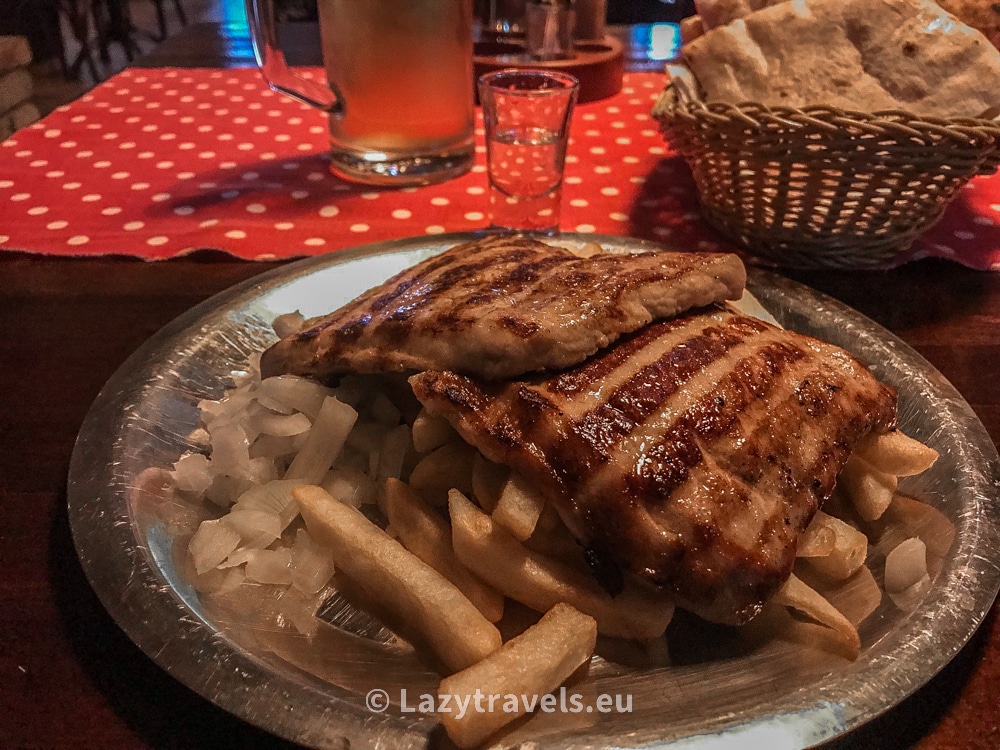
But what a hit it was. First of all, there were locals sitting inside, which is always a good sign! Secondly, there were fortunately free seats, and thirdly, the waiter took an immediate interest in us. What’s more, he was really honest and when we ordered a beer “Nectar” in his eyes you could see that it was a bad choice. For that the food they had was great and I won’t say a bad word. And if you add to this that the rakija tasted delicious and came in many flavors, I don’t think I need to convince you further?
Of course, as it is in Bosnia, we paid really little money for a meal for three people. Including the tip, because it was due!
The only drawback is that, as in the entire Balkans, you can smoke inside :/ For that, if it’s warmer in the Anika restaurant there is a terrace and you can eat your meal on it. Then across the Drina River you can see Andrićgrad.
Hotels in Višegrad. Where to stay for a night or more
Let’s face it: there are not many tourists staying in the city overnight. But surprisingly the accommodation base in Visegrad is quite large! We decided to sleep in a hotel and, like lazy people, go down in the morning for breakfast, so our choice was the Visegrad Hotel with a view of the bridge from the room. Well, many more of them are not here. The hotel was quite decent and the rooms were baaavery large. You park your car in the parking lot in front of the building and there is no problem with that. The rooms are pretty ok, but don’t count on four stars. But for the price of PLN 100 per person it’s not bad. Of course, you can also find apartments like Apartment Ive Andrica 3 with a view of the bridge on the Drina.
Other accommodations you can find, for example, in this place.