Wiślica isn’t a town that typically appears on the standard itinerary for tourists visiting Poland. But few Poles are aware of the fantastic treasure housed in the local museum. However, this isn’t the only attraction or reason to visit Wiślica. Here are the most interesting places to see.
Wiślica appeared on my “mental sightseeing map” quite recently. And all because I found out that one of Poland’s oldest medieval monuments is located here. I’m referring to the slab of orants, also known as the Wiślica Slab. I’ve written more about it below. But it’s worth noting that a very interesting multimedia museum has also been created “around the slab.” It is one of the most modern and multimedia-rich museums in Poland.

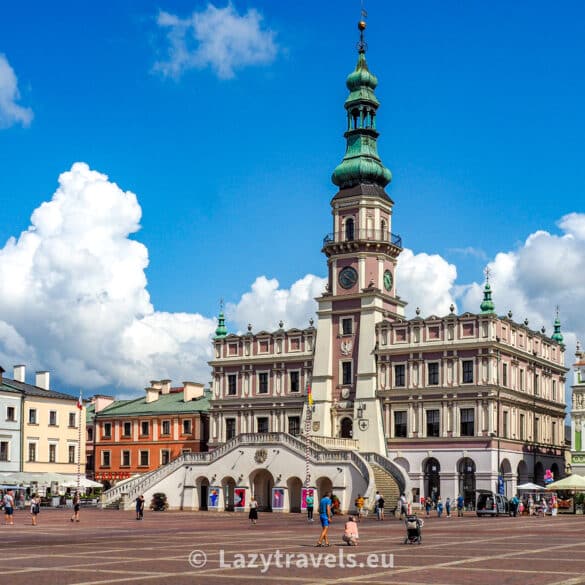
Wiślica is unique and hasn’t followed the path of other small towns in Poland. It hasn’t paved over the town’s central square. Trees continue to grow here undisturbed, and on a hot day, residents sit on shaded benches and eat ice cream. Of course, the park is traditionally surrounded by a parking lot. There aren’t many historic sites in Wiślica, so I headed straight for the most impressive building: the Collegiate Church of the Nativity of the Blessed Virgin Mary.
The Collegiate Church of the Nativity of the Blessed Virgin Mary in Wiślica
The collegiate church is the third church to have been built in Wiślica for the glory of God. Each successive church was larger and more impressive. The building we see today is a work we owe to Casimir the Great. Here’s a brief explanation: Casimir the Great is considered one of the greatest Polish kings. Just how much he did for the Republic is evidenced by the fact that everyone in Poland knows the saying that Casimir the Great “found Poland made of wood and left it made of stone.”
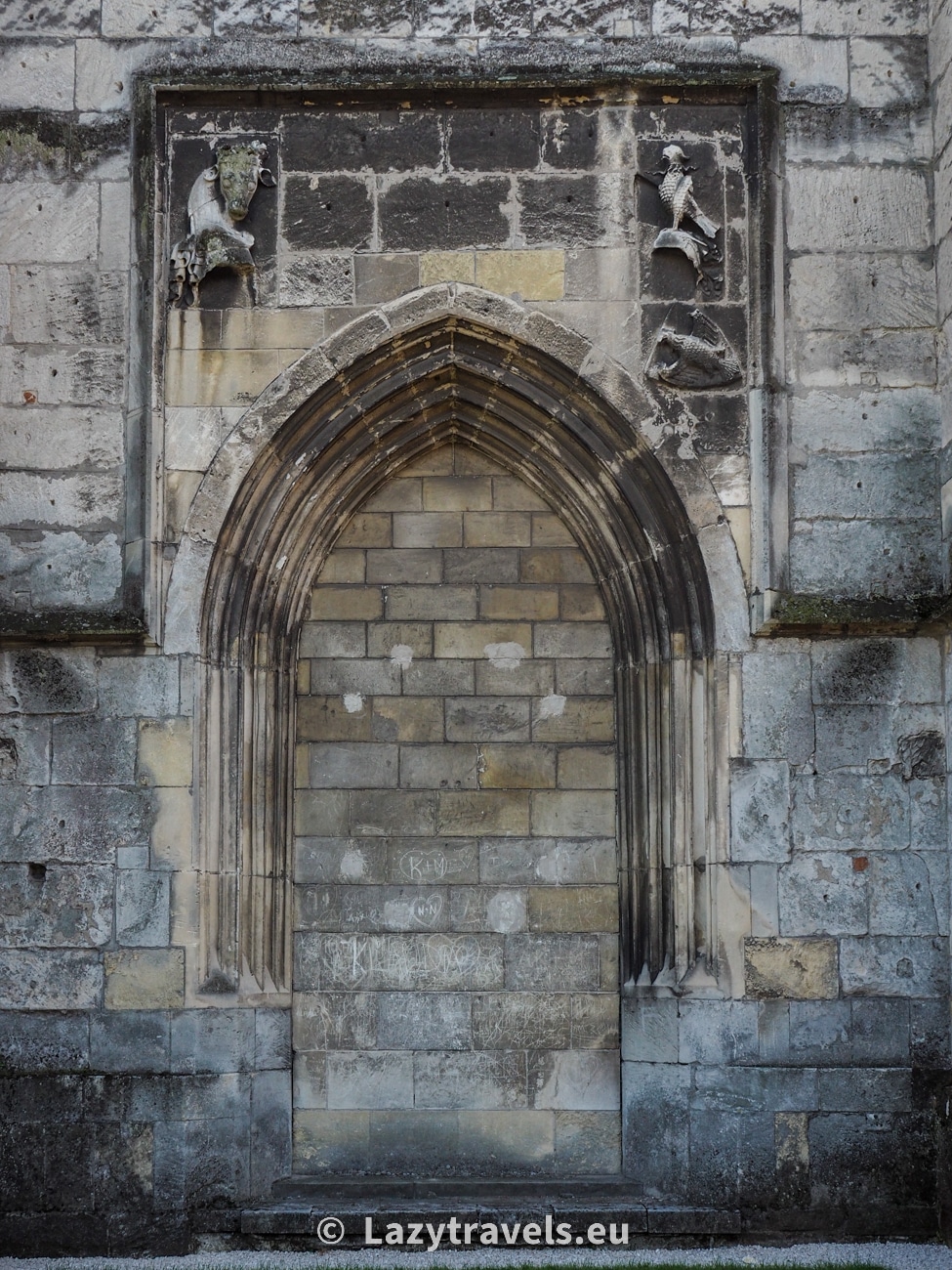
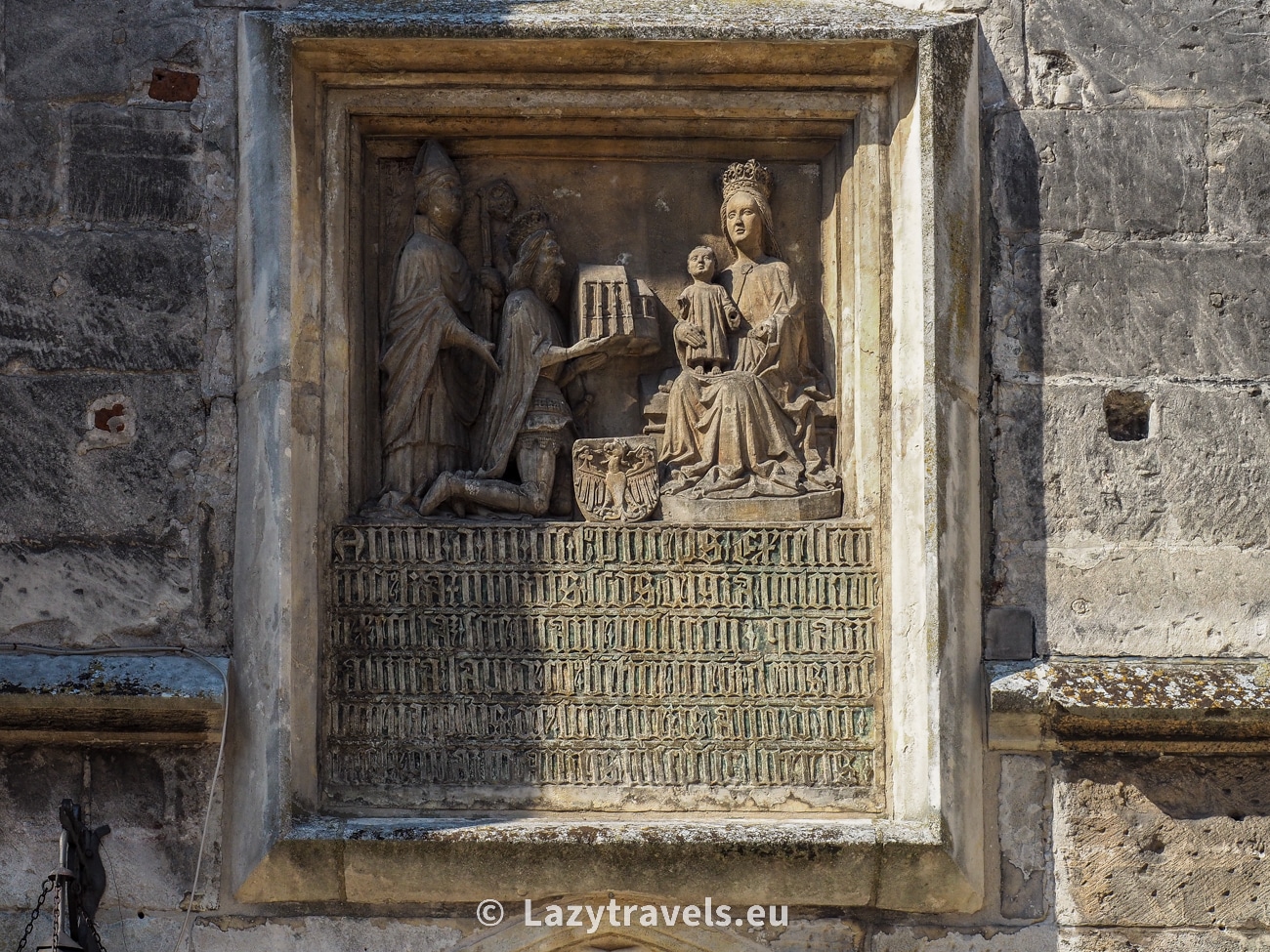
The local church is part of this great achievement of leaving Poland as a brick-and-mortar nation. In fact, on the right exterior wall, you can see a bas-relief in which King Casimir dedicates the church building to the Virgin Mary with the Child. Admittedly, the bas-relief does not date back to the time of Casimir the Great, but is a hundred years older, and we owe it to Jan Długosz, who commissioned it. When you’re standing beneath this bas-relief, it’s worth walking over to the second, northern wall of the church, because there’s an interesting feature there as well. It’s an old, bricked-up entrance portal, above which you can see two Piast eagles and the coat of arms of Greater Poland.
Now let’s go inside the collegiate church. The most interesting part is the chancel, because there—or rather, on the walls above us—we can see Ruthenian polychromes that have survived to this day. The decorations were created between 1397 and 1400, and if you’ve traveled around Poland, you’ll quickly recognize them as similar to those found in the castle chapel in Lublin. Besides, right next door in the Sandomierz Cathedral, there are similar ones, only better preserved. If you like this type of historic site, the polychromes in Sandomierz are a must-see when touring Poland.
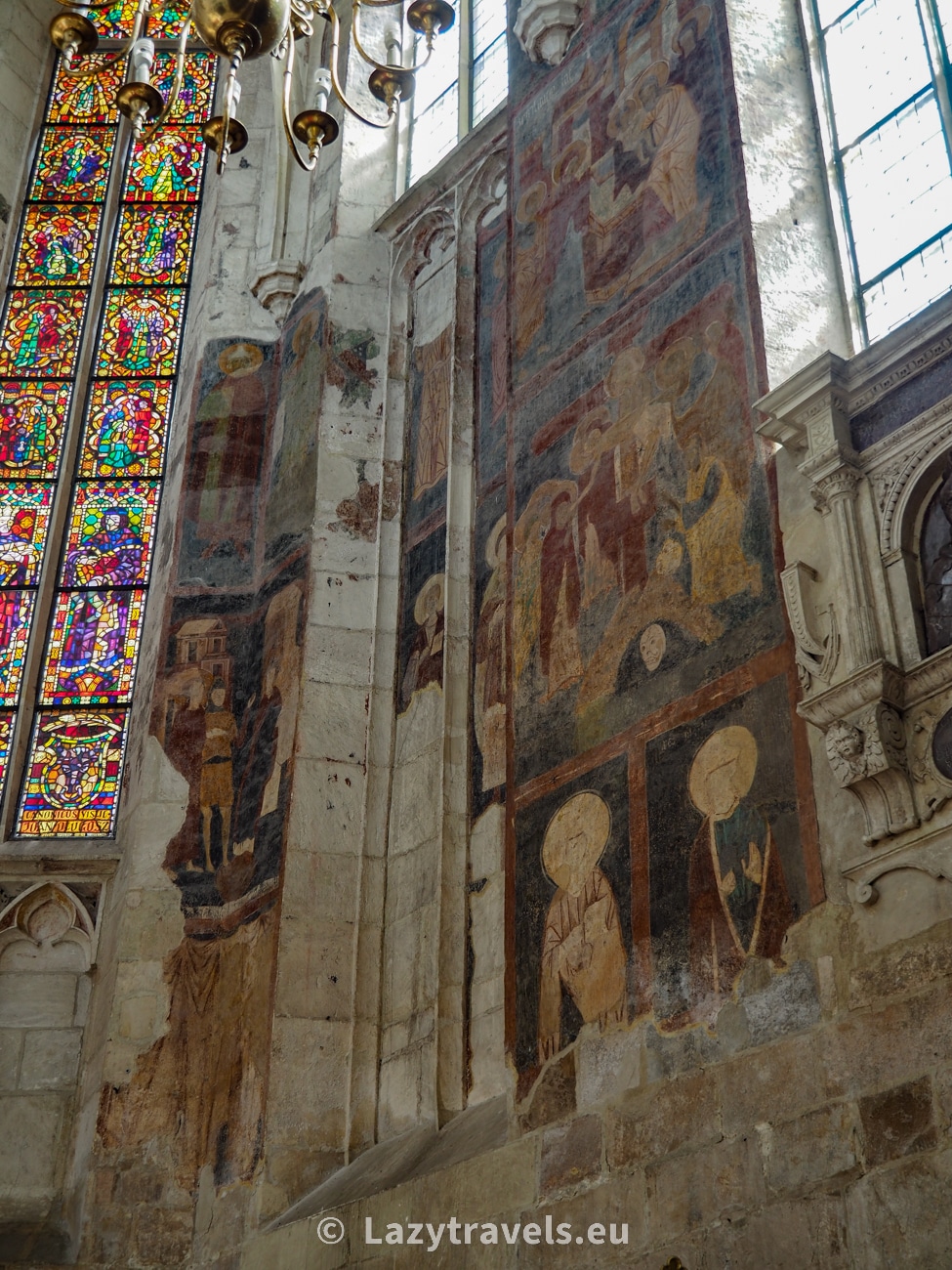
An interesting feature of the interior, located above our heads, are the keystones. They bear the coats of arms of the territories that became part of the Kingdom of Poland after the end of the period of fragmentation. Yes, in the Middle Ages, Poland was divided into small appanage duchies, which made the state very, very weak and vulnerable to external attacks. To preserve its statehood, it was necessary to unify the country. This, of course, happened under Władysław Łokietek with his coronation in Kraków in 1320.
Długosz House
As you leave the church building, you’re sure to notice a large brick house. This is the so-called Długosz House, named after the famous priest who was one of the first Polish chroniclers to document the history of Poland at that time. Unfortunately, I didn’t get to tour the building because I arrived on a Friday, and it’s only open on weekends. So keep that in mind if you come to visit the attractions of Wiślica.

Inside, there are several preserved frescoes; one of them likely depicts the building’s founder, Długosz himself. And when viewing the monument from the outside, take a look at the window portals. They have survived to this day, and the decorations you see are the Wieniawa coat of arms, which was used by the aforementioned founder.

Wiślica Archaeological Museum. The jewel of the city
I’ll admit right away that I didn’t expect to find a museum like this in such a small and obscure Polish town. But it turns out that this recently opened museum is both multimedia-rich and well-presented. And best of all, I had it all to myself! That’s the advantage of visiting during the summer, on a weekday around 3:00 p.m. on a Friday.
After purchasing a ticket, you receive an audio guide with headphones, through which the narrator’s voice shares historical facts and interesting tidbits.
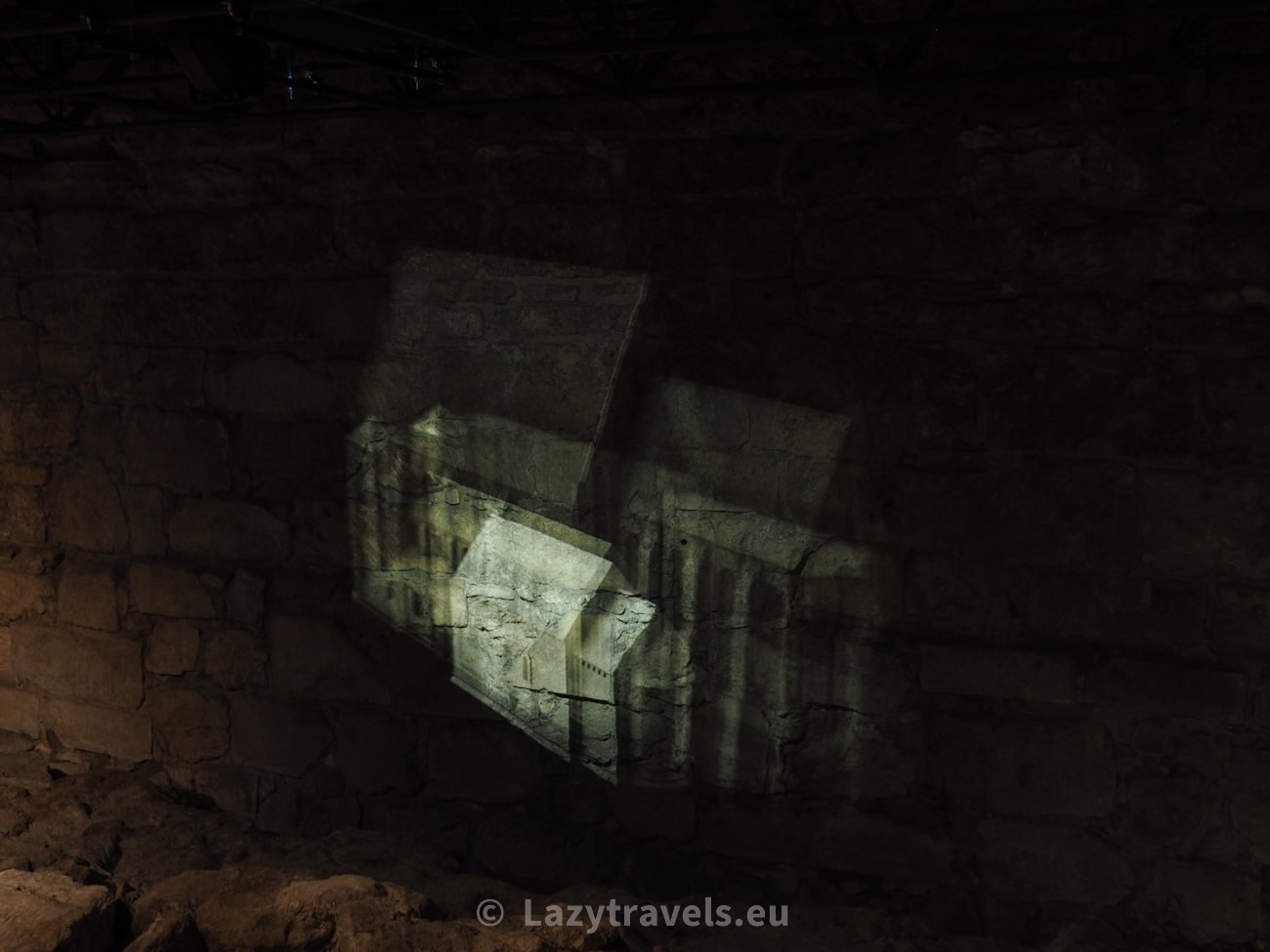
The first room refers to the earliest times, when the Vistula tribe lived in Wiślica; as we recall from history, this tribe existed even before the Polans and competed with the powers of the day. On the wall, we see a projected model of what the defensive stronghold might have looked like at that time. And then a quote from “The Life of Saint Adalbert” reaches our ears.
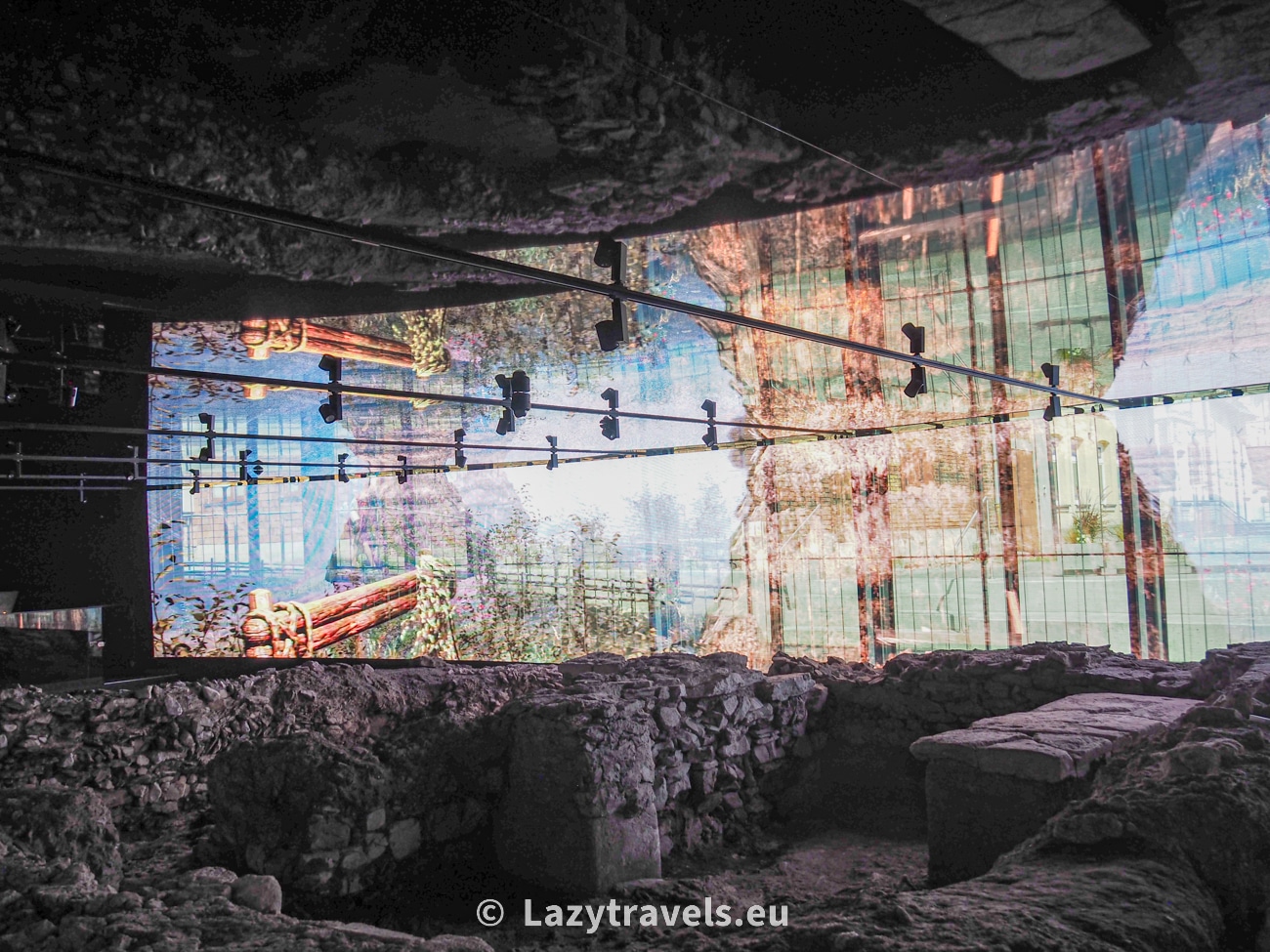
“A pagan prince, very powerful, who ruled in the Vistula region, greatly mocked the Christians and did them harm. Then Methodius sent word to him, saying: It will be good for you, my son, to be baptized of your own free will in your own land, so that you may not be baptized by force in a foreign land, and you will remember me. And so it came to pass.
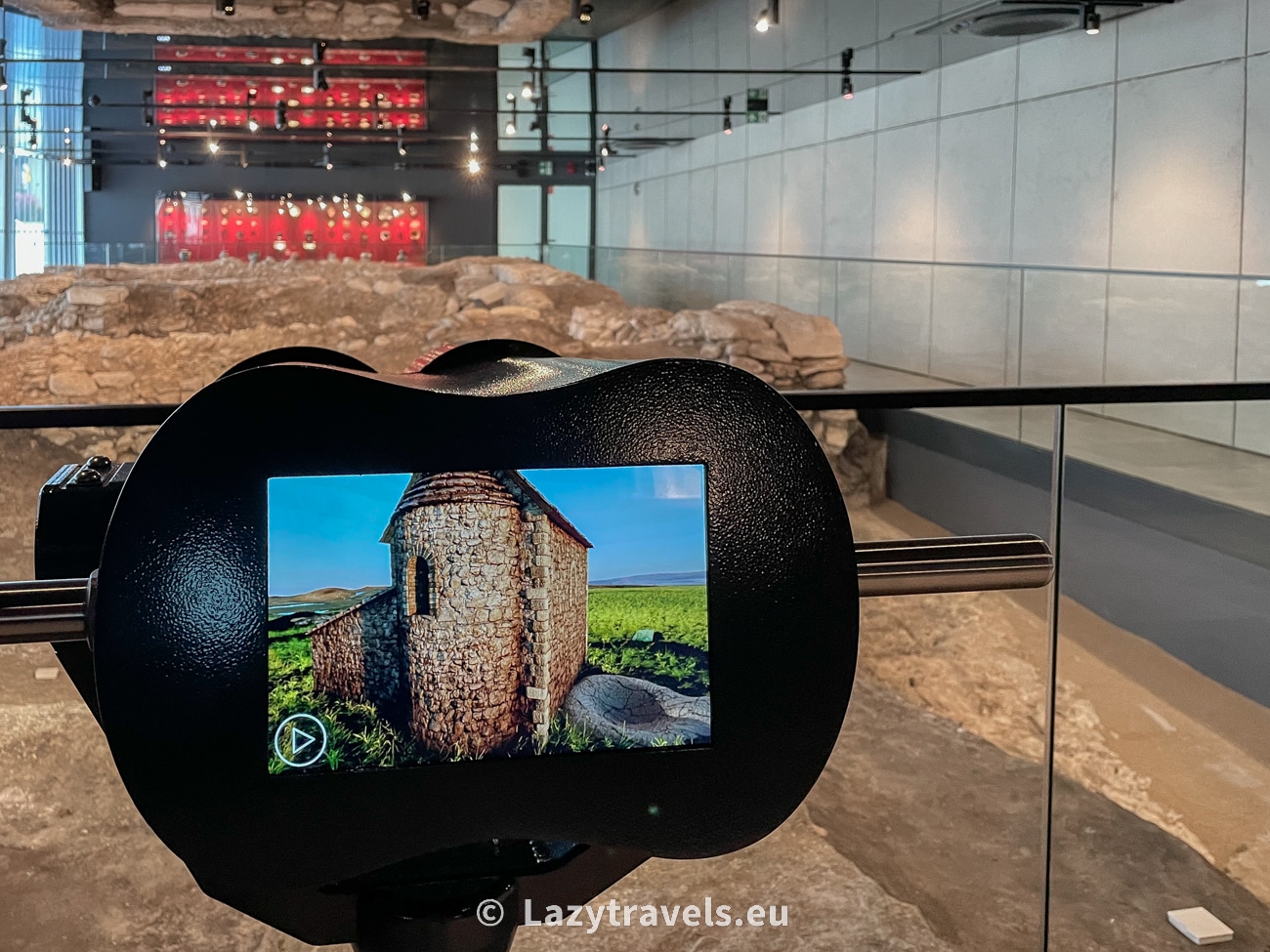
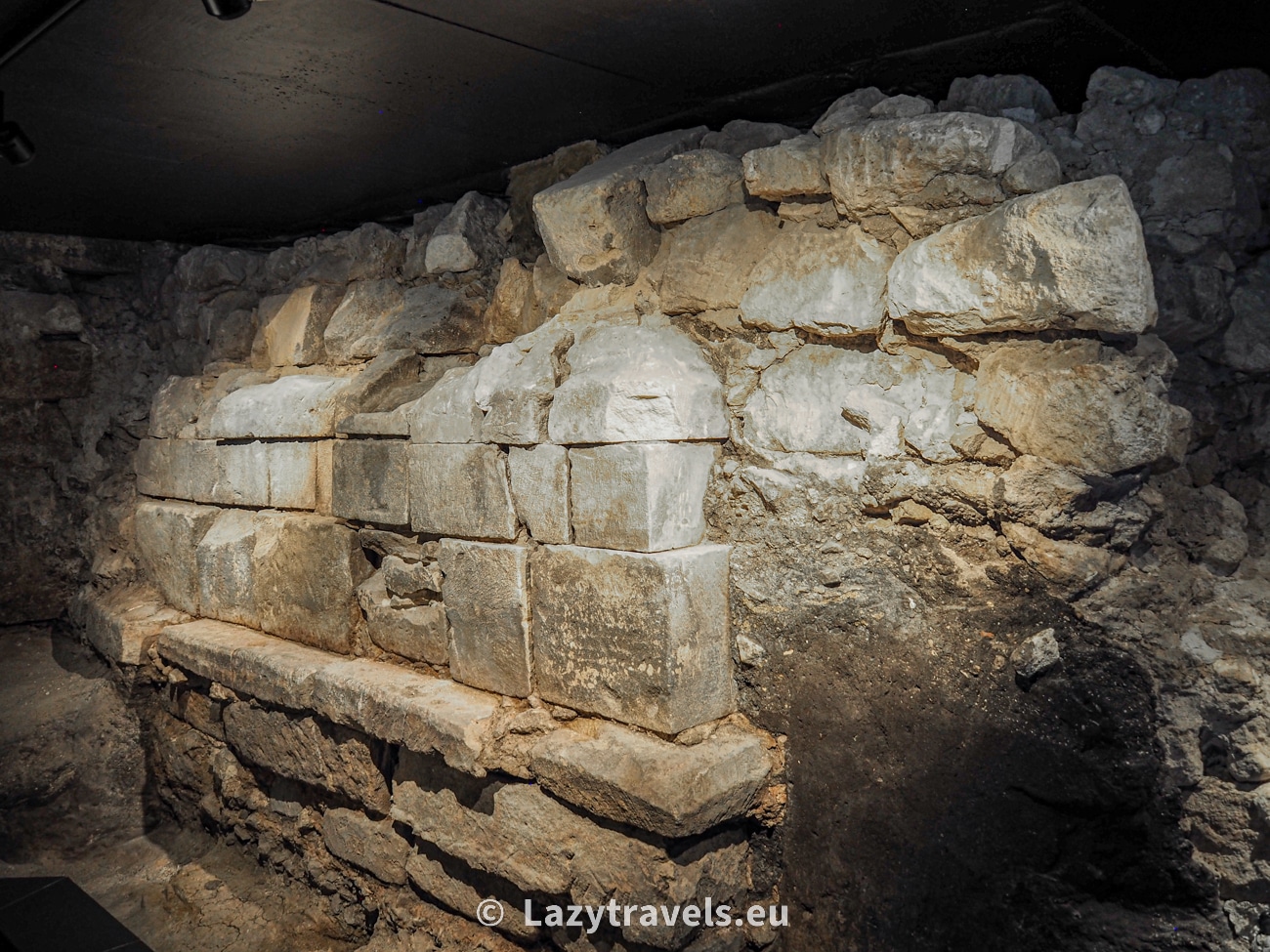
But right before our eyes, we find another trace of the past: the foundations of St. Nicholas Church, which was later demolished around the 13th century. Another church already stood nearby at the time, so there was no need to maintain several. And here’s an interesting fact: two “telescopes” have been set up at the end of the hall. Usually, they bring what is far away closer, and here it is similar. They bring time closer to us, because through their lenses we can see what this small church looked like in its heyday.
The „Slab of the orants” – „Płyta orantów”. This is why it’s worth coming to Wiślica
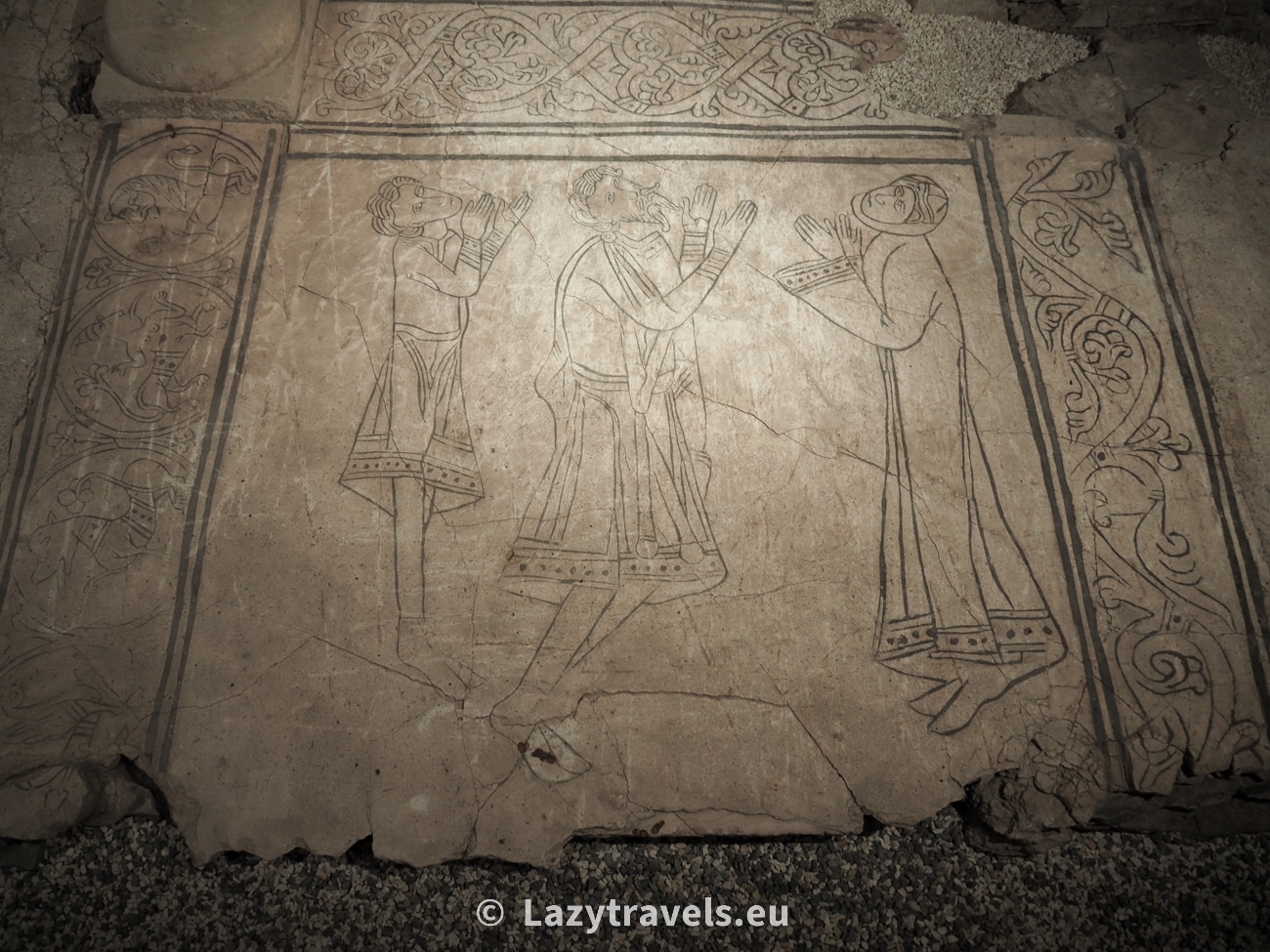
When researchers from the Polish Medieval Studies Team at the University of Warsaw and the Warsaw University of Technology began their research on the collegiate church in 1959, they did not expect to make such a discovery. But it happened: while digging into the past, they stumbled upon an ornate tombstone. The slab is not small, as the rectangle measures 2.44 by 4.12 meters and dates from around 1175–1177.

It is richly decorated, and we can see several figures on it. These are likely the patron and his family. We likely see the figures of Casimir the Just and his wife Helena of Znojmo. The other figures are their sons: Casimir, Bolesław, and Henryk of Sandomierz. Completing the group is a clergyman who cannot be precisely identified.
On the edge, there is a Latin inscription, which translates as: They wish to be trampled upon so that they may be raised to the stars and both…
Unfortunately, the slab is slightly damaged, as during the construction of the current collegiate church, the support for the rood arch fell precisely on the edge of the Slab of the Orants.
Where did the name „Slab of orants” (“Płyta orantów”) come from?
But you’re probably wondering where such a strange name as “Płyta orantów” comes from. Here we must go back to the roots, namely to Latin. When we look at the figures, their faces are turned upward, in a position as if they were just saying a prayer. Orants are people praying, and hence the name Płyta orantów. (Slab of orants)
It’s also worth mentioning that the slab isn’t a bas-relief. The figures weren’t carved into stone, but into stucco, a plaster-based material. First, the figures were carved into the hardening stucco, and then the recesses were filled with a dark-colored material.
The Underground Museum
The museum in Wiślica is located underground, and I must admit that when I was the only visitor there, it had a certain incredible charm. No one disturbed me, and all the exhibits were just for me. Imagine dark corridors that light up only where you’re standing. You could say that with each step you take, you illuminate the darkness of the Middle Ages and subsequent periods for yourself.
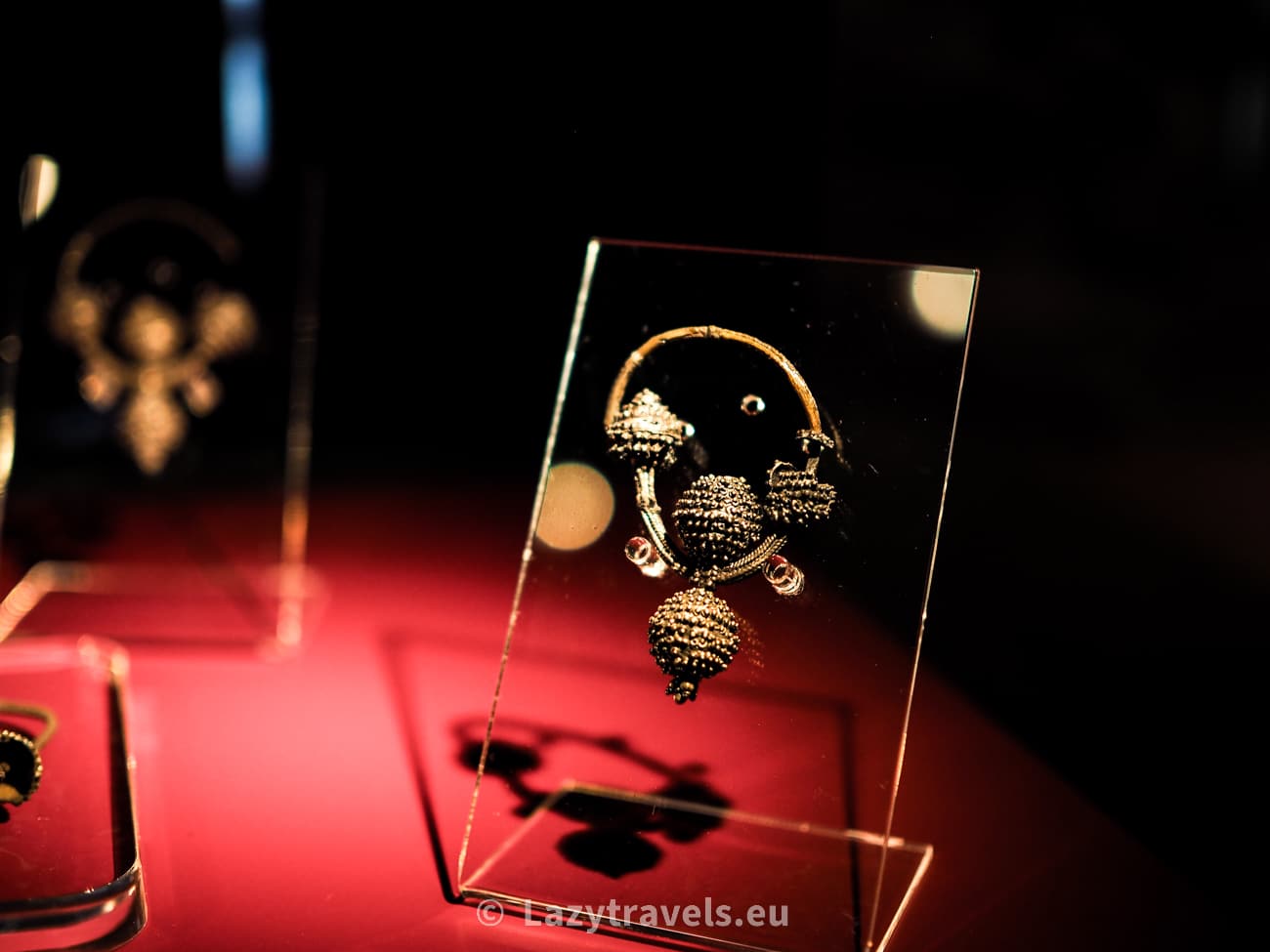
On one hand, there are multimedia presentations showing, for example, how one church succeeded another, and how the size of the next was meant to outshine its predecessor. But there are also display cases where you can admire treasures unearthed during excavations. And such wonders include, for example, intricately crafted gold earrings. Judging by their craftsmanship, they must have cost a fortune back then. And that fortune was equivalent to, say, several villages. Few could afford such an expense. Therefore, the owner must have been the wife or daughter of a very prominent figure.
In the basement, there are also long corridors where multimedia presentations are displayed on the walls. A narrator in your headphones tells you, for example, about the history of the collegiate church’s doors, which are now bricked up. You’ll hear about the Statutes of Wiślica, but also about the history of the town and the specific section of the wall you’re standing in front of.
There are also photos from World War I, when the Russian and Austrian armies faced off right in the vicinity of Wiślica.
Unfortunately, the city came under artillery fire, and the collegiate church, Długosz House, and the city were severely damaged. Believe me, the time you spend at the Wiślica Archaeological Museum will not be time wasted. It is one of the most modern museums I have visited in Poland. I don’t think the Middle Ages and history could be presented much better.
Right next to Wiślica is the old Wiślan stronghold, but I didn’t go there. Well, if you don’t have a drone, there’s no way to see what the stronghold looked like in the old days. From ground level, you simply can’t make out the outline of the old earthen ramparts.
And finally, I’ll mention that Wiślica, due to its location quite close to Kraków, was often visited by Polish kings. But despite that, interestingly, there is no evidence that a castle ever existed in Wiślica. King Casimir the Great planned such a fortification, but did he build it? Archaeological research cannot confirm this. So, when visiting the sights of Wiślica, don’t look for a castle.
And then I left the museum and… went for ice cream, because it was an exceptionally hot day. Well, there wasn’t much going on in the town. So the only thing left to do was get in the car and drive on to explore the attractions of Ponidzie. Today I wanted to watch the sunset over Grodzisko Stradów, which, like Wiślica, was one of the settlements of the Vislans tribe. And then? Then it was just a return to the hotel in Busko-Zdrój, where I had set up my base. And of course, I also explored the attractions of Busko-Zdrój.