At first glance, the Turda Salt Mine appears unremarkable. But once you venture inside, you will be amazed by the view. After all, how could you not be amazed by a chamber high enough to house a Ferris wheel and an underground salt lake 8 metres deep? Salina Turda, as it is known in Romanian, is truly impressive!
And there was no sign of it being a surprise. Let’s start at the beginning. First of all, we decided to visit the Turda Salt Mine on a Sunday. And visiting any tourist attraction on a Sunday is a bad idea because of the crowds of other tourists. But well, our tour of Romania’s attractions was such that we had no choice. We just expected that we wouldn’t be able to buy a ticket to the mine.

And that was a big surprise. It turns out that although there are a lot of people wanting to go into the mine, there are no queues at the entrance. This is because the managers of the site assume that if people want to go in, they should be allowed to go in! For the owners, buying a ticket is the highest good, and everyone will fit in. This is because in Turda there is no such custom as, for example, in the oldest Polish salt mine in Bochnia, where you enter in groups with a guide. In the Turda Salt Mine, everyone enters on their own and wanders through the corridors and salt mines on their own. I must admit that at first it seemed unthinkable, but in the end it made sense. There are no attractions like, for example, the Mining Route in the Wieliczka Salt Mine in Poland. You just walk around and there are no interactive elements. And if you are more interested in where you are and what the equipment you see is used for, you can read about it on the (few) information boards.
The underground chambers of the Turda salt mine
The first surprise comes as soon as you enter the mine, because the staircase that all tourists follow on their tour leads down through a fairytale landscape. This unusual staircase is carved into blocks of rock that shine like striped flint.
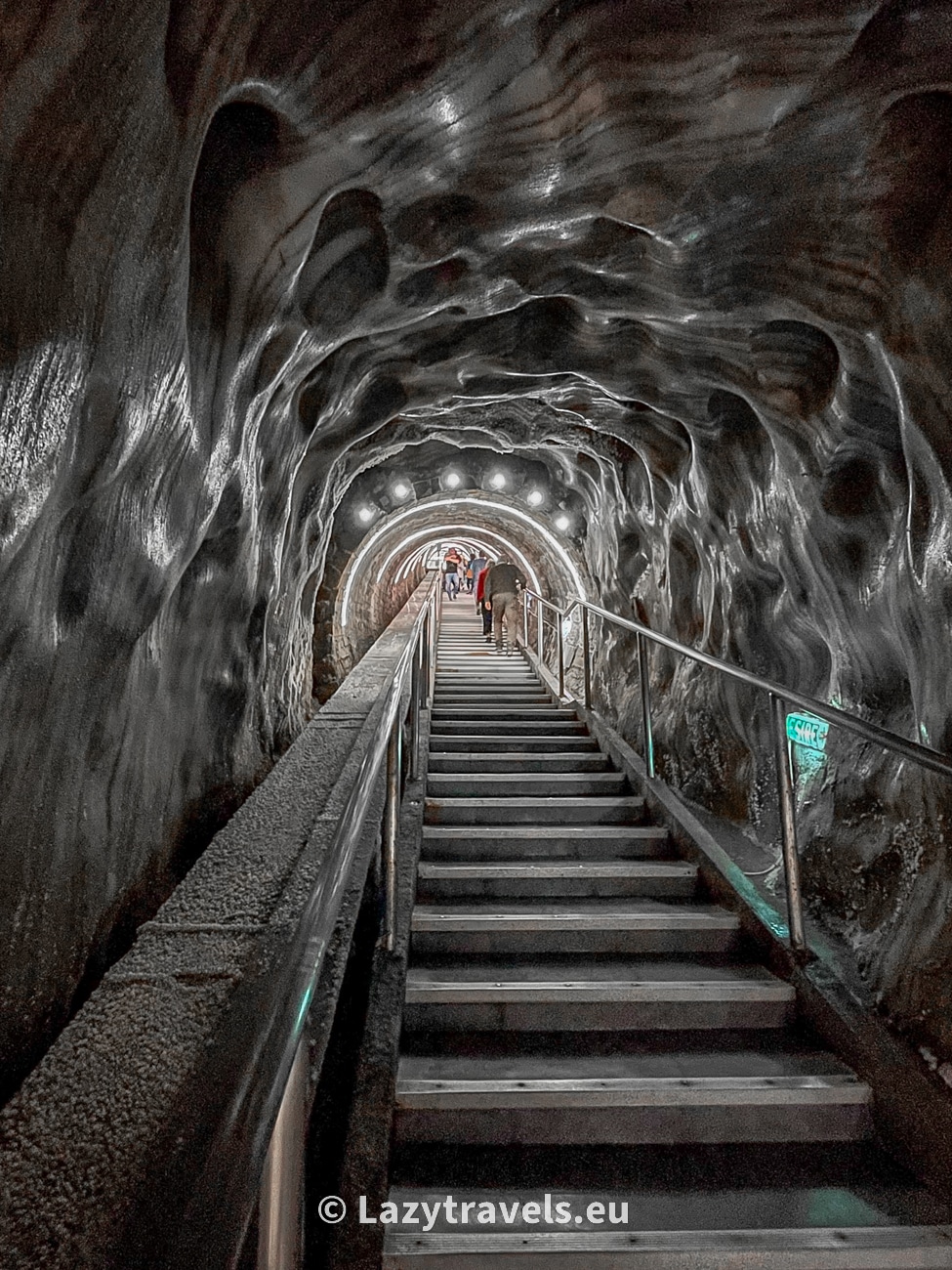
And comparisons with flint mines (e.g. in Krzemionki Opatowskie in Poland) are not far-fetched, as many of the walls of the Turda Salt Mine look as if they had been hewn out of flint and then polished to a high gloss. And it is 'only’ salt and moisture that give this impression.
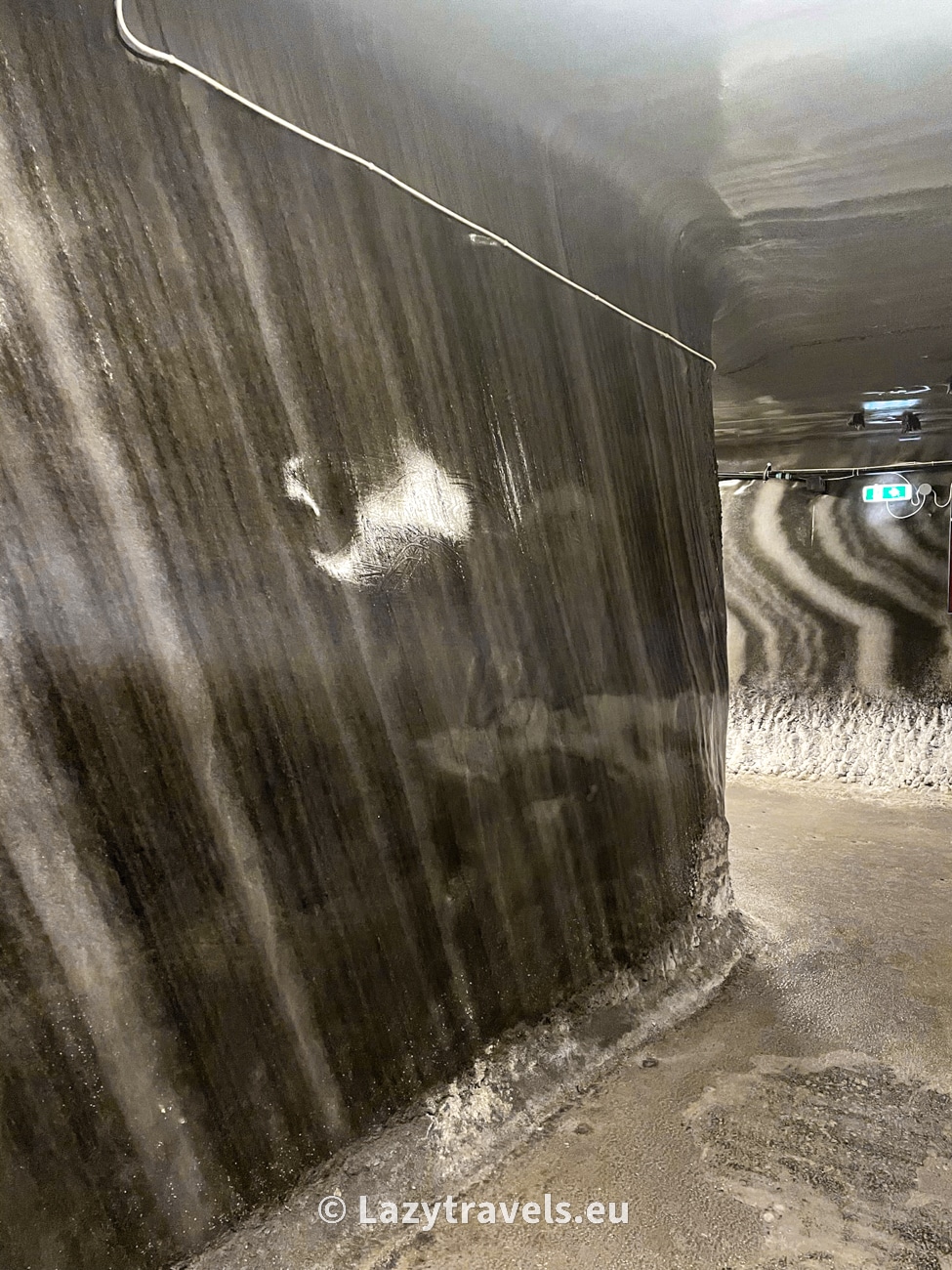
Anyway, as soon as we entered, we threw ourselves into the whirlwind of sightseeing. At first, we randomly decided to walk down the main corridor. We just walked and walked and walked. And that was a mistake, because the corridor connects two entrances to the mine: the old and the new. And it is 885 metres long, so as you can see, it is quite a distance. And don’t be fooled into thinking that this corridor is boring. Yes, it does get boring after a while, but all the best things are close by. All you have to do is open a door or take a side staircase and a whole new world is waiting for you.
The Great Chamber of the Rudolf Salt Mine
If you have been to the Wieliczka Salt Mine mentioned in this article and have seen the chamber/chapel of St Kinga, then you know that she could easily enter the chamber created at the site of salt extraction in the (former) Rudolf Mine. She went in and there would still be plenty of room. But let’s start again.
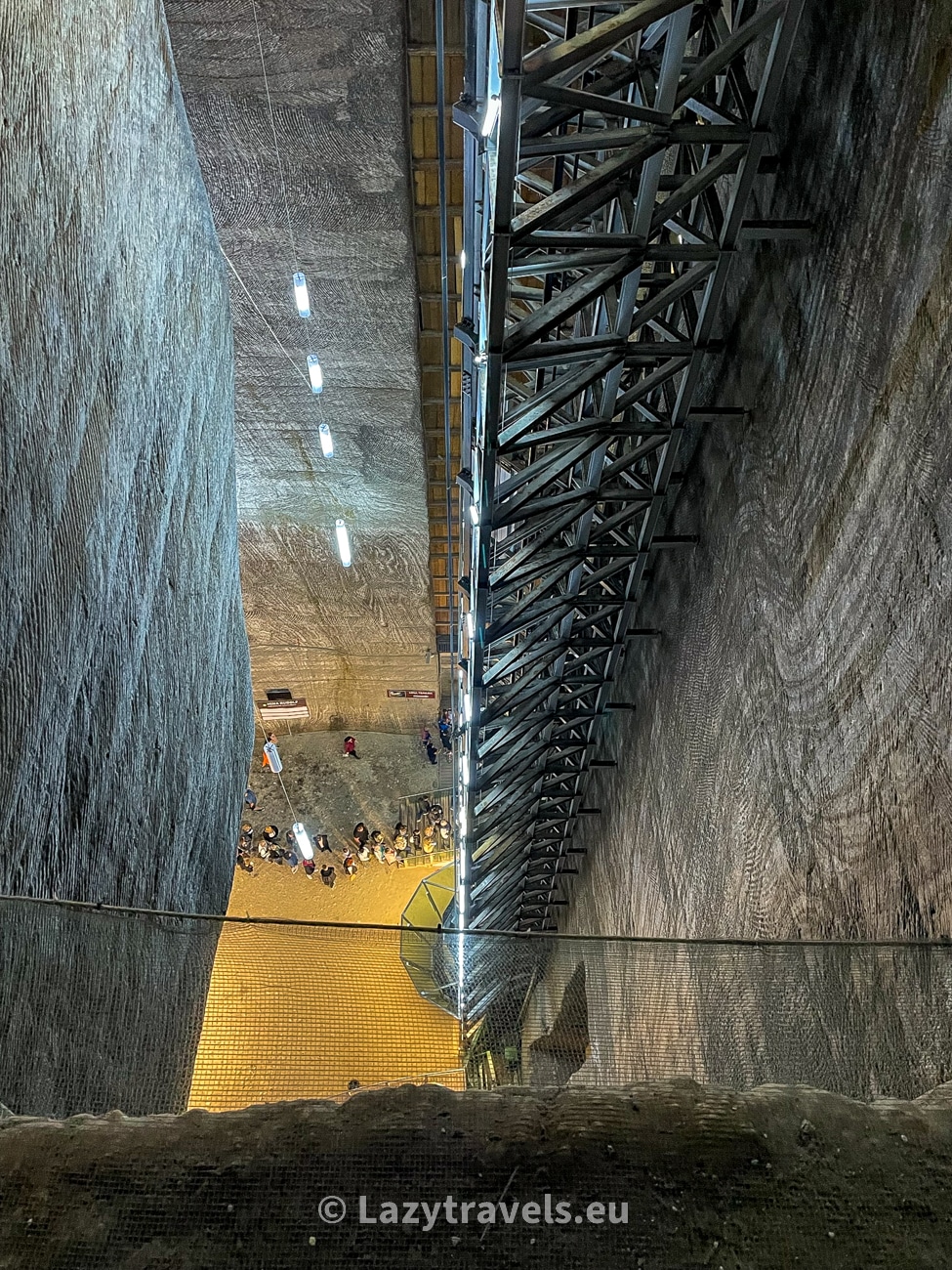
First we turned into a side corridor towards the stairs and… the lift! Yes, it turns out there is a lift that goes down to the bottom of this chamber. And why is that? Just look at its size. The chamber is trapezoidal in shape and measures 42 metres deep, 50 metres wide and a whopping 80 metres long! Impressive, right? Anyway, the photo below shows just how deep it is.
Of course, there are long queues for the lift, which can take up to half an hour, so in my opinion it’s not worth it if you have healthy legs. It’s better to take the stairs, first of all through a wooden gallery. The gallery is an attraction in itself, as it is attached to the side walls on both sides of the chamber. You walk on wooden planks suspended several metres above the 'floor’ towards the staircase.
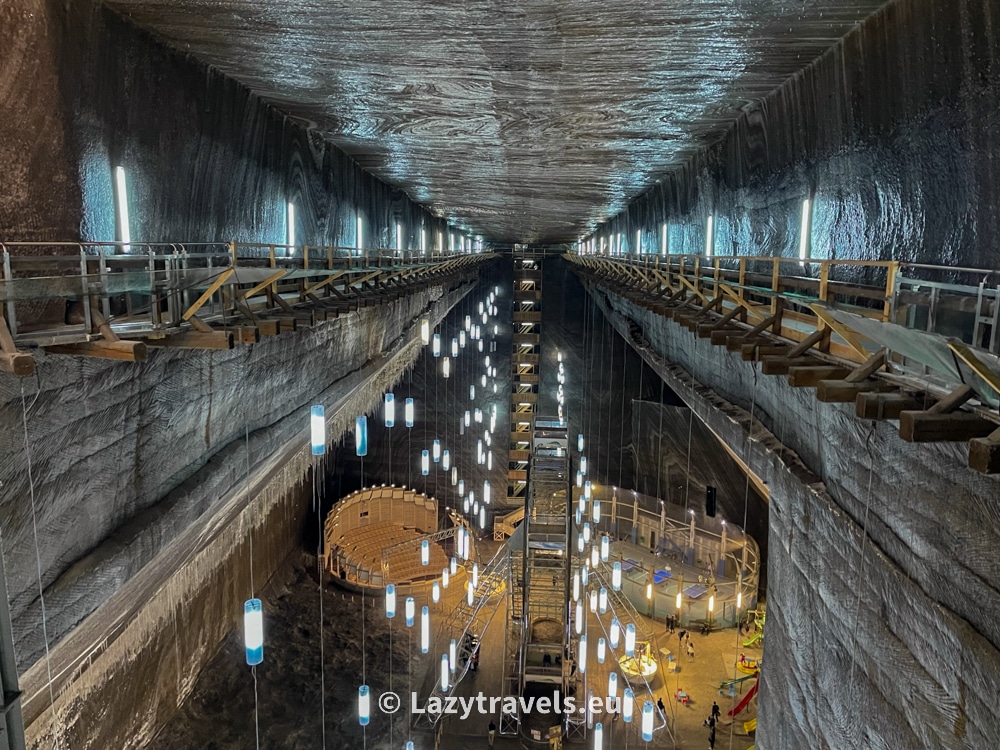
There are 13 floors to descend, each with 172 steps. In principle, this would be nothing unusual if the planks did not bend slightly under your feet and the people you see at the bottom were not strangely small! As you descend, it is worth taking a look at the plaques, as they have dates engraved on them – thanks to them we can find out in which year this particular salt deposit was mined.
And when we get to the very bottom, we see another world. It is one thing that the upper gallery ends somewhere above us. But what is more interesting is that a large amusement park has been created at the bottom of the chamber. We have the opportunity to enjoy many attractions such as table tennis, darts, bowling, mini golf, billiards, a basketball court and a children’s playground. But the most eye-catching attraction is the Ferris wheel! Yes, at the bottom of the Turda Salt Mine there is a 20 metre high Ferris wheel and of course you can ride in the carriages! I don’t know if anyone else in the world has come up with this idea. If not, it is the lowest Ferris wheel in the world.
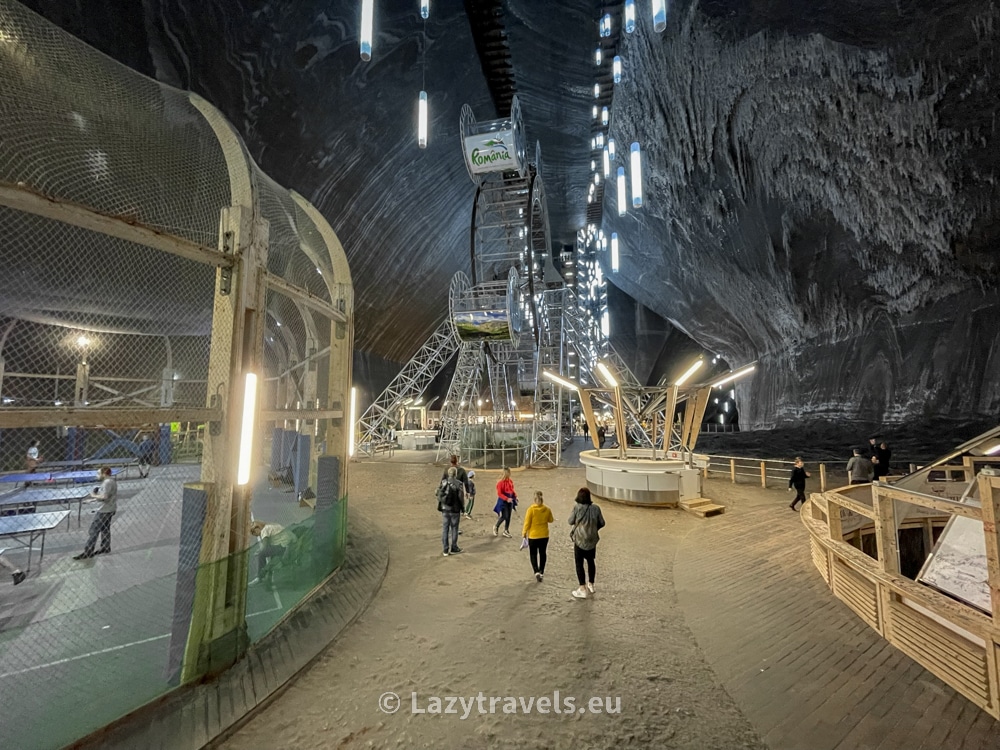
To be honest, I have a problem with these attractions because they spoil the atmosphere and look of the room. The 20 metre high steel structure inevitably interferes with the chamber. On the other hand, it is certainly unique in the world!
Terezia Mine and Chamber
From the huge chamber described above, you can get to a place even lower down. And just like the Rudolf Chamber, there are two ways to get there. The first is by lift (with another long queue) and the second is by stairs. Unfortunately, you have to wait for both. The stairs are so narrow that they have introduced alternating traffic, regulated by lights and controlled by the staff. What I recommend is that if you manage to go down first, you can spend about 15 minutes looking at the lower chamber by yourself and then go straight back up on the next roundabout.
Unless you want to hire a boat and go for a swim in the salt lake that has formed here. The lake is 8 metres deep and so salty you won’t drown. You’ll be like a cork in the water, but I still wouldn’t recommend it.
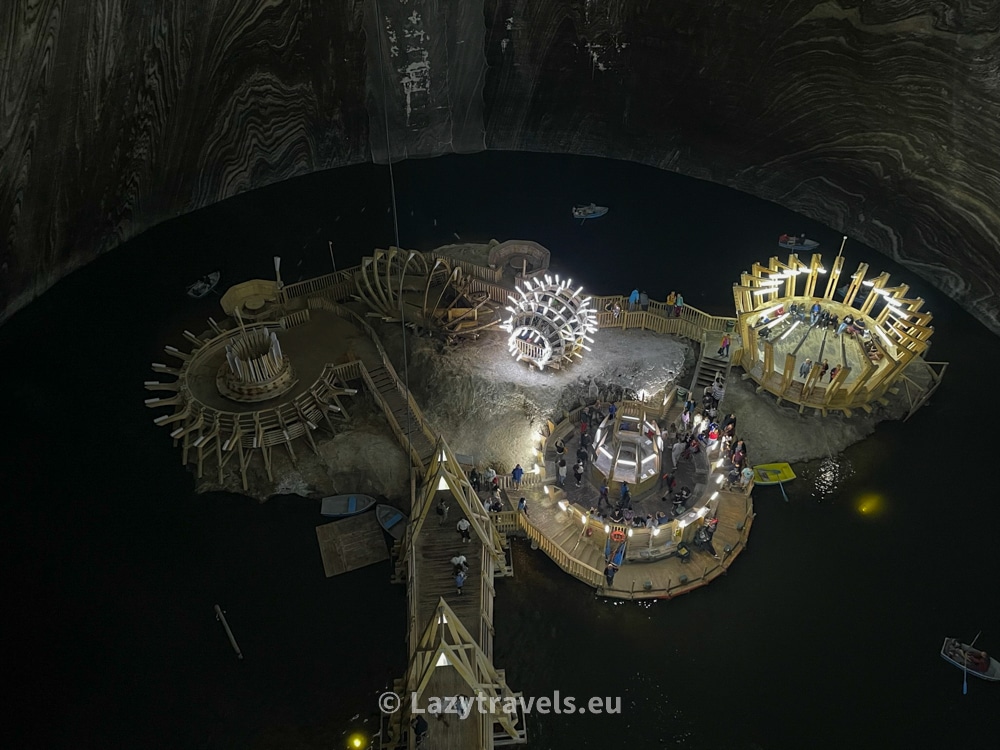
The chamber itself is also phenomenal and is the oldest part of the Turda salt mine. Salt was mined here from 1690 to 1880. The shaft, or narrow chamber, is 90 metres high and 75 metres in diameter. However, after the construction of the tourist route, the depth from the mouth of the shafts to the bottom of the mine is now 112 metres.
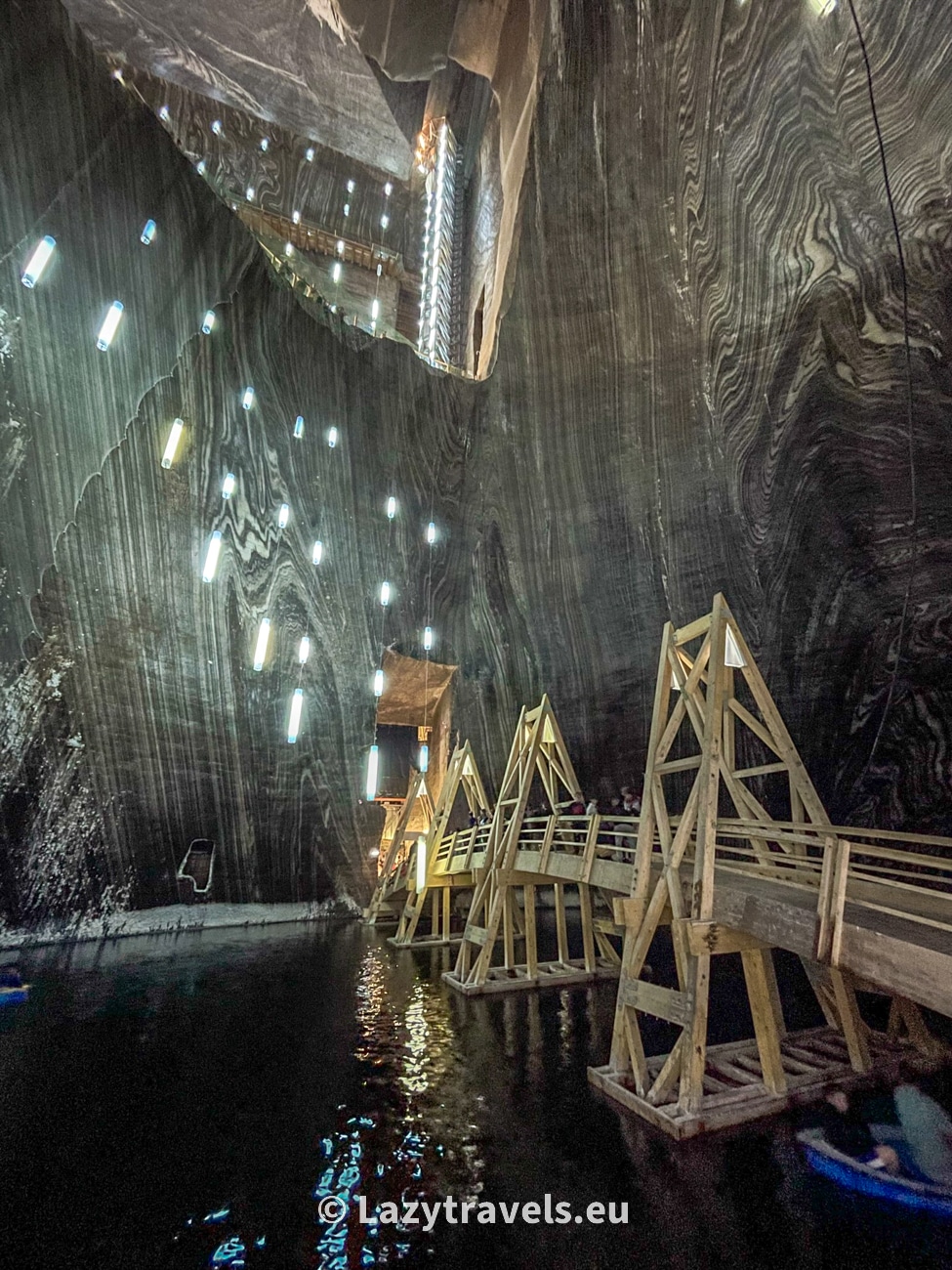
Believe me, it’s worth going down, if only to look up and see the space above you. No photograph can capture it, but it looks phenomenal. Again we have high, striped walls reminiscent of flint, and in the background boats on a salt lake at your fingertips.
However, if you don’t want to queue to get down, you can also enjoy the beautiful view of the island in the lake and the footbridges from above, which allow you to see the chamber from a frog’s perspective. Yes, I was not expecting such views when I went down the Turda Mine.
How salt was mined
In addition to the two most spectacular salt chambers mentioned above, there are several other rooms in the Turda Salt Mine that branch off from the main corridor that forms the axis of the museum. As you enter them, you will come across tools and equipment that were once used to mine salt.
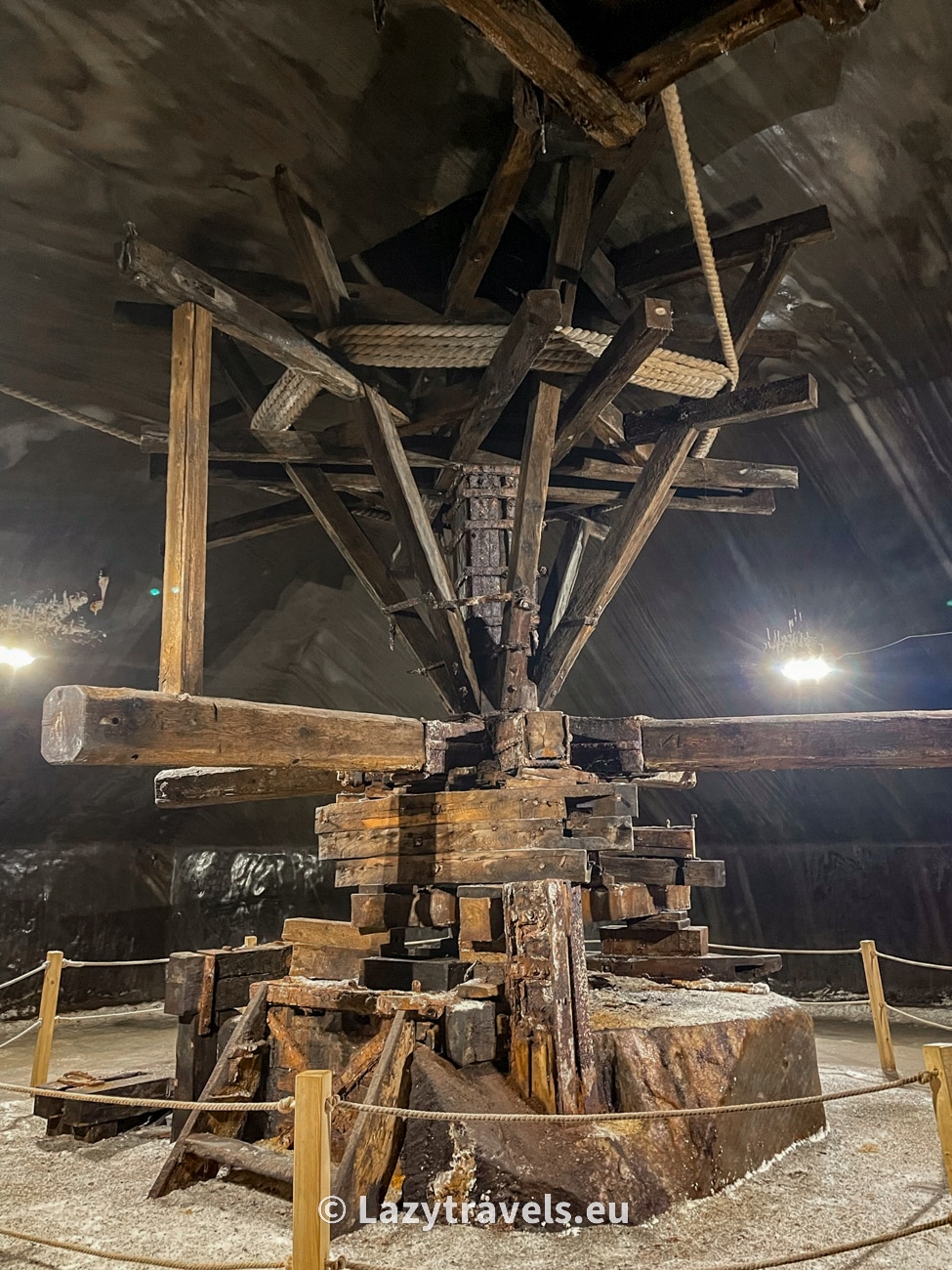
The most spectacular is the crivaca, which is basically a kind of winch with gears that was used to lift the salt to a higher level, from where it was transported directly to the surface. The Turda Salt Works website boasts that it is the only tool of its kind in Europe still in its original place of use.
The device is a cross between a treadmill and a spinning wheel, which used a gear and a system of ropes to lift weights from the bottom to the top. But this is not a place for people sensitive to animal cruelty. Until the advent of electricity, horses were used to power the spinning wheel. One or two horses were tied to the reins and the machinery was set in motion. Unfortunately, the darkness (the only light was provided by torches) and the monotony of the work (repeated as if on a treadmill) caused the horses to go blind after about two weeks. The maximum working life of a horse in these conditions was about six months. I don’t think they would have been sent to a well-deserved retirement after that either 🙁

Walking through the corridors, we also come across wagons that were once used to transport salt. But that’s standard exhibition equipment for any mine. Nothing surprising, it’s just that such a wagon could not be missing here.
The assembly hall. The most beautiful place in Turda
However, I would like to draw your attention to another place that is a must see. It is the Assembly Hall (Sala de Apel in Romanian), which is basically a meeting hall. As you can easily guess, this is where the miners would gather before going down for their shift to extract salt from the deposits below Turda.
The most striking feature of the assembly hall is the Rich Man’s Staircase. Strange name, isn’t it? Let me explain its origin. It’s because the Emperor of Austria-Hungary, Franz Joseph, is said to have walked down these stairs when he visited the Turda salt mine. Is this true? I don’t know, but apparently since the Emperor himself came down these stairs, no ordinary worker has been allowed to use them. The stairs were reserved for the nobility. But for heaven’s sake! How could the nobility have worked in the salt mines if they didn’t do manual labour?!

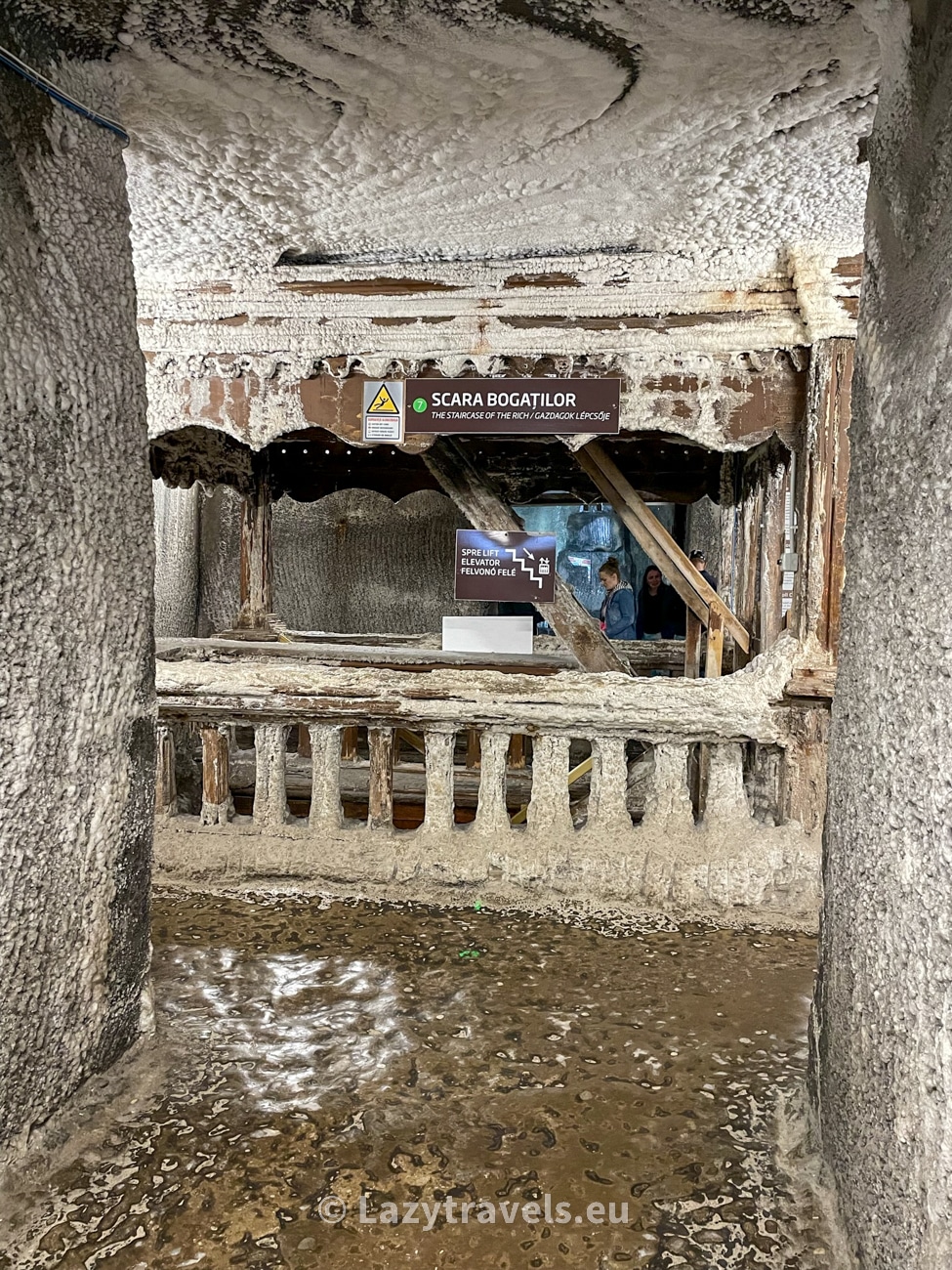
But what actually happened was that services were held in the Appeal Hall. Before the miners went down to work in the dark corridors, they prayed here for a safe return up the mountain.
There is another interesting fact about this place. The stairs are made of pine. This makes sense because fir wood is very special. The resin is resistant to salt, which means that it does not eat into the wood, but settles on the surface, hence the fancy growths on the stairs. Furthermore, fir does not crack easily, and when it is overloaded, it makes a sound that warns of impending disaster.
Salina Turda. A brief history
Once upon a time there was Dacia, a Roman province. Yes, Dacia, part of modern-day Romania, was a Roman province and the first large-scale salt mining was carried out by the Romans. They (or rather the people they employed) dug chambers about 17 to 34 metres deep and about 10 to 12 metres wide. Interestingly, once such a mine had been exploited, it was abandoned and flooded by rainwater and groundwater. After the Romans left Dacia in 274, there is no evidence of any institutionalised exploitation of the local salt deposits.

The next mention of the exploitation of salt deposits in the area of today’s Turda dates back to 1075, when a Hungarian chancery wrote in a document about the mine: „qui dicitur hungarice Aranas (Aranyos), latine autem Aureus”, which means „in the place called Aranyos in Hungarian and Aureus in Latin”.
During the Hungarian rule in the 15th-18th centuries, no less than four new mines were opened in the Turda area. The Habsburgs also had an influence on the development of the mines, as the empire they created gave an impetus to the development of industry, including mining. This is not surprising, as salt was one of the most important food preservatives until the advent of refrigeration. For this reason, five mines were built between the 17th and 19th centuries.

The mines were in operation until 1932, when the economic calculations proved ruthless. The mines were obsolete and inefficient. In addition, there were already more modern salt mines in the area and throughout the Austro-Hungarian Empire, such as the mine in Kaczyka (Cacica). As a result, the mines were closed and left to their own devices.
The breakthrough came in 1992, when the mine was given a new lease of life after the democratic changes in Romania. It was reopened, but not as a salt mine, but as a tourist attraction and a place to treat respiratory diseases.
Another important event took place in 2009, with the support of the European Union. After two years of work and the investment of 6 million euros, the site now looks much like it does today.
What we see today is a path through what used to be separate bell pits. They are called bell pits because of the shape of the huge chambers left after the salt was removed. They used to have their own names, but today they are simply known as the former Turda Salt Mines (Salina Turda in Romanian).
The Turda salt mine. Is it worth a visit?
The Turda Salt Mine is one of the biggest tourist attractions in Romania today. I don’t know if that’s a bit of an exaggeration, but I have to admit that it is very impressive. For me, it may not be as impressive as the painted Orthodox churches in Bucovina or the fortified churches and peasant castles in Transylvania, but these huge underground spaces are definitely impressive. So if you can include the Turda Salt Mine in your trip to Romania, do so without hesitation.

Turda salt mine. Practical information
- Allow at least two hours to explore the mine (that’s how long it took us, and we looked in every corner)
- The temperature in the salt mine is a constant 12 degrees all year round
- Humidity is 80%.
- There are hardly any germs in the air. And the lower you go, the fewer they are, making it the perfect place for people with respiratory problems.
- It is not allowed to take photos with a camera in the mine, only mobile phones are allowed
- There is a car park right in front of the main entrance, which costs 5 RON per hour. But if you come to Turda at the weekend, you can park about half a kilometre from the entrance. There is a side car park there (free of charge)
Turda mine ticket prices and opening hours
- The mine is open daily from Monday to Sunday from 9am to 7pm.
- Last admission is at 6pm, so you have to sprint through the mine at that time.
- A normal ticket costs 85 lei at the weekend.
- An adult ticket from Monday to Friday costs 70 lei
- A reduced ticket costs 45 lei (for children and pensioners Monday to Friday) and 55 at weekends
- Guided tour on request – 200 lei
When writing the article, I used the official website of the salt mine in Turda and the Romanian Wikipedia (yes, there is more information about the mine there than on the English version of this website)