Zalipie is sometimes referred to in Poland as the Painted Village. It would not be an unusual tourist attraction were it not for the persistence of one person – Felicja Curyłowa. It is thanks to her that the local custom of painting cottages has become known throughout Poland, and the village’s fame is slowly spreading throughout Europe, so that foreign tourists can also be found in Zalipie. I invite you to see and visit the painted cottages of Zalipie.
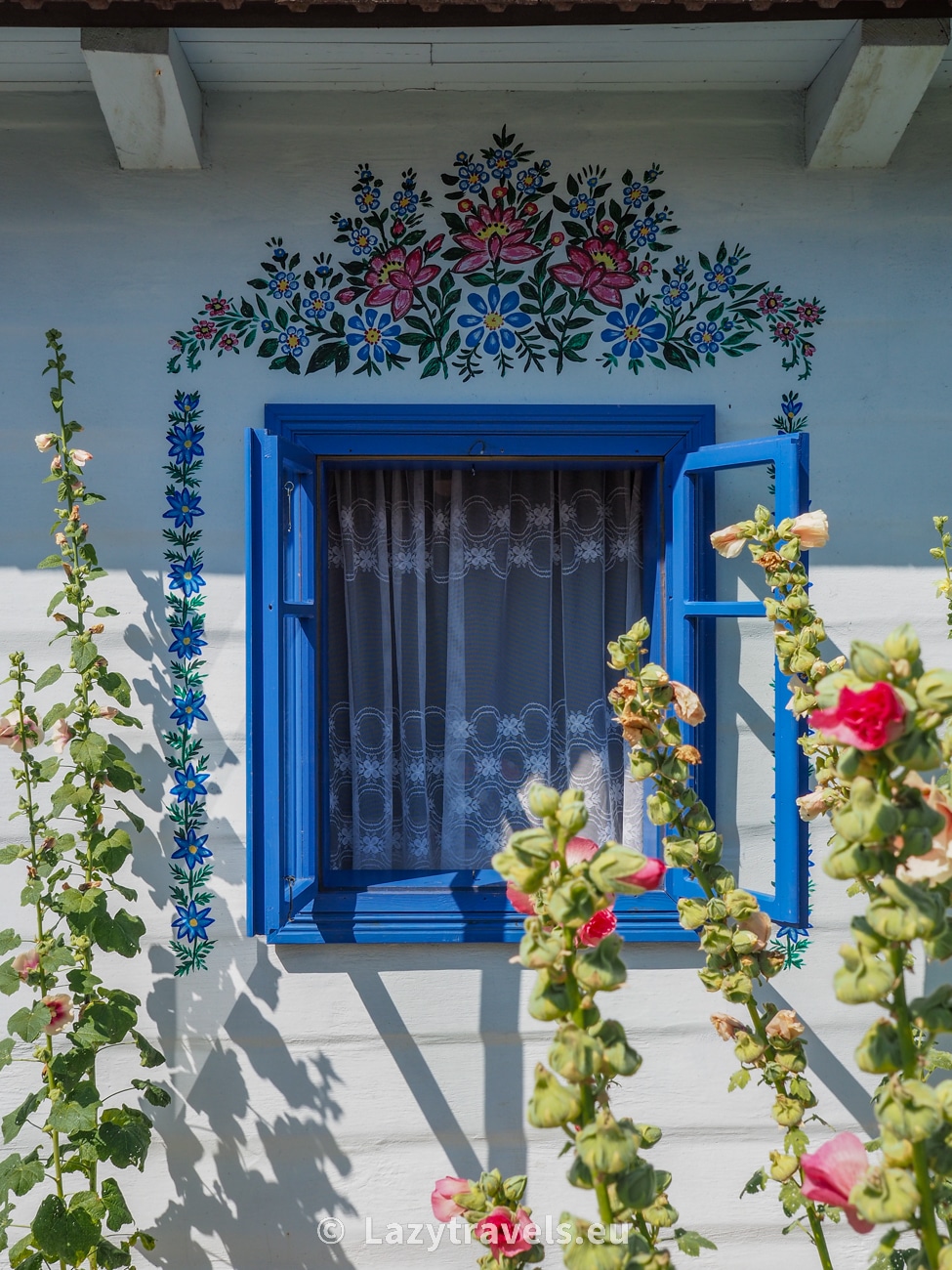
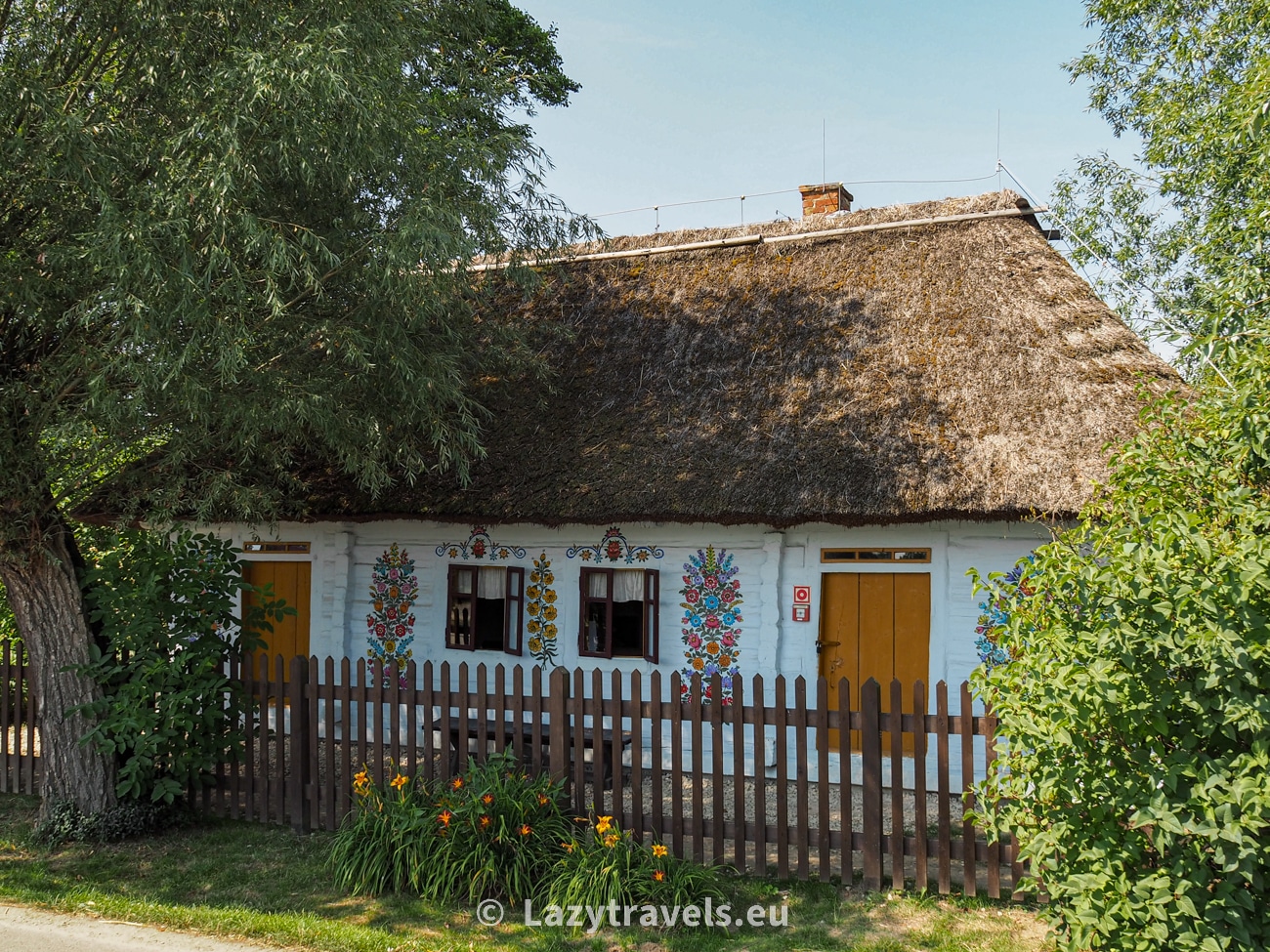
First, however, I will dispel any illusions you may have. If you think that Zalipie is entirely covered with cottages painted with decorative patterns, you are mistaken. In the entire, very extensive village, there are only a few dozen such fully painted cottages. And even then, you will only see a few of the most beautiful ones. Without a car or at least a bicycle, you have no chance of seeing them all. Although, of course, there is also a place that is the heart of this unusual open-air museum. It is the cottage of the aforementioned Felicja Curyłowa and two houses that were moved next to it to show how people used to live in this area. And, of course, how houses were decorated. And that is why, if you type the phrase “cottage from Zalipie” into a search engine, this house will probably be the one that comes up.
When I arrive at the parking lot next to the museum at 10 a.m. on Saturday morning, there are no crowds yet. Tourists from Krakow, Tarnów, and the surrounding area are just starting to arrive. Morning is the perfect time to visit, because you can admire the interiors without crowds and take photos without any problems. That’s why, as soon as I arrive, I waste no time and go straight to the ticket office to buy a ticket for a specific time. There are three of us in our group, so as you can see, a comfortable visit in the morning is guaranteed.
Where did the custom of painting cottages in Zalipie come from?
Huts were apparently decorated as early as the 19th century, and quite possibly even earlier, but this was done on the inside. All in all, it makes sense, because in winter, for example, people spend more time at home, especially women in old Poland. They had to prepare meals, weave, and do other household chores in their rooms. Initially, the interior decorations were not as beautiful and colorful as we see today. The first decorations were… white! This was because, as you can easily guess, since there were stoves inside the houses, which were of course fired with wood, they were not completely airtight. Sometimes smoke billowed inside, sometimes soot escaped. Heck, some huts even had open hearths! This caused the rooms to be covered in soot. That is why white decorations looked particularly good against such a sooty background and simply brightened up the interior.
The decorations that were painted at the beginning of the tradition were more like “shapely stains,” but later they evolved into more complex forms, such as floral motifs. Then came the era of Felicja Curyłowa, who, as befits a true and confident artist, boldly took her decorations outside the house. Other housewives followed in her footsteps, a local activist and social worker of great authority. In this way, a tradition was born (or, if you prefer, survived). The tradition became even stronger when a competition for painting cottages was established. The first Malowana Chata (Painted Cottage) competition was organized in 1948. It should be noted that the competition includes not only cottages from Zalipie, but also from the entire surrounding area, i.e., Powiśle Dąbrowskie.
But back to history: if we add electrification to the post-war social changes and the fact that cottages no longer needed to be lit with smoky lamps, and open hearths were replaced by bread ovens, the artists’ paintings became more durable. All the more so because such an oven was a very good object to decorate. The oven used to be the center of the kitchen, providing heat.
It was worth investing in colorful paints. Anyway, dyes were also becoming cheaper. And so, thanks to a tradition passed down through generations, the painting of cottages has survived to this day. All thanks to the enthusiasm and talent of a local artist and activist: Felicja Curyłowa. Isn’t that a beautiful story?
The painted village of Zalipie – is it worth visiting?
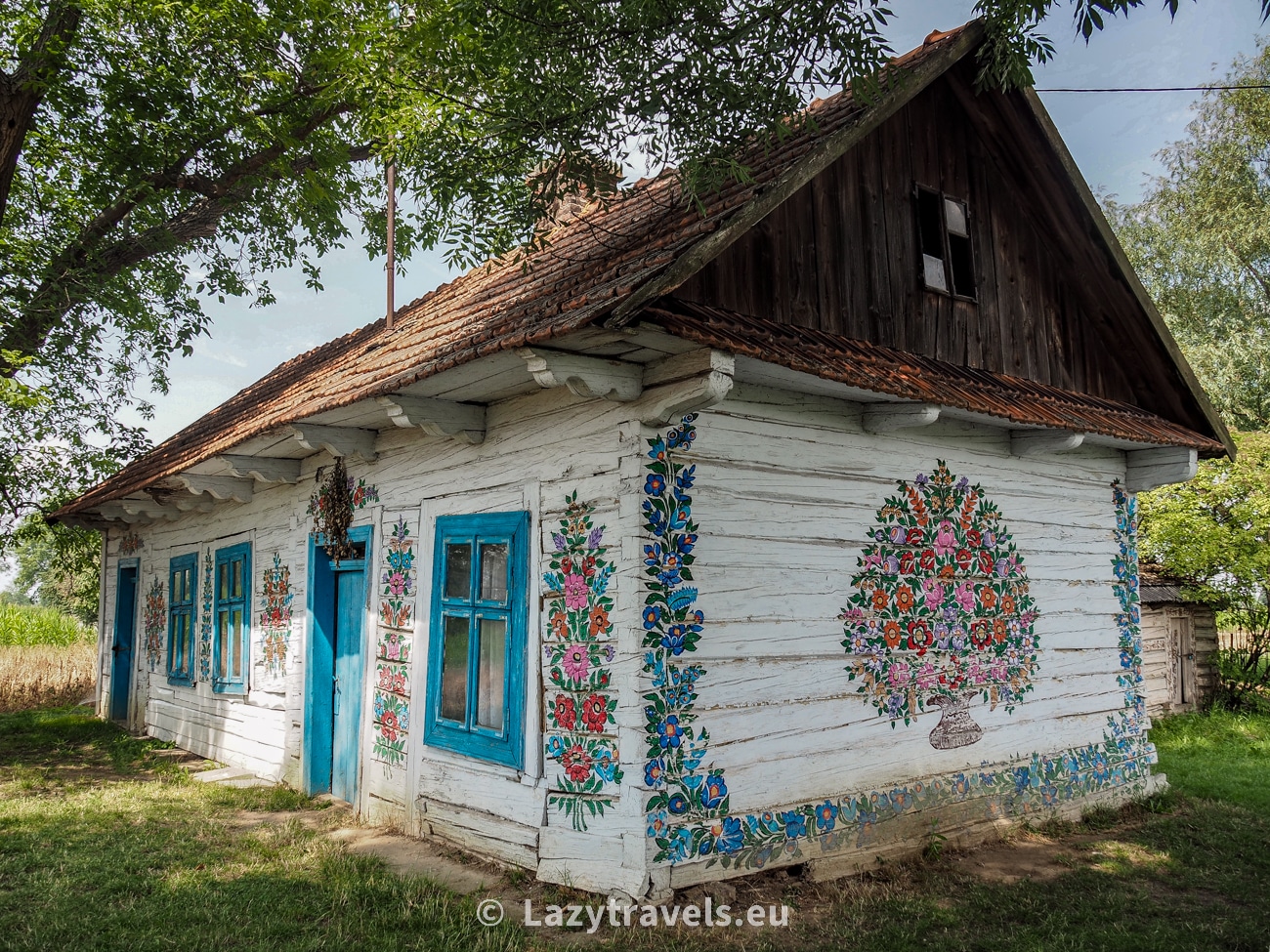
If you are wondering whether something beautiful is worth seeing, then that is a rhetorical question. But the fact is that to visit Zalipie, you have to like folk art. Because it must be said outright that Zalipie is not an open-air museum, as you might imagine. These are not densely packed, painted farmsteads from the 19th century, as you know them, for example, from the nearby open-air museum in Tokarnia or the famous Sierpc in Mazovia. There are only three such historical cottages, and you could say that it is a small open-air museum. But the Painted Village is, above all, an ordinary place where people simply live. Where most of the houses are painfully normal, meaning they don’t have a single ounce of decoration. That’s why you have to drive around a lot when visiting, but I admit that I don’t regret a single minute spent here. And I don’t feel disappointed with my visit in the slightest. The place is original and simply beautiful!
Plan about two hours for visiting Zalipie.
The most beautiful cottages in Zalipie
The most beautiful houses in Zalipie, whose decorations and paintings can be viewed from the outside, but also from the inside, are: Felicja Curyłowa’s house, Stefania Łączyńska’s house next door, and the so-called “poor cottage.” While the first two are beautifully decorated inside as well, the last house is an example that best fits the description of an “open-air museum.” It stands here so that visitors can see for themselves how poorly the poorest inhabitants of villages such as Zalipie lived. Poverty literally screams from every corner.
Felicja Curyłowa’s House
For many years, the cottage was simply a home where Felicja Curyłowa lived and worked with her family between 1903 and 1974. It is an ordinary wooden cottage, like many others that used to be common here and in the nearby Ponidzie region.
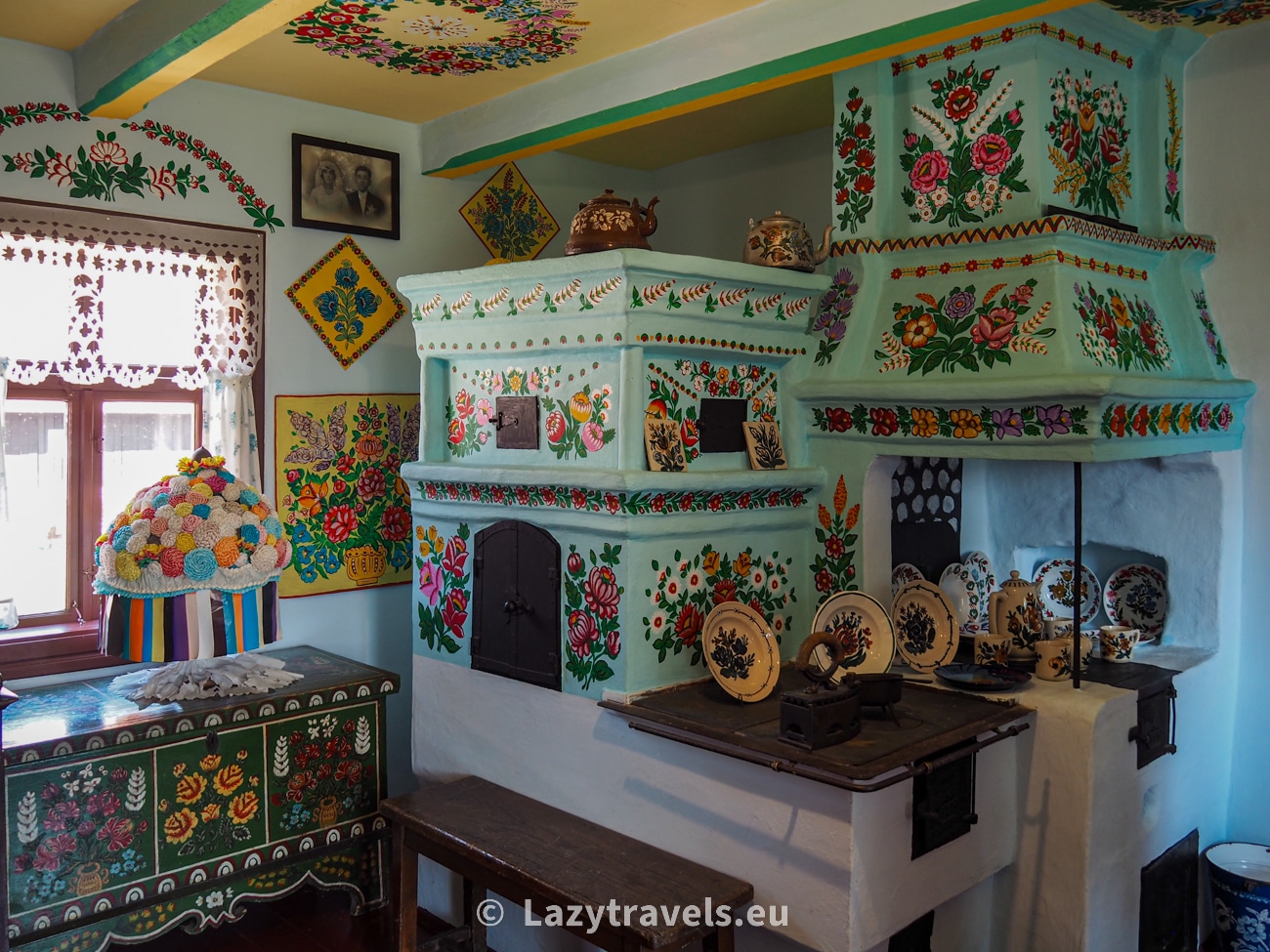
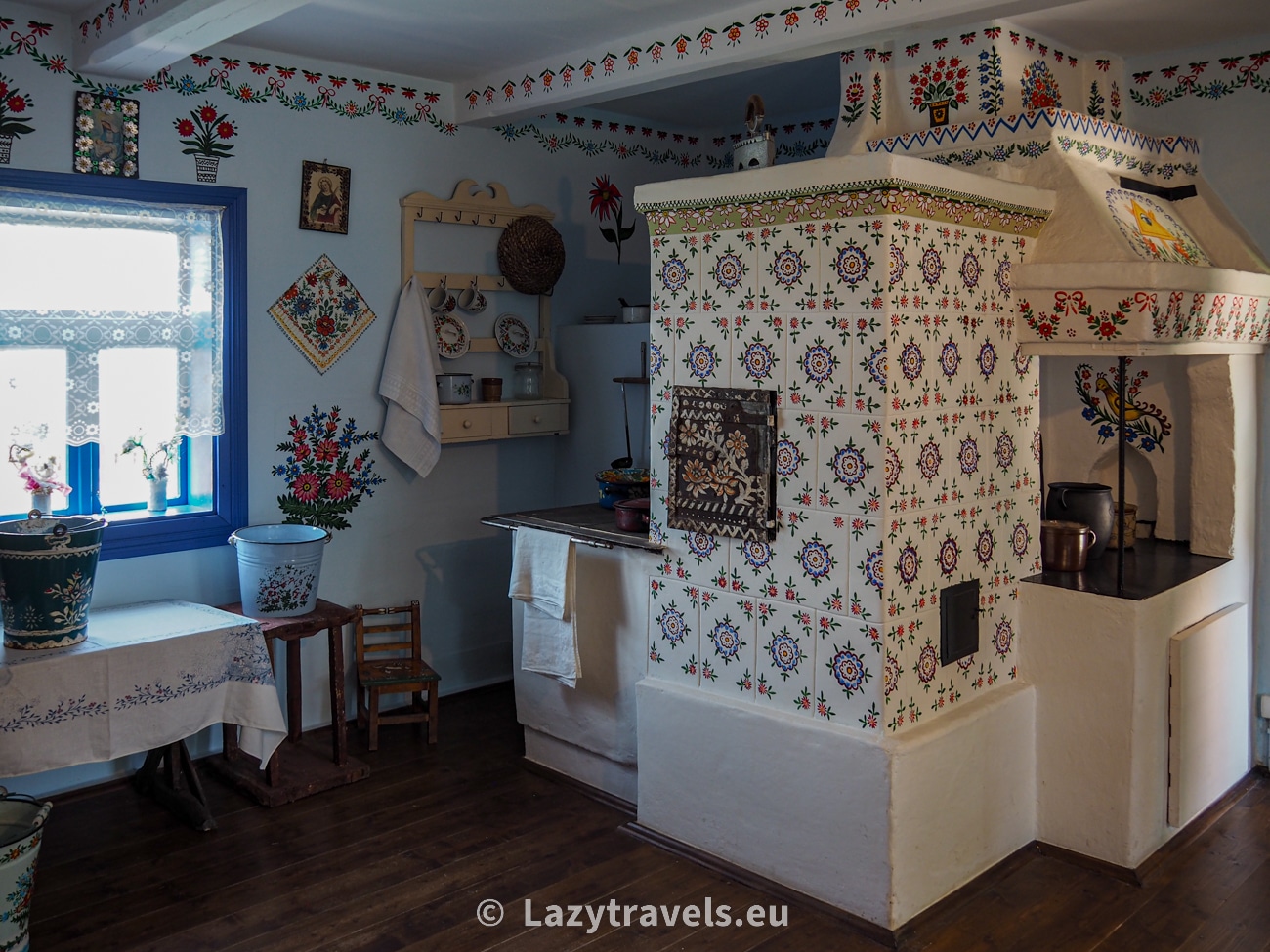
The interior has been preserved as it was in the past, i.e., it is divided into two rooms: the black room and the white room. All in all, I can’t decide which one is prettier. I think it’s the black one, because it has more decorations. It just has a larger area. The black room is simply a kitchen and a space where the family’s daily life took place. This is where they cooked, baked bread, spun yarn, or did other seasonal work that had to be done indoors. This room was the heart of the house, serving as both a dining room and a bedroom. Yes, there was a stove here, which kept the room warm, and winters used to be really cold!
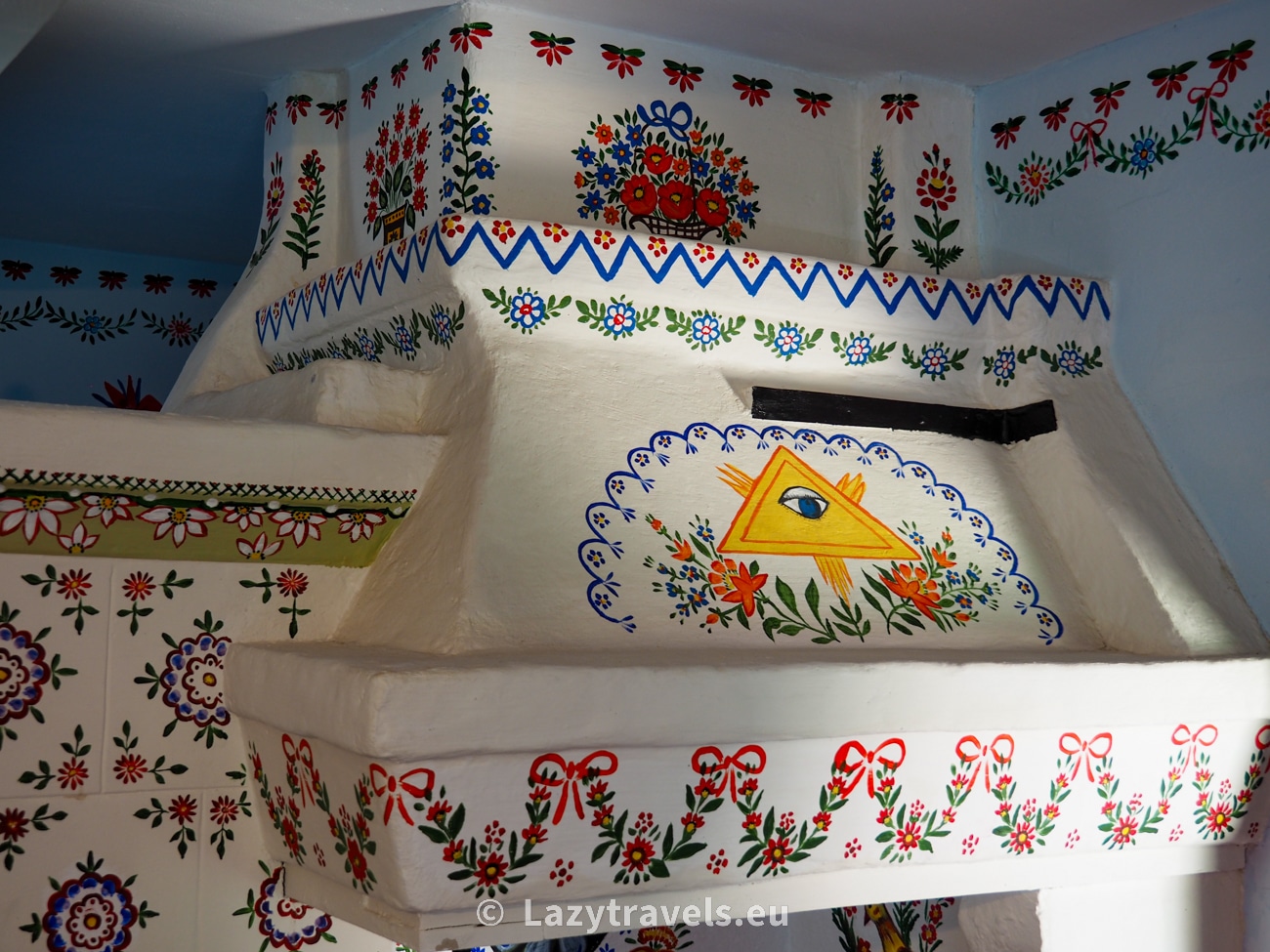
And as you can easily guess, almost every piece of furniture in the room is covered with characteristic paintings. From the stove to the chest, walls, ceiling, and even… the bucket and plates. The intense colors are striking, but they do so in such a beautiful, tasteful way. Felicja Curyłowa was a true artist! She had excellent taste!
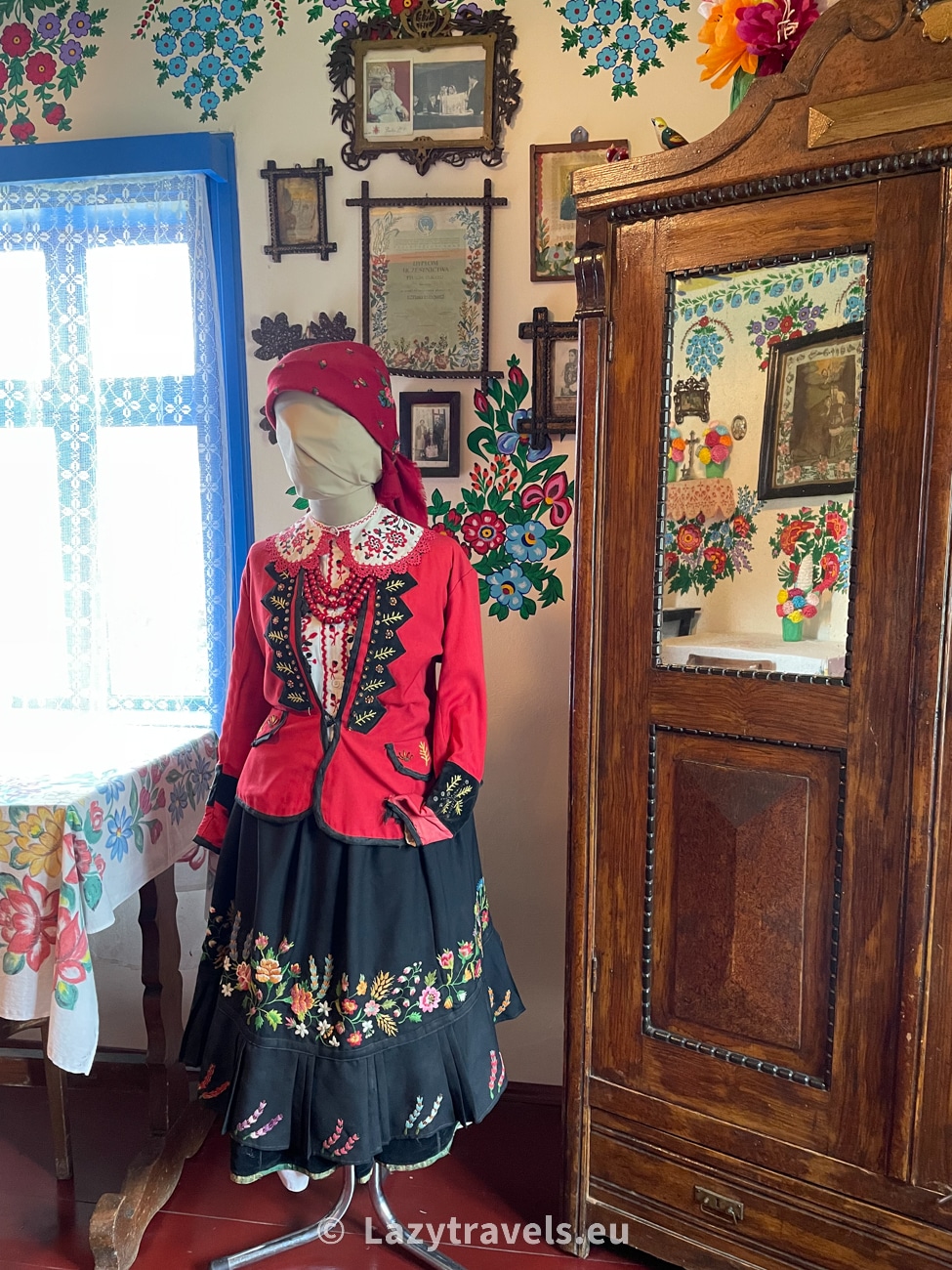
This can also be seen in the adjacent white room, which served as a reception room. This is where important guests were received, family celebrations took place, and the priest was welcomed during Christmas caroling.
It is worth paying attention to the mannequin standing here, wearing an original costume, which the hostess of the house, of course, decorated with embroidery herself. In addition, the ceiling and walls here are also beautifully painted. You will also notice the sacred images hanging on the walls. You can clearly see how important religion was in rural life.
The house of Stefania Łączyńska and a poor peasant’s cottage
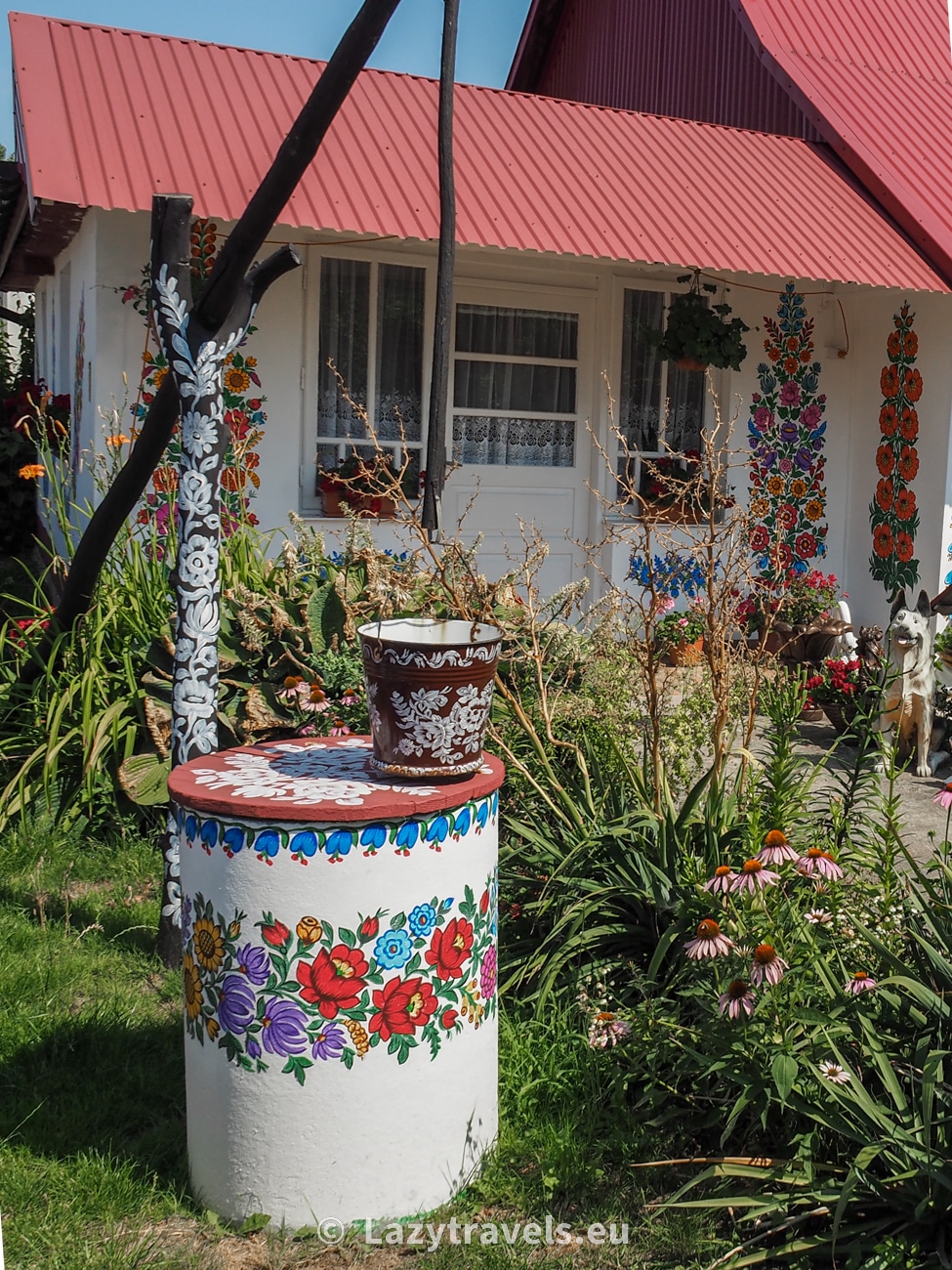
This cottage, built in 1886, is another place that commemorates an artist involved in the development of cottage painting. Ms. Stefania lived from 1914 to 2005 and during that time she participated in the Painted Cottage competition many times. The interior and the surroundings are beautifully decorated. The owner tried to decorate all the buildings and farm structures, such as the well and even tree trunks! So believe me, there is a lot to see here.
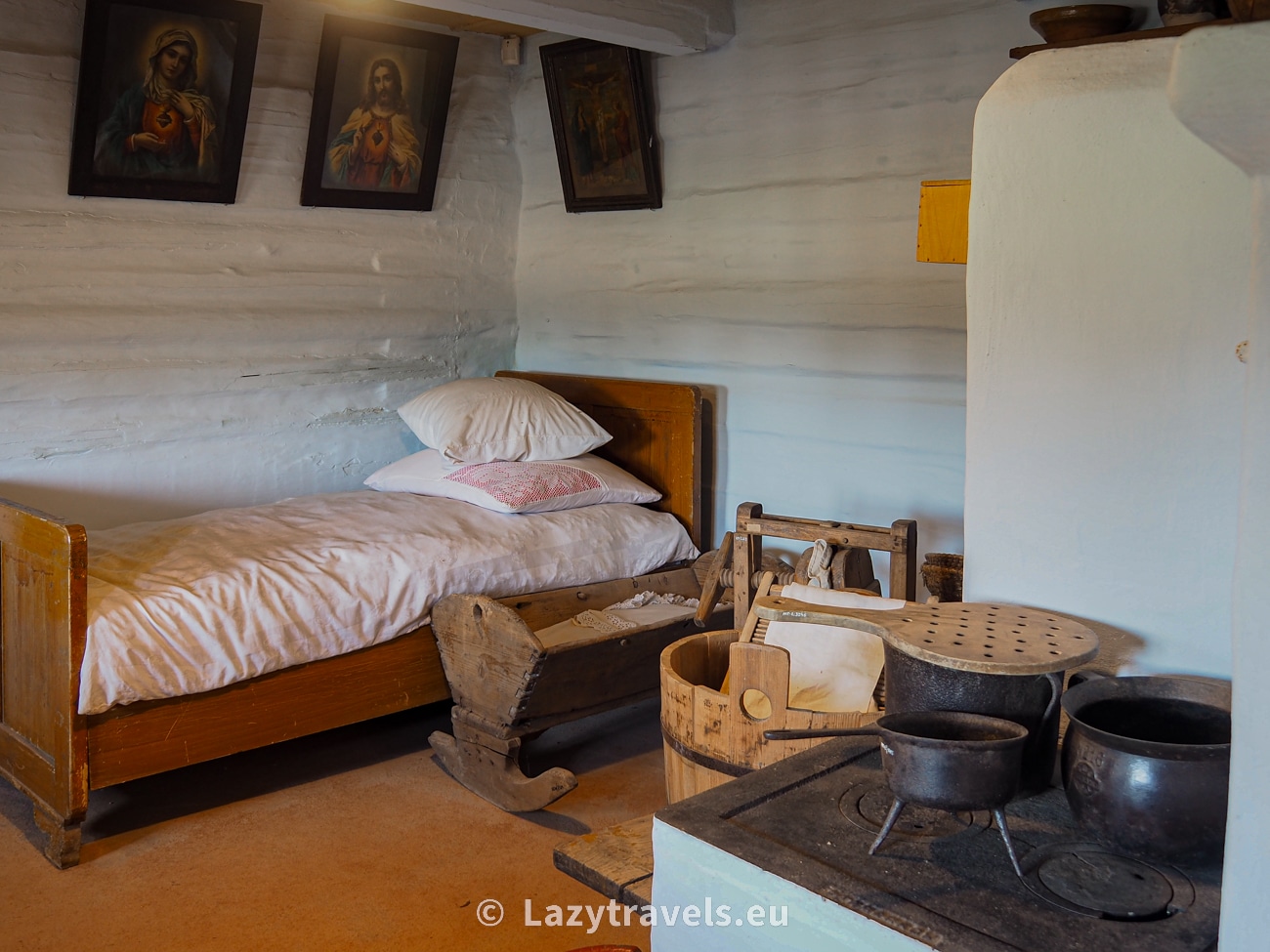
The poor cottage standing next to it has a different purpose. The building was, of course, moved here and stands to show visitors how poorly the poorest part of the village lived. The single-room cottage served many functions. First of all, it was a place where people lived, but on the other hand, it was also a barn where animals such as goats were kept. The house is thatched, and the floor is not made of boards but of ordinary earth. However, this hut is also decorated on the outside. As you can see, the branch of the District Museum in Tarnów (as it is officially called) takes care to show the broader context of the place. And for that, it deserves respect.
Other attractions in Zalipie
As I have already mentioned, Zalipie is very large and I would guess that it has well over a hundred houses. Not all of the houses are decorated, and I would say that the vast majority of them are quite ordinary. However, we can often see farmsteads that are partially or completely covered with decorations. The owners invite you inside, tell you who paints them and how long they have been doing so. Admission is free, and in exchange for the opportunity to admire and listen, you can buy, for example, a fridge magnet. But no one here forces anything on you.
Of course, the most convenient way to visit Zalipie is by car, but if you have the opportunity, I recommend exploring by bike. You simply won’t have any problems with parking, and you can lean your bike against a tree, lay it in a ditch, and start taking pictures and admiring the sights. To avoid getting lost and to know where the painted houses are, it is worth stopping at one of the maps that have been set up to improve orientation in the area.
When visiting Zalipie, you will probably find yourself at the House of Painters, or the local cultural center. Well, I must admit that this place made the least impression on me. However, I do not want to belittle the memorial room, where large photographs of deceased and living people who contributed to the development of the art of painting cottages in Zalipie look down on us. It is a gallery of local celebrities who should not be forgotten.
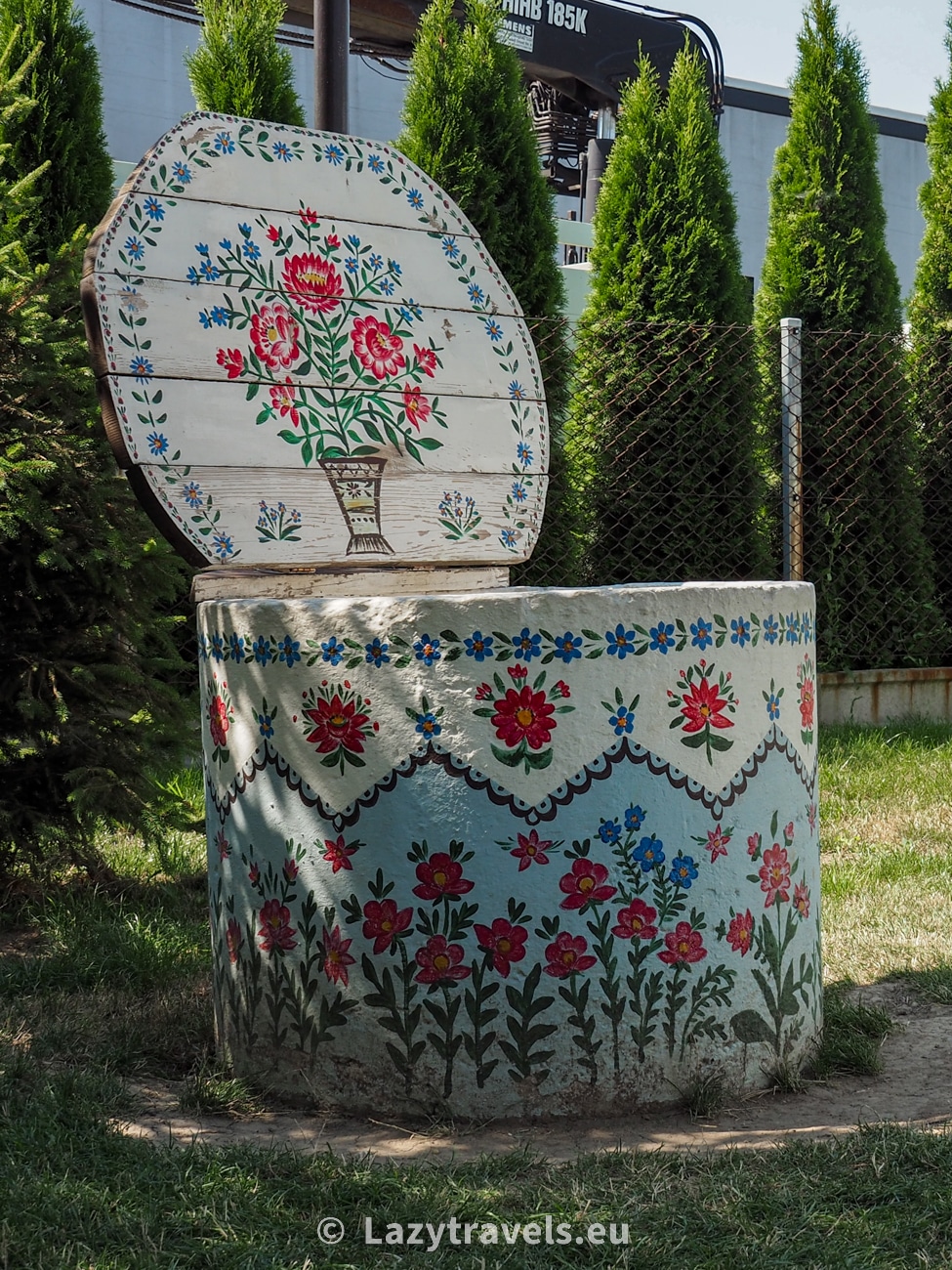
However, visitors will probably be most impressed by the area around the Painters’ House, where you can take a photo by a decorated well with a crane.
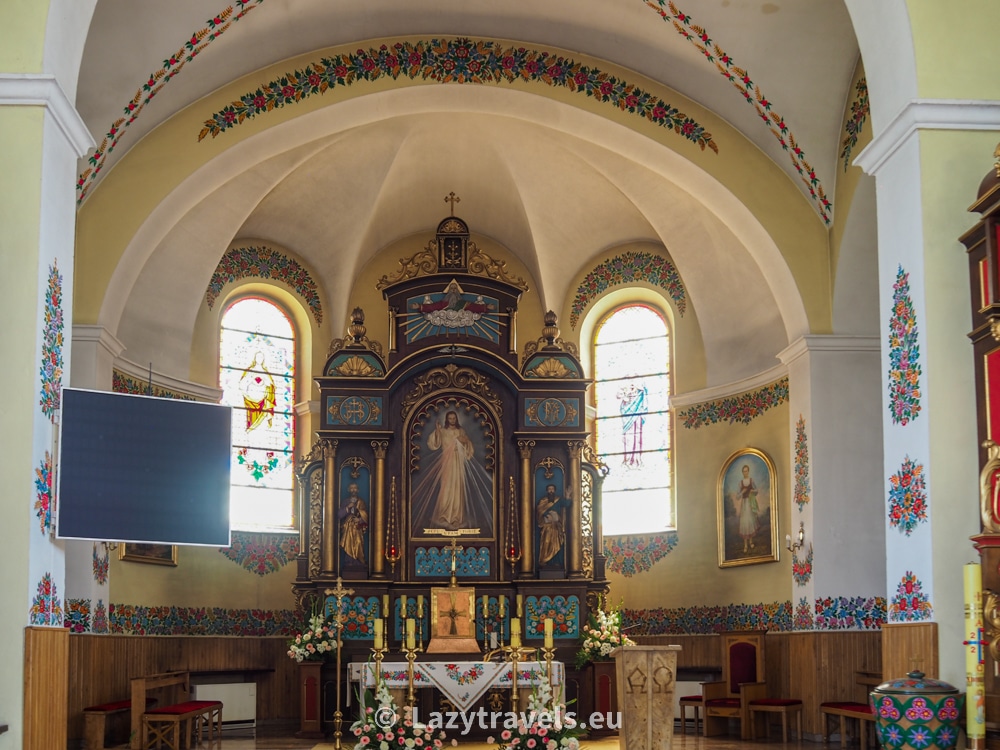
Of course, there is also a church in the village. Its interior is also partly covered with characteristic ornaments. Although, to be honest, if I hadn’t stopped here, I wouldn’t feel like I had missed out on anything. So, I leave it up to you to decide whether to stop here or not. The advantage is that, as is often the case with churches, there is no problem with parking in the parking lot 🙂 Right next to it, there is also a map of Zalipie with marked houses that are decorated.
Getting to Zalipie
The narrow local roads are not the most comfortable to drive on, but you will certainly have no problem getting there. If you are coming from Krakow, the largest city in the area, it will take you about 1 hour and 20 minutes. From the beautiful health resort of Busko-Zdrój, the journey takes only half an hour, as it is only 30 km away. On your way here or back, you can stop, for example, in the interesting town of Wiślica, located nearby. If you have time, „Koziołek Matołek and the European Fairy Tale Center” are also only 30 km away.
As for parking, there is a large parking lot next to the church, but it is far from Felicja Curyłowa’s farmstead. However, there is a medium-sized parking lot in a meadow right next to it. If you arrive in the morning, you will have no problem parking. Later in the day, people usually park along the road.
And if you want to spend the night in Zalipie, some of the cottages offer agritourism services. You will have no problem finding them.