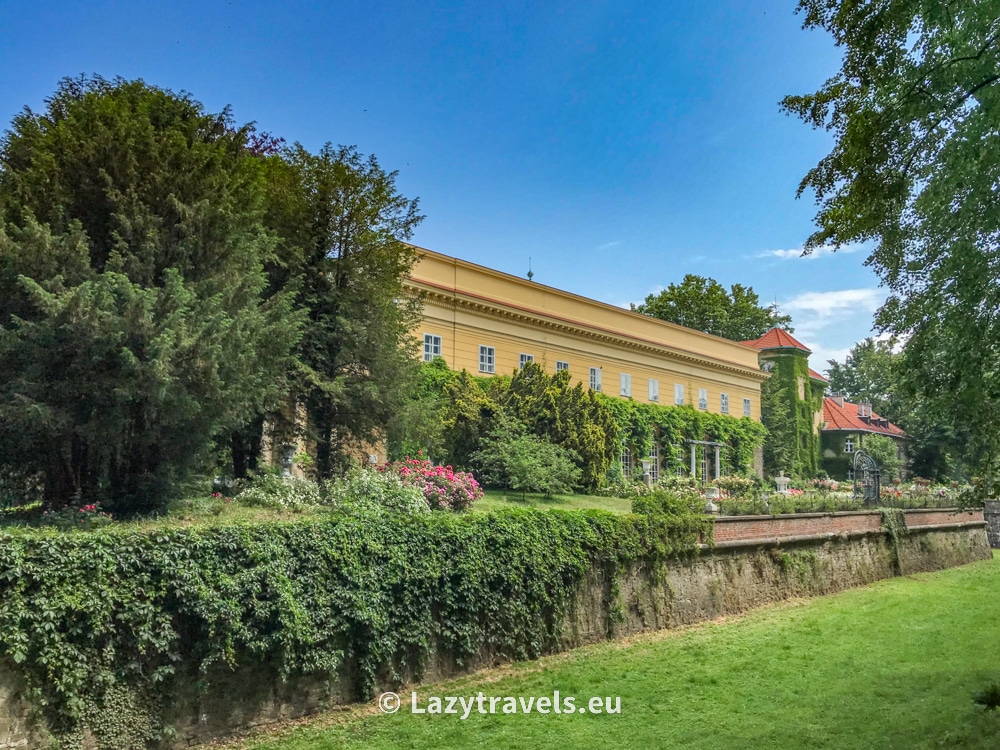
The castle in Łańcut is certainly not a castle today, it is simply a magnificent palace. A place full of splendour and ornamentation that impresses even those who are not art historians. And on top of that, we can visit the carriage house and take a walk in the beautiful park. I invite you to visit the castle in Łańcut.
It is interesting why we use the formula castle in Łańcut for this one of the most beautiful magnate residences of old Poland. Well, it’s probably just a habit. A tradition that has lasted for several hundred years. Because, humanly speaking, it is simply a palace. One of the best preserved in Poland.
And yes, I know, that polish word „Łańcut” is hard to pronounce, but is you say „Lancut” everybody understand.
History of the Łańcut castle
It is said that the location of Łańcut in 1349 is linked to one of the most famous Polish kings, namely Casimir the Great. But, in fact, history began to materialise into the form that took its present shape around the 16th century. It is connected with the Pileckis family, who built the first fortifications here. The next owners, the Stadnickis, gave it its characteristic horseshoe shape. But what decided the future of the castle in Łańcut was built by Governor Stanisław Lubomirski. In the years 1629-1641, something described as a „palazzo in fortezza” was built. That is, a palace in a fortress. Centrally located and fortified, the palace (castle) was surrounded by defensive bastions.
And it was these fortifications that determined that the palace remained unconquered by the Swedes during the so-called Swedish Deluge. The Swedish army captured almost all Polish towns and fortresses. They failed to enter only a few. Everyone in Poland has heard about the defence of Częstochowa, but the invaders also did not broke through the fortifications of Zamość and, Łańcut. It was worth investing in defensive architecture. Thanks to this, the interiors were not plundered and taken to Sweden.
We owe the present shape of the former castle to Izabela Lubomirska née Czartoryska. She was probably not a great fan of militaria, because it was on her order that a park was built on the site of the fortifications, and the castle took the shape of a palace. This is how the castle in Łańcut was born. Of course, the process of shaping the space took many, many years. However, the final result was that at the end of the 18th century, Łańcut was one of the most beautiful residences in this part of Europe. To emphasise the importance of the place, the owner invited distinguished guests, thanks to whom musical and theatrical life flourished here and the picture gallery grew. When Princess Lubomirska died in 1816, the palace passed to her grandson, Alfred I Potocki. And it was the Potockis who ruled the ordynacja that was created here.
The castle during and after the II world war
They were not oppressed by the partitioners, so the castle in Łańcut did not suffer from the persecution often applied by the occupants. In Poland, which regained its independence, the palace continued as before. And even the Second World War did not change much here. The Potockis got along with the Germans to some extent, to the extent that the castle housed the Wehrmacht headquarters. As the owners were not ashamed, they knew that there were no jokes with the wild boar coming from the east, i.e. the Soviet army. Therefore, before the Red Army arrived on 31 July, Alfred Potocki loaded what he could onto the carts and fled. He settles in Switzerland.
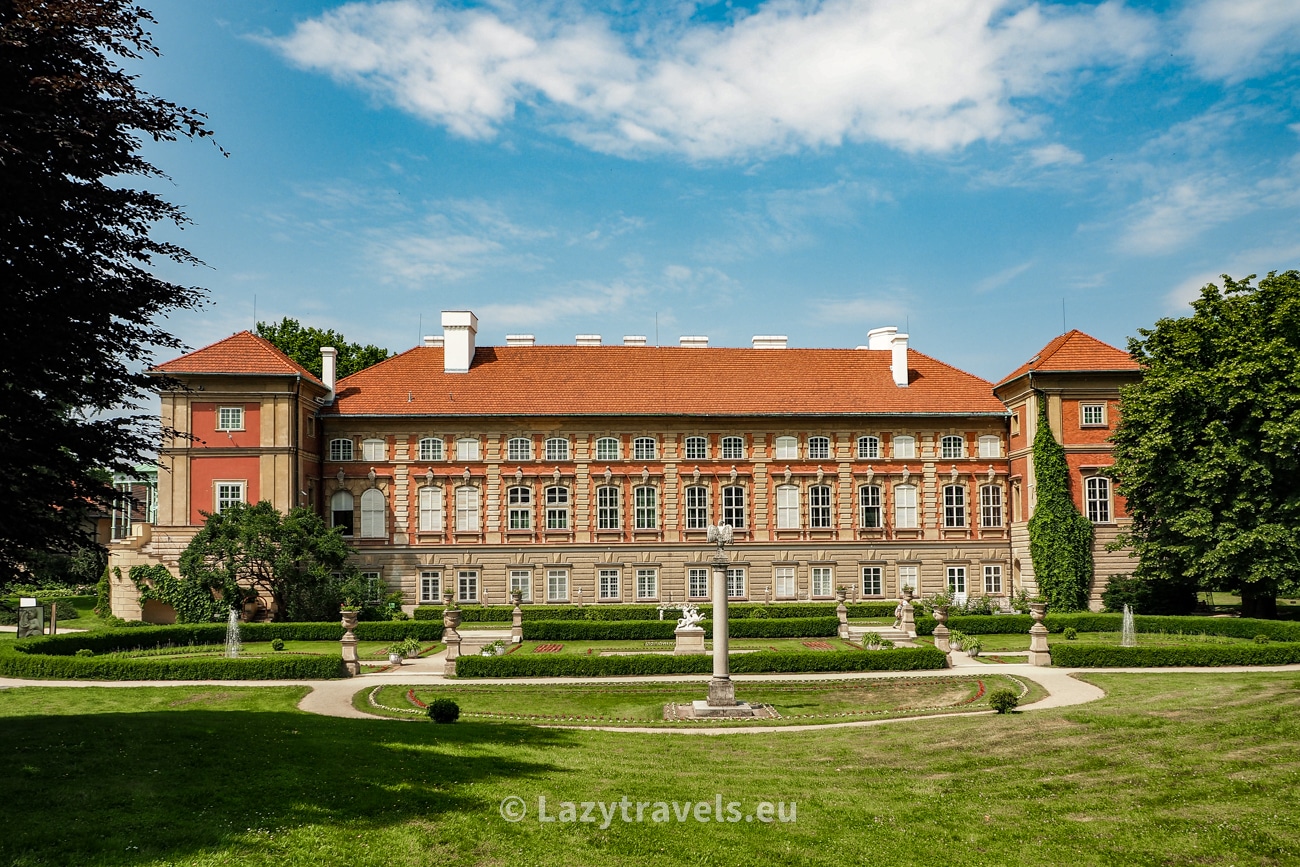
The estate manager Juliusz Wierciński, who is left behind, decides on an interesting manoeuvre. In the face of approaching Soviet troops, he hangs an inscription in Cyrillic letters on the palace gate: Museum of the Polish Nation. Surprisingly, the Russians do not loot the palace and it does not share the fate of dozens of other palaces in Warmia and Mazury (for exaple). It was not burned and it was not abandoned. The only traces of the Red Army are said to be traces of beer barrels left on the castle floor.
And then, under land reform, the palace is taken over by the Polish state. A museum was created at the castle in Łańcut, which can still be visited today.
Visiting the castle in Łańcut
What I like is that you can visit the museum on your own and you can do it with an audio guide. You don’t have to wait for a group to gather and follow a guide. Ok, having a guide of course is a plus and you can learn a lot of history and interesting facts, but the guide goes on, he has to fit in time. And I like to stop at something that interests me and take as much time as I feel like. And there is plenty to see in the chambers!
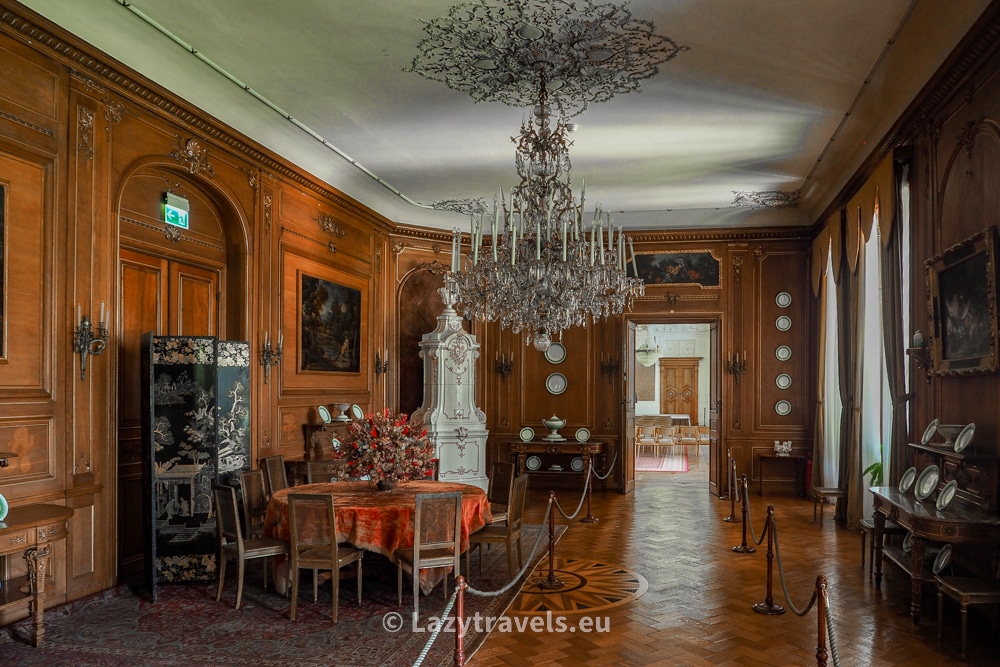
To begin with, it is interesting to note that the tour of the palace interiors is the same as it has been for the last few decades. Just as we used to visit on school trips! Here we get the famous museum slippers, put them on our shoes and, scrubbing them on the floor, we can go (scrubbing) to the rooms. And believe me, these slippers make sense, because the floors in this sumptuous interior are richly inlaid and it would be a shame to damage them.
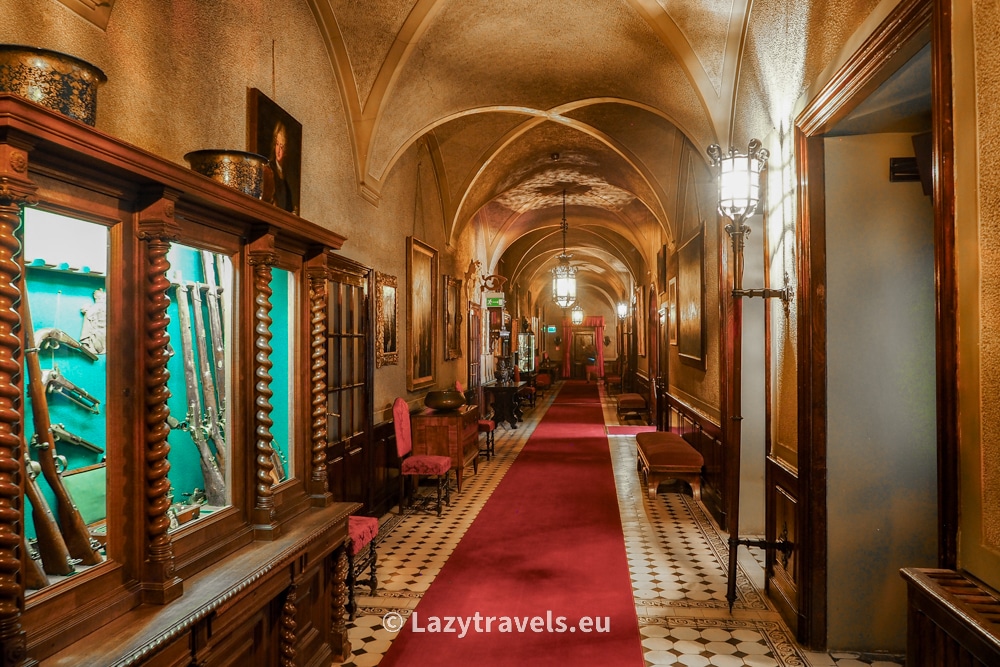
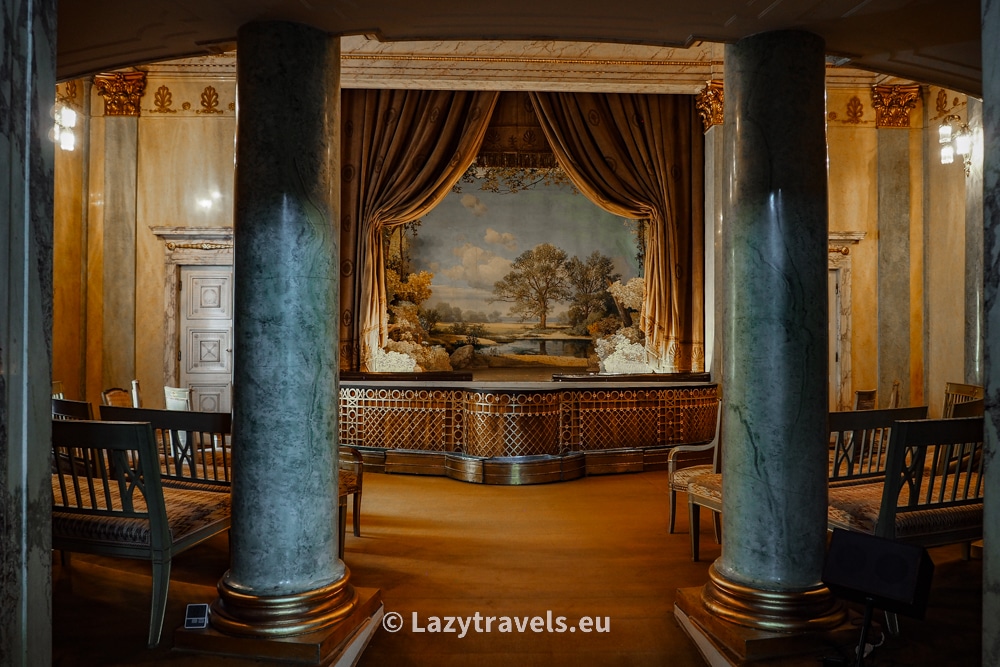
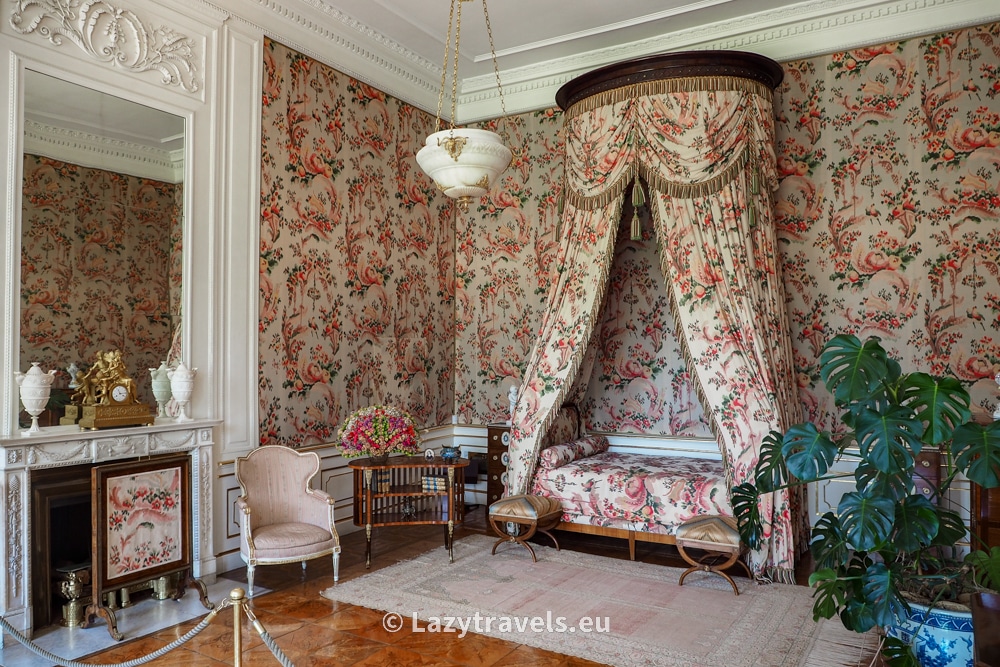
Luckily, the palace survived the wars and we can see rooms here that still date back to the 17th century. These are: The Great Vestibule, the Hall under the Zodiac and the Hall under the Ceiling. Unfortunately, the rooms are not unchanged since their creation, but they are still impressive survivors. There are also quite a few rooms from the 18th century for example these are: The Turkish Suite, the Columned Room, the Pompeian Room, the Duchess Marshal’s Bedroom.
And if we are at the latter, some of the original furnishings that were purchased by this most famous female owner of Łańcut have survived to this day. But here I must pass on a small ‘but’. Well, some of the most valuable original furnishings are in the collection of the National Museum in Warsaw.
It may also be worth mentioning that most of the interior decoration comes from the last great renovation of the palace, which took place at the turn of the 20th century. But the Potockis did not reach for the then fashionable Art Nouveau, but were more conservative in taste. They stayed with neo-Baroque, so it’s a bit hmmm sweet-tempered. But I do like this glamorous, slightly kitsch style.
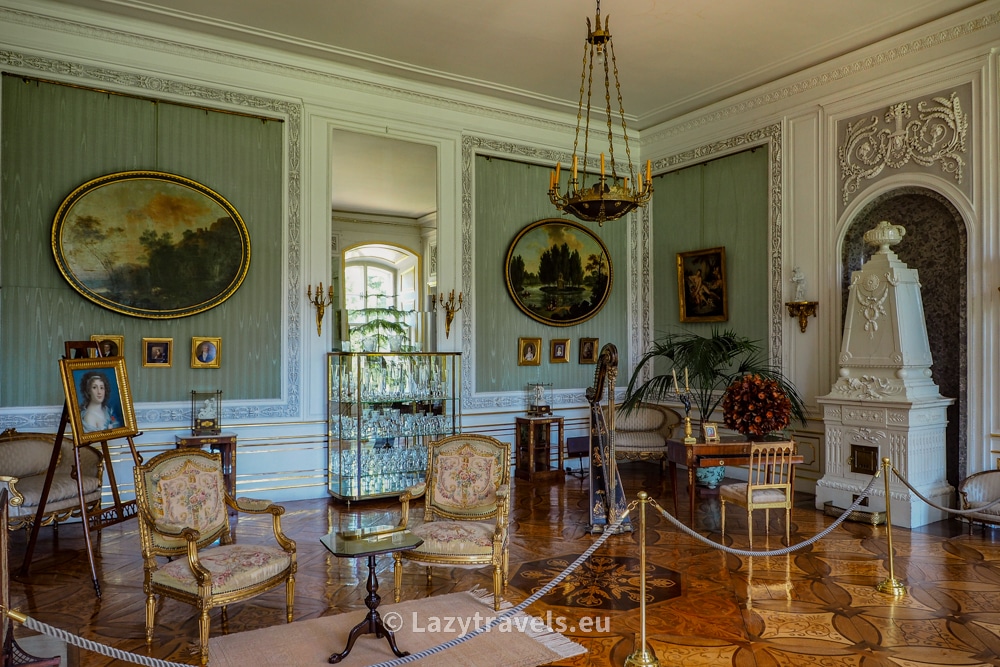
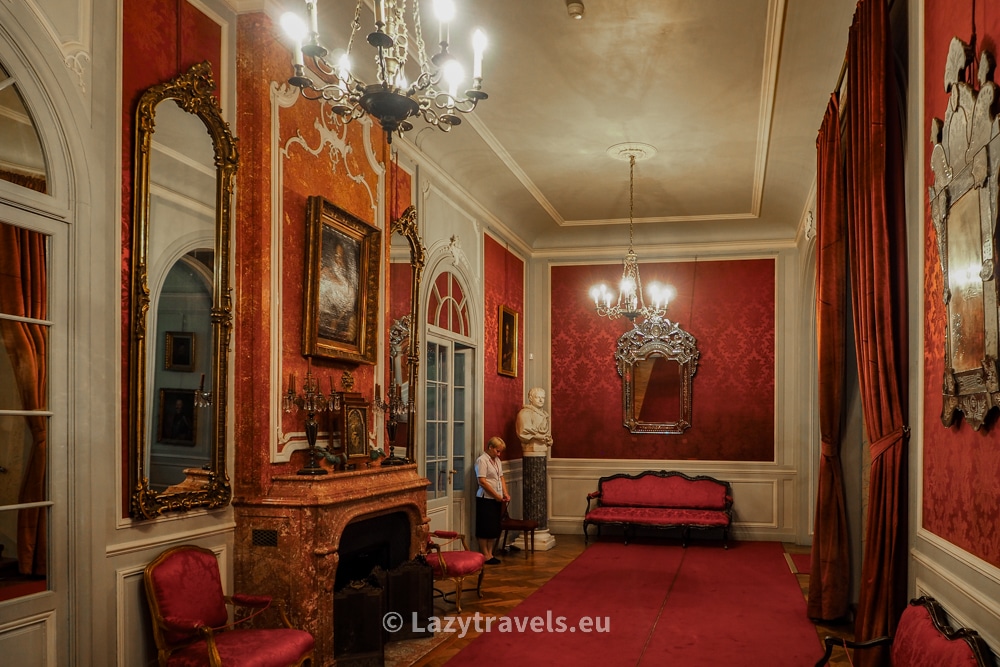
Today, when we walk through the palace chambers, we see partly the reconstructed interiors and partly what used to be there. But certainly the collections gathered here allow us to imagine the splendour in which the old aristocracy lived. Rich draperies and paintings hang on the walls. Sculptures and trinkets delight the eye on the antique furniture. In addition to this, information boards provide information about the interiors. And the intricately decorated porcelain! One would like to get closer and admire the details of the designs, but… visitors are separated from them by thick ropes. And, of course, the tour takes place under the close supervision of the ladies guarding the interiors. As befits a proper museum!
And you will probably have the same sad thought when putting your slippers away in your trunk as I did. This palace cost a fortune! It cost such a huge amount of money that we can’t imagine it and can’t count to so many zeros! And at the same time, the peasants who worked in the fields were in such poverty and living in such scandalous conditions. That we don’t know how to imagine it either. The extreme wealth of the lordly magnates and the extreme poverty of the boors, as the peasantry used to be called.
The palace park
The park can be considered the jewel in the crown of the magnate estate. For while the interiors are beautifully decorated and furnished, they are dead…. Outside, on the other hand, the green as always soothes the eyes, while the red of the roses makes the heart beat faster. Depending on where you go, this is the effect you can get. Anyway, the pictures speak for themselves.
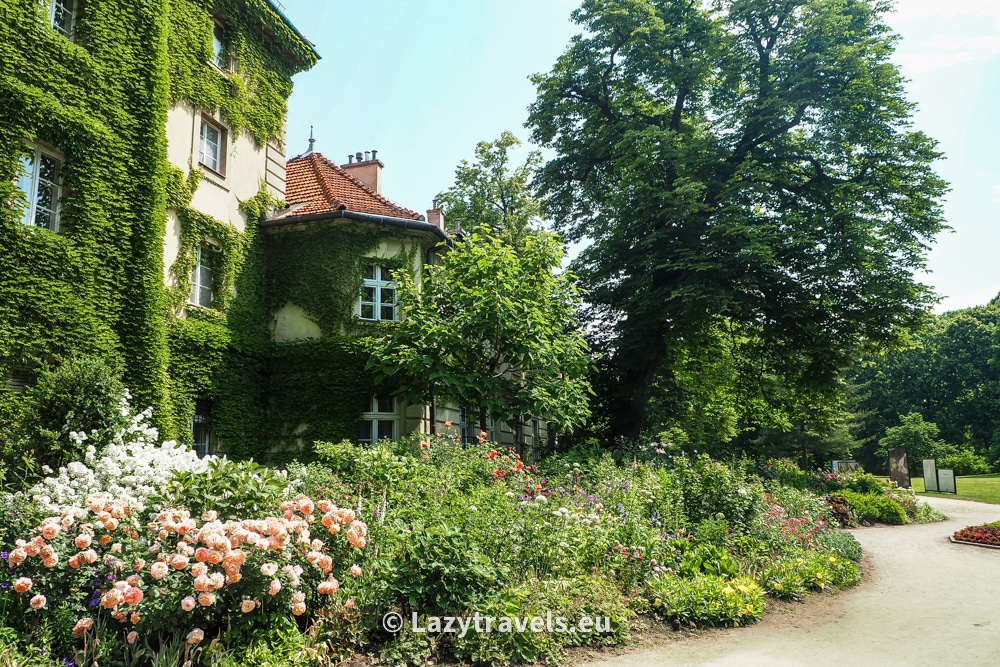
As I wrote above, the English-style park was created at the request of Princess Lubomirska and occupied the area of former military fortifications. On an area of as much as 36 hectares, we have an outdoor park and an indoor park. And within them a rose garden, an Italian garden and a perennial garden.
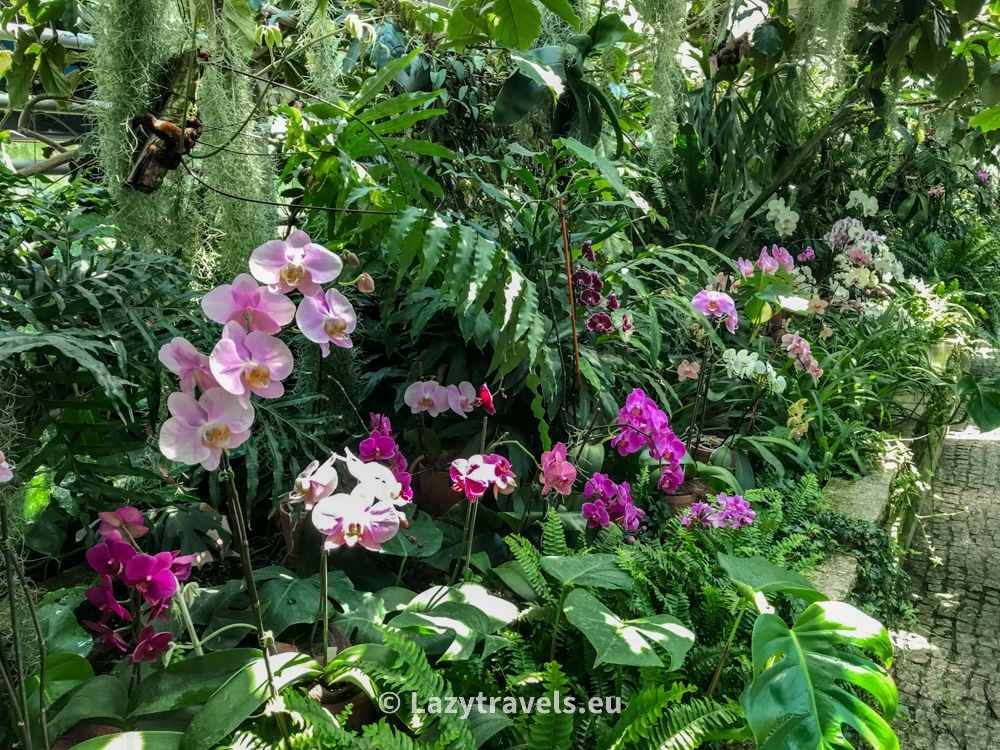
What I recommend is simply walking around and stopping where you feel like it. Smell the flowers, admire the gardens and, of course, take a peek at the places that are worth seeing. The coach house is certainly one such place. And of course the conservatory, where exotic plants grow in warmth. Hardly anyone could afford a conservatory in the past. After all, winters used to be harsh, not like today!
Carriage house in Łańcut
The coach house and stables at the castle perfectly reflect how the magnates used to live. And their tastes and purchases were not very different from today. They could not invest in cars, but invested in other vehicles for mobility and recreation.
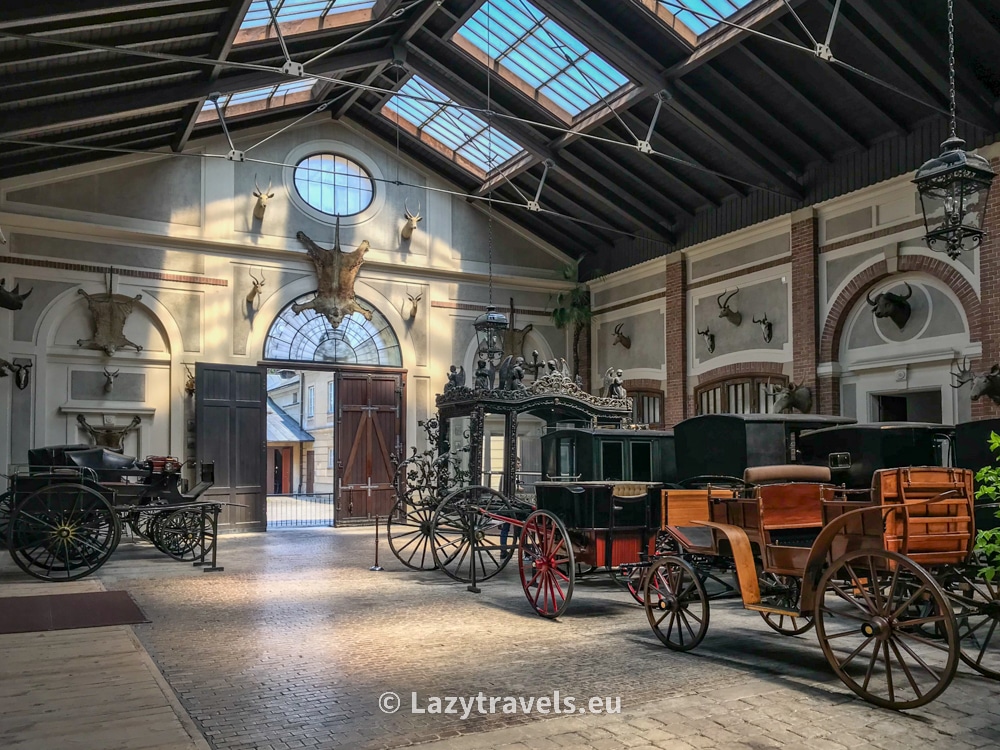
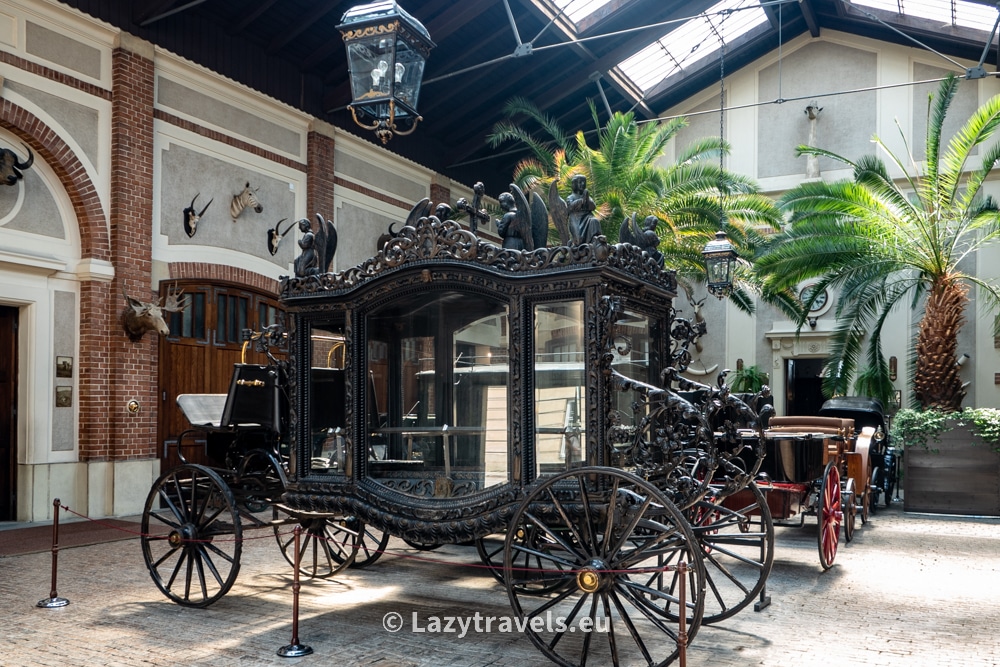
That is why we will see the largest collection of carriages in Poland in the palace carriage house. The most representative one stands in the middle of the Carriage Hall, in the place where horses used to be harnessed. This rather unusual vehicle is a richly decorated hearse. The vehicle of the last journey… At this point, it is also worth raising your eyes and looking at the walls. On them, skins and heads of animals that were killed during exotic hunting expeditions are hung for decoration. Hunters, as you can see, have always done well. At that time, however, there was a lot more wildlife running around in the forests than today. Because there were more forests, too.
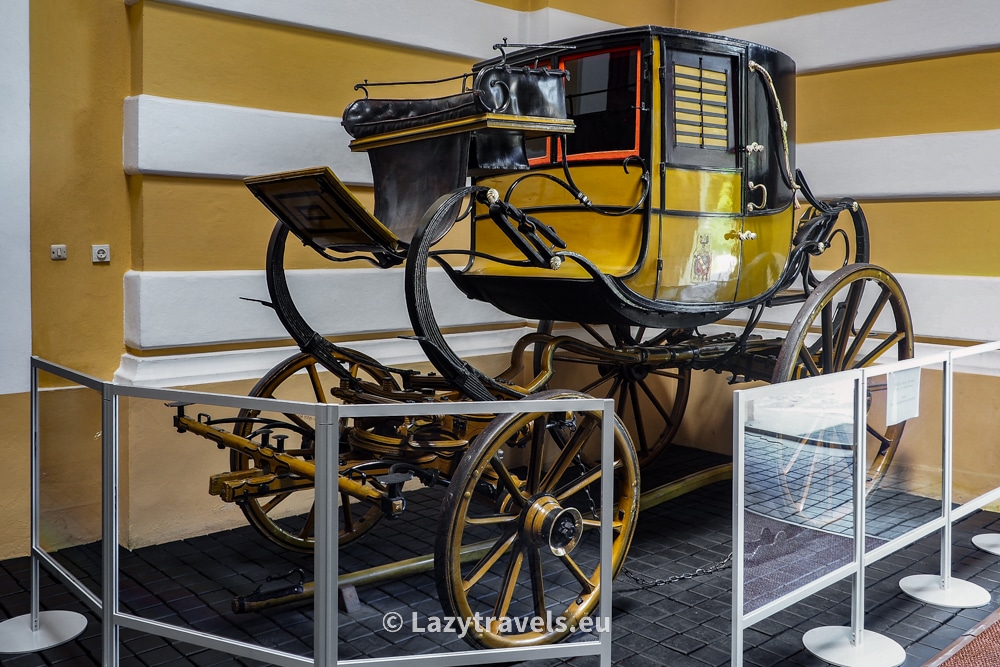
But it is worth going into the rooms next door, these are the Black and Yellow Coach House. These are where the carriages, chaises, breeches and what other names were given to the former vehicles to which horses were harnessed were parked. What is not here! There are vehicles for long journeys and those for short trips. There are representative ones and there are intimate ones. But there are also those with a story behind them. For example, we can see here the carriage which Frederic Chopin himself drove to give a concert in one of the nobleman’s manor houses. You can see it in the photo below.
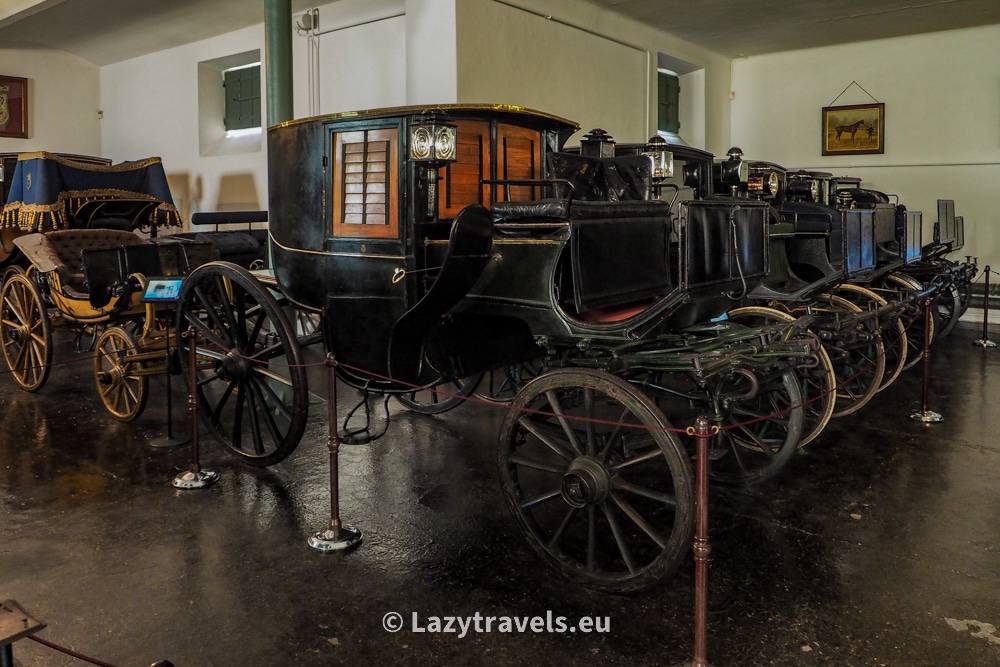
Oh, there are multimedia boards next to the carriages, which display more information about specific carriage models.
You will also see vehicles that were formerly intended for children! An example is the ziegewagen. A miniature carriage was harnessed to a… goat!
It is worth adding here that the palace carriage museum does not only house vehicles used by the magnates living in Łańcut, but the collection is still being expanded with carriages from other places. Currently, the collection is divided into two parts. The first consists of 55 vehicles connected with the family of the palace’s owners, the Potockis. The second consists of 80 units and started to be collected after the war, when the museum was established here.
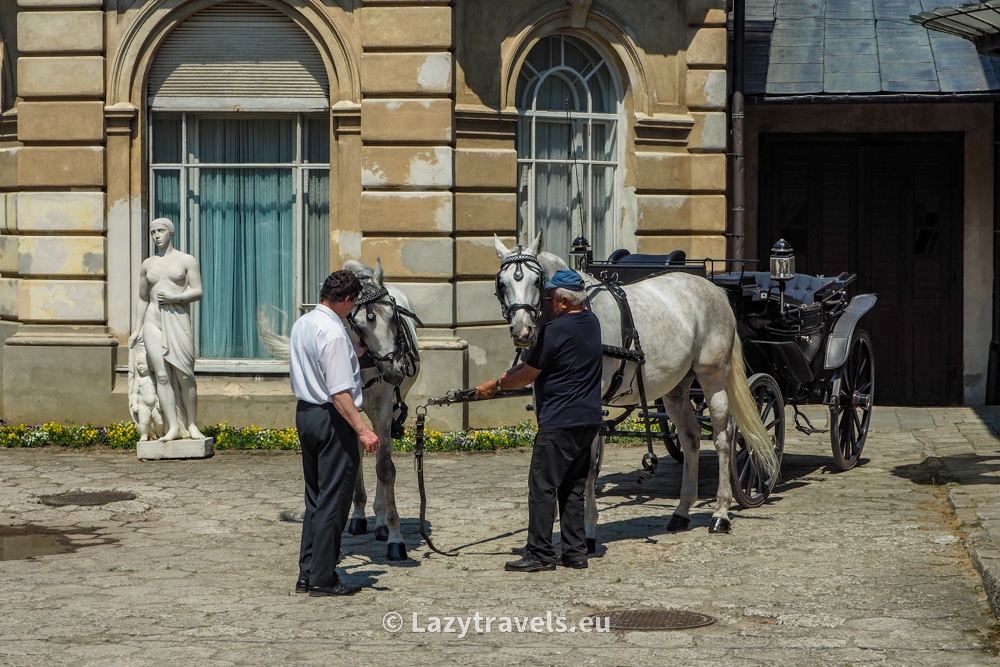
While visiting the carriage museum, don’t forget to visit the room where you can find the equipment you need to harness a horse to a coach or carriage, as well as to drive it and go on a journey. The stables are open right next door, so with a bit of luck you’ll see horses being harnessed to one of the carriages. If there was also a steward and period costumes, you would think you had travelled back in time.
Practical information
Opening and visiting hours of the castle in Łańcut
- Monday 12.00 – 16.00 (last entry at 15.00)On Mondays admission is free of charge, but tours are without guides or audio guides.
- Tuesday, Wednesday, Thursday, Friday 9.00 – 16.00 (last admission at 15.00)
- Saturday 10.00 – 18.00 (last admission at 17.00)
- Sunday 10.00 – 18.00 (last admission at 17.00)
Łańcut Castle – price list
The castle ticket offices are located in the manege at 10, 3 May Street. Parking is along the street by the pavement and in fact on most adjacent streets. Therefore it is sometimes difficult to find a place to park.
- Normal ticket – 29 PLN
- Discounted ticket – 23 PLN
- The price includes a tour of the castle, coach house and stables
Entrance to the castle park
- Normal ticket – 2 PLN
- Discounted ticket – 1 PLN
If you need more information, please visit the castle’s official website.
Places worth seeing near the Łańcut castle
I went to visit the castle in Łańcut during my tour of the Podkarpacie region. My base at the time was the magnificent, though not so widely known and loved, town of Jarosław. I also took the opportunity to visit Przemyśl, as it is a wonderful city where the spirit of the Habsburgs hovers. Right next door is also the castle in Krasiczyn. And if you have the time, a stone’s throw from Łańcut is Rzeszów after all!