The Cistercian Lubiąż abbey is an absolutely extraordinary monastery! Who would have thought that the second largest religious complex in the world would be located in a Polish village? It’s truly fascinating how history unfolded to bring us this powerful and magnificent complex of buildings. Because it was not always the outskirts!
The Cistercians built a monastery in Lubiąż, far from civilization, to immerse themselves in prayer, and they did it in a perfectly chosen location! The monks built this massive complex in a bend of the Odra River and at the same time on the trade route, because one of the river crossings led here in the Middle Ages and even earlier. As time passed, the monastery grew to become the magnificent complex we see today.If you want to learn more about the history of the Cistercian Lubiąż abbey, its monuments, and sights, then you’re in luck!
Cistercian Lubiąż abbey – history od the monastery
The story of the Cistercians Lubiąż abbey began in 1163, when the Piast prince Boleslaw I the Great brought them from Thuringia, and the center grew stronger and more prosperous. The Cistercians, as a forward-thinking organization, invested in the area to improve agriculture and craftsmanship. Money flowed into the coffers of the Order, which grew larger and larger.The monks were hard at work, and their efforts paid off.
The monastery in Lubiaz is an incredibly important cultural center, and it’s where some of the most significant works in Polish history were written, like the „Chronicle of the Polish Princes” and the „Catalogue of the Bishops of Wroclaw.” The monks were not only devoted to their spiritual lives, but they also invested in the community and became significant landowners. Their wealth allowed them to establish other monasteries, including those in Mogila near Cracow in 1222, Henryków in 1227, and Kamieniec Ząbkowicki in 1249.
The monastery’s growth was greatly influenced by the movements that broke out in nearby Bohemia, which at the time was under Bohemian sovereignty. The Hussite wars of 1419-1436 reached Silesia, and the monastery was burned by the Hussites. After the war, the complex was rebuilt and fortified, and the monastery learned its lessons from the invasion.The next turmoil of the Thirty Years’ War took its toll on the monastery, which was looted, including a very rich library.
Then, a new chapter in the Lubiąż abbey history began. Starting in 1649, the visionary Abbot Arnold Freiberg spearheaded a series of reforms that brought the monastery back to its former glory. They fixed the damage, built new structures, and began adorning the interior. During this time, they constructed the impressive abbot’s palace, a hospital, and a brewery, among other buildings. The monastery also underwent a beautiful transformation, embracing the Baroque style.
Then, the incredible Michael Willmann showed up in Lubiąż. He was the most famous artist in Silesia during his time. He was self-taught and his paintings are still loved today. He painted the huge paintings that decorate the church in Lubiaz, as well as the frescoes—not only in the temple.You can see his work in the summer refectory of the monastery. It’s fascinating to think that after the upheaval of World War II and the loss of the Lower Silesian territories, these paintings, including those from our local church, found their way to churches in Warsaw. Unfortunately, they weren’t signed, so I’ll have to search for them in the churches of the capital.
The end of the monastery’s glory years
In 1740, Silesia became part of Prussia, and the Protestant Prussia’s relationship with the Catholic Order was a bit rocky.The Cistercian Lubiąż abbey closed its doors in 1810. At that time, the government took over the monastery and its property, and the monks had to leave. In the years that followed, the monastery complex fell into disrepair, and its functions changed, which unfortunately left its historic interiors in a state of deterioration. The church, however, still stands today, a testament to the local community’s deep connection to this sacred place. The authorities, understanding the significance of this cultural heritage, have made a conscious effort to preserve it, respecting the community’s wishes and maintaining a sense of respect for the historic site.

World War II brought further destruction to the interior as it was converted into a Telefunken factory, which is really too bad. Fortunately, the Allies did not bomb the place. Instead, the wilderness from the east, i.e. the Russians, proved to be just as destructive.When they arrived in 1945, they started a treasure hunt. They ransacked the crypts and threw the Piast mummies out of their sarcophagi. They probably also stole the insignia of power with which the rulers were buried. For centuries, generations have respected the peace of the dead; the herds from the East have respected nothing. Just like the robbers who destroy the necropolises of the pharaohs in the Valley of the Kings in Egypt. I only hope that some kind of curse has reached them.
The rest of the furniture here has also been burned in the ovens. It’s truly heartbreaking to see the complete devastation caused by the horde from the east.
After the Russians left, these walls were used for all sorts of things. For a while, they were a museum warehouse. But in 1989, local history buffs and people of good will came together to start a renovation of the Lubiąż abbey. They’re still working on it today, but it’s a big job! They need a lot of money, and the foundation’s income is relatively small. Luckily, they have enough money to slowly restore the monastery to its former glory.

At this point I would like to thank those wonderful community members who, with their own persistence and love for the monument, led to the rescue of the abbey. Lubiaz Foundation, I bow before you!
And what are the attractions of Lubiaz? Keep reading below to learn more.
Places to see in the Lubiąż abbey
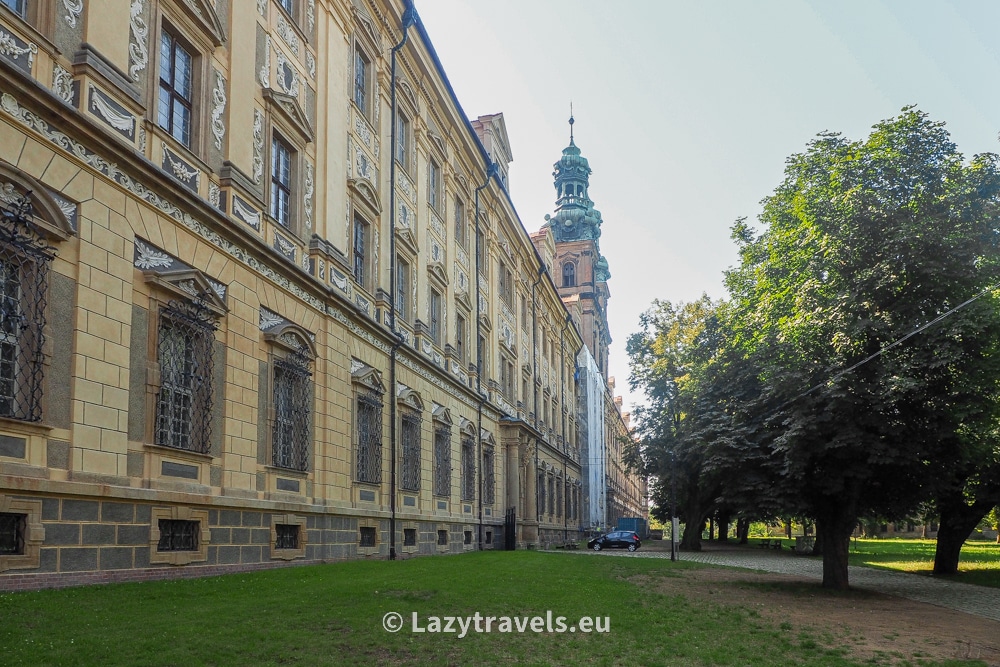
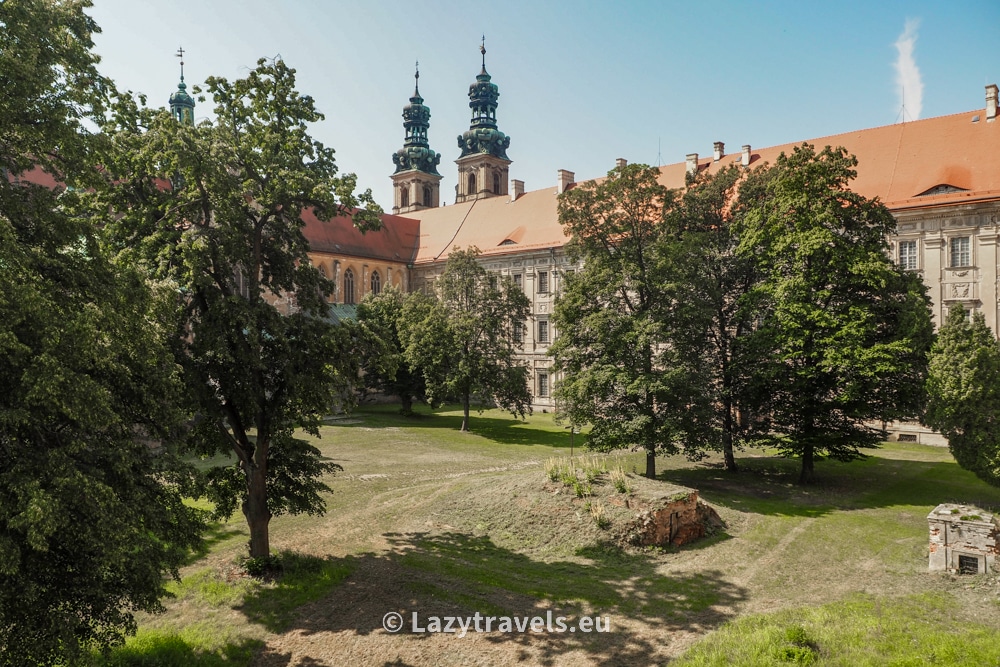
When we arrive at the local parking lot on an August Friday at 10:05 a.m., we’re delighted to find it completely empty. This is perfect for us, as we’re not big fans of crowds, and our group is just eight people.The walls of the abbey are absolutely stunning from a distance, and the size of the complex is truly indescribable.As you walk along the walls, you can’t help but feel a sense of history and tranquility. Then, you turn left, and… The other end of the building fades away into the distance, and you can see that the building is 223 meters long. They’ve already restored some of it, and they’re currently working on restoring other parts. There are still plenty of areas that need the restorers’ loving attention.
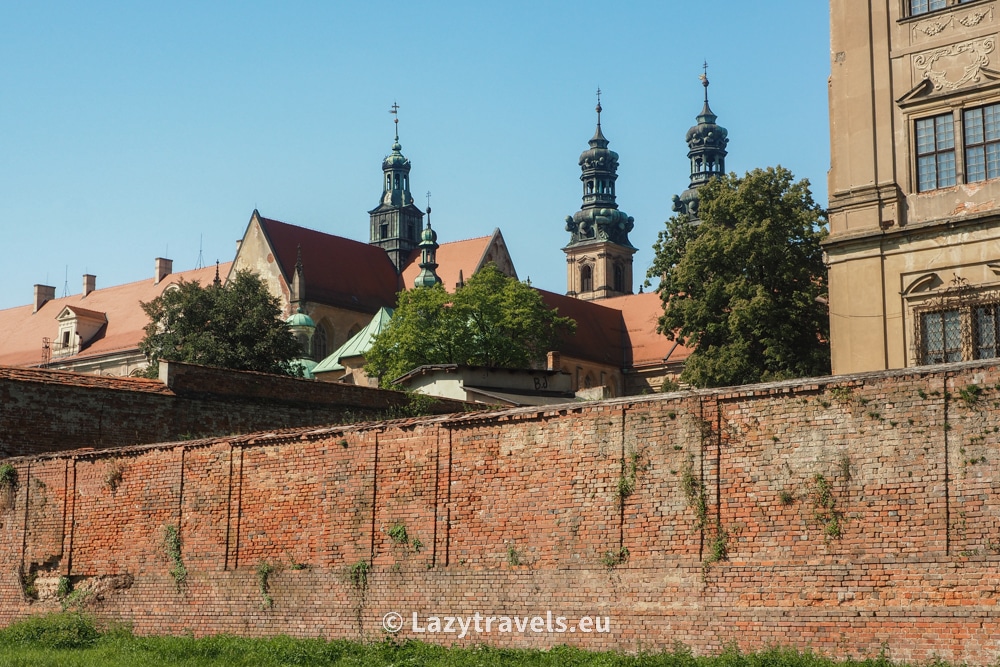
Speaking of records, I’m delighted to tell you that the Cistercian Abbey in Lubiaz is the second largest religious building in the world. The largest is the Escurial in Spain, which I’m sure you’ll agree is absolutely stunning! I gave the exact time of arrival above because, when we arrived at the ticket office, it was about 10:15 a.m. We were a quarter of an hour late for the 10 o’clock entrance because, as I’m sure you know, guided tours are held at every full hour.
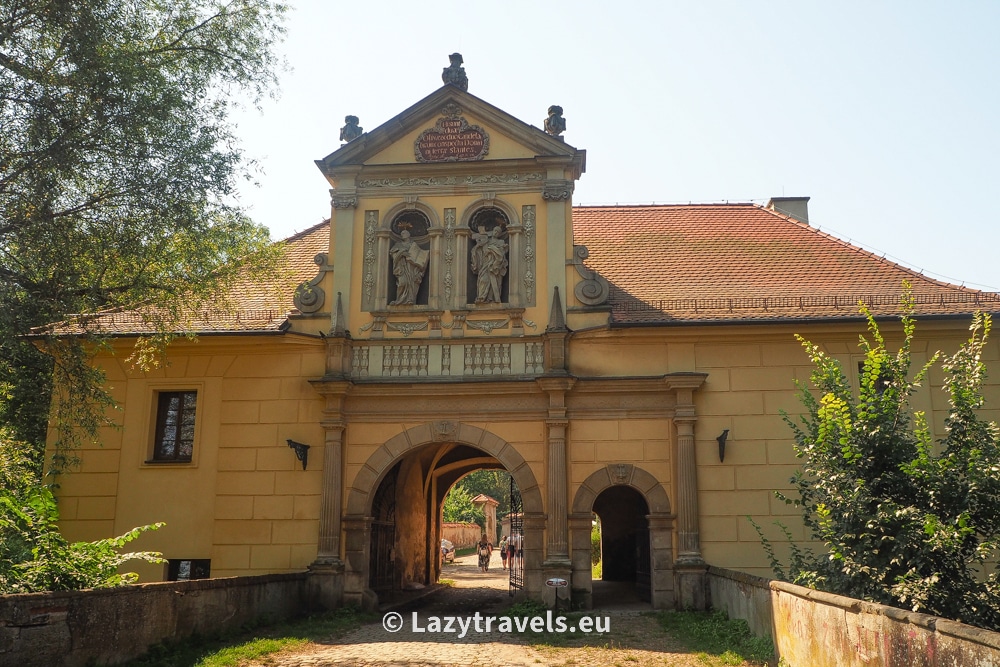
But this gives us time to still walk around the grounds of the former abbey on a sluggish morning and get bitten by mosquitoes in the process. So we peek into the gate building, we also go out into the fields somewhere through a smaller gate. But above all, we look at the impressive facade.
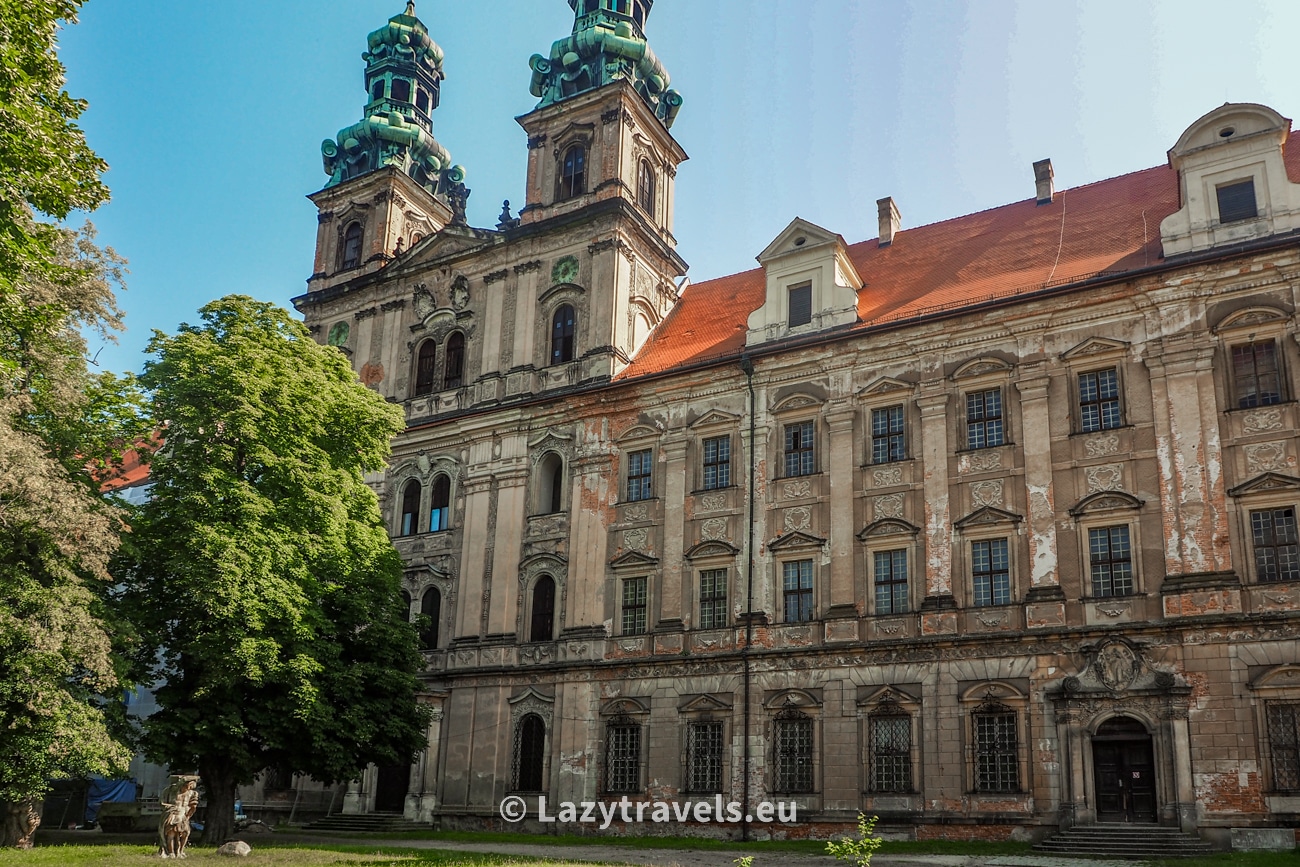
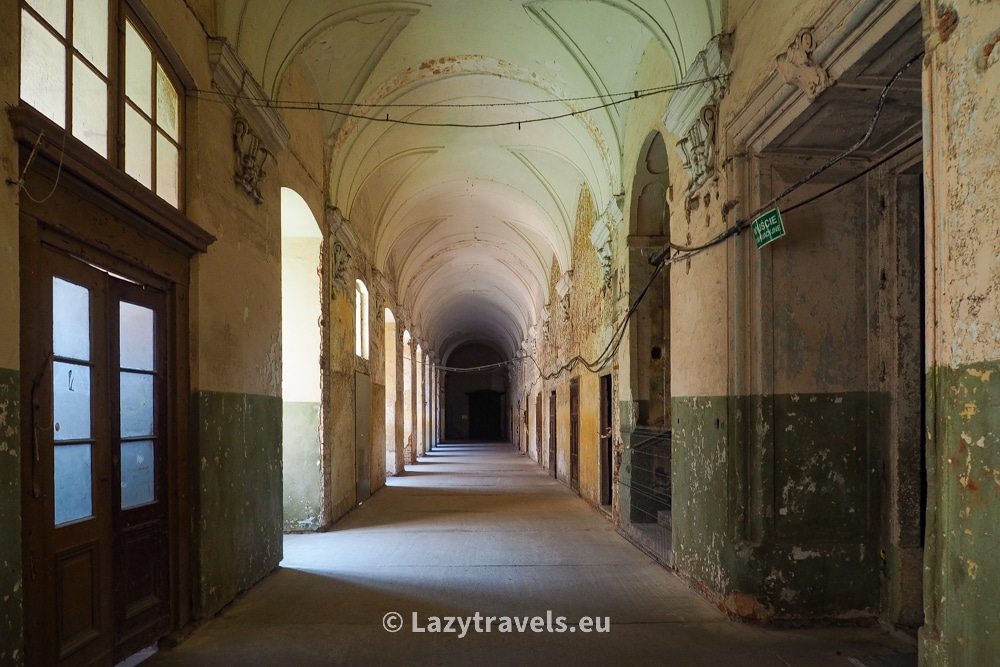
At 11 a.m., we’ll head out to visit the beautiful Cistercian Abbey of Lubiaz. I’ll let you in on a little secret: the monastery looks impressive from the outside, but what’s inside is sometimes surprising. I invite you to join me as we explore what we’ve seen and what I sincerely recommend you see, even though it’s still a shadow of its former glory and grandeur. It’s truly impressive, I promise!
Monastery
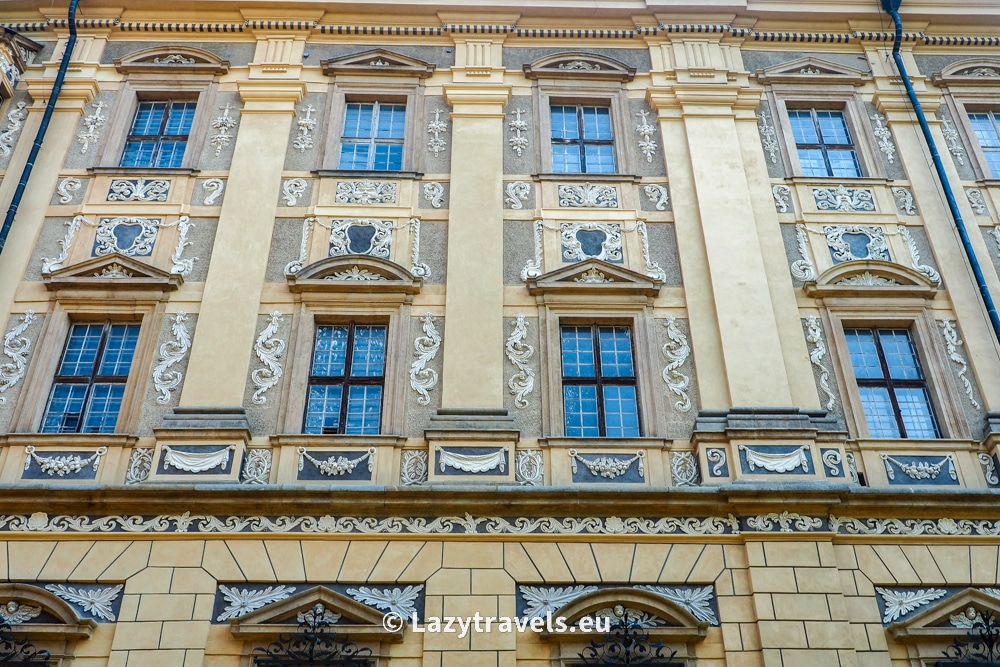
The monastery, or main building, where the local Cistercians lived, was built between 1692 and 1710. It was built partly on the site of the old monastery, so there is continuity between the old and the new, which is really lovely.It is a massive building, 101 meters long, and such size meant that the local monks had everything they needed. Their cells were spacious, ranging from 24 to 50 square metres, and were beautifully adorned.Each floor was home to around 30 rooms, along with a library and a refectory, creating a sense of community and harmony.The monastery and the abbey palace, which we will now explore, stand in a line, forming a compact and inviting structure.
Abbots’ Palace and the Prince’s Hall
I’m sure you’ll agree that the Abbots’ Palace is the most fascinating and beautiful part of the Cistercian Abbey in Lubiaz. It’s here that you’ll find the most representative halls, such as the abbot’s dining room and the Prince’s Hall.
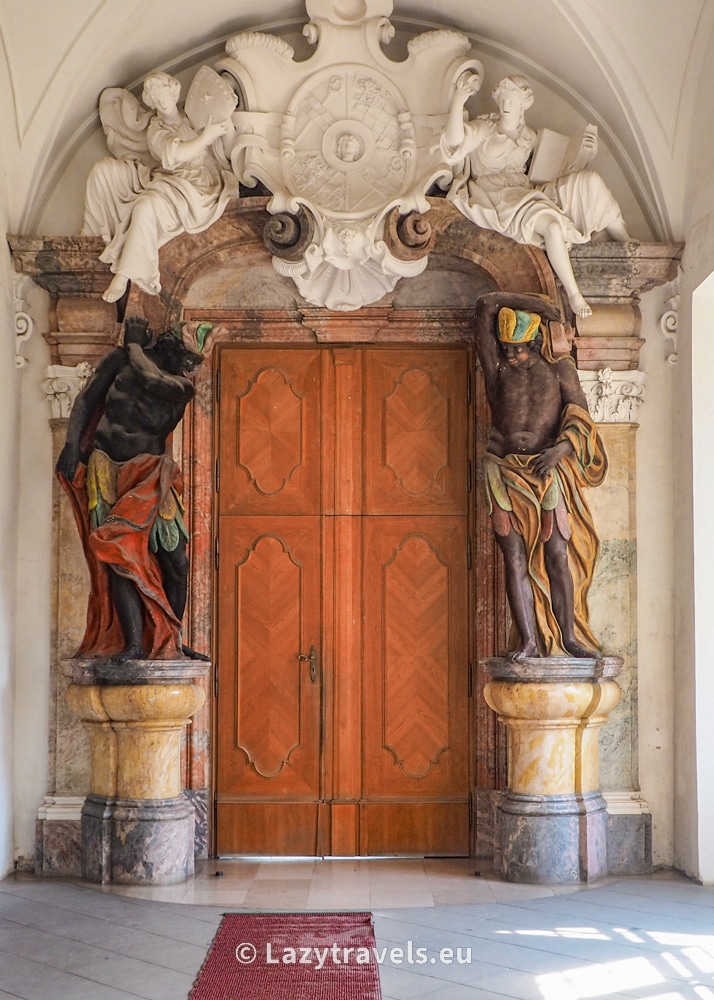
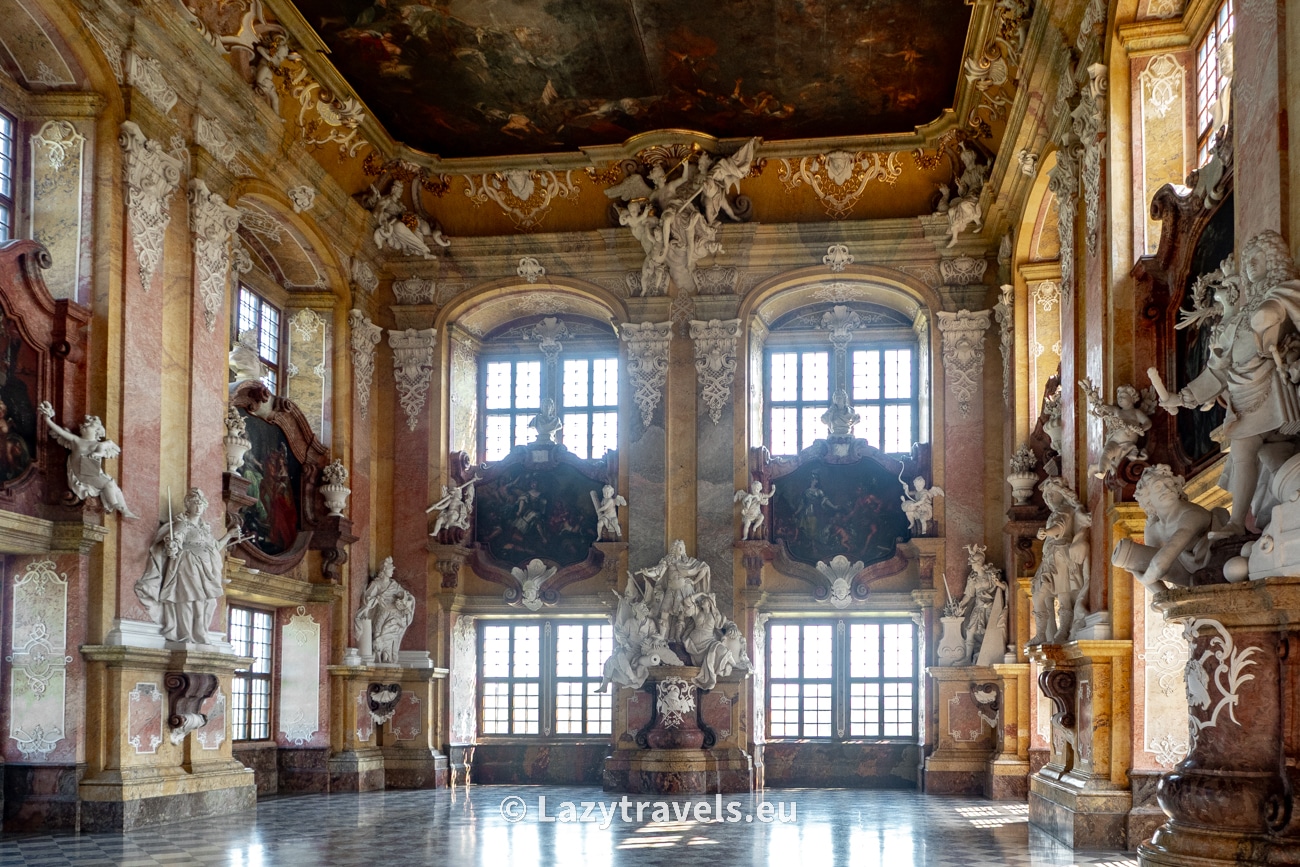
You can tell straight away that the Prince’s Hall is going to be something special, even before you go in. There are two figures guarding the door: an Indian and a Negro. This was a time when people were excited about discovering what was different and distant. But the real treasures are behind that door!The huge hall is absolutely amazing! It’s 13.4 metres high and over 400 square metres in area, and everything has a meaning and everything is beautiful! After all, this is the most beautiful baroque hall in Lower Silesia, and I’m tempted to say maybe even in Poland!
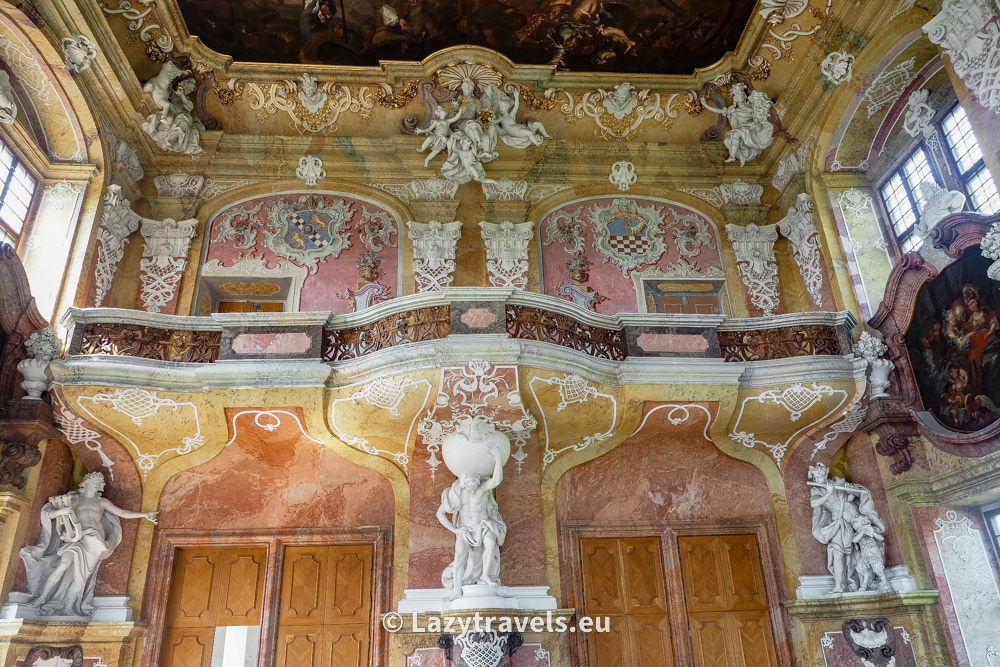
Here we have some really cool personifications of the four continents: Europe is represented by a bull, Asia by an elephant, Africa by a camel, and the Americas by a lion (I’m not sure about that choice!). There are also the cardinal virtues: courage, prudence, justice. But the decoration of the hall also pays homage to the Habsburgs, who ruled at the time, as their sculptures really stand out. The Prince’s Hall ceiling is an impressive 300 square metres, and it’s truly a masterpiece of symbolic art by Christian Bentum. Every detail has a meaning and a reference, and it’s like a gentle „wink” from the artist himself, who even made his self-portrait there!
But above all, the ceiling glorifies the Catholic faith.
And the absolute best part? The amazing art of illusion! If you look closely, you’ll see that at one point the painting turns into a 3D work of art. Isn’t it beautiful how the Virgin Mary, the dove as a symbol of the Holy Spirit, and the baby Jesus are all there? And there’s even a representation of the seven Christian virtues!

I absolutely love the ceiling, and it’s so lovely to see that the Cistercians didn’t forget to whom they owed their success. In the western part of the ceiling, there’s a portrait of the founder of the abbey, Prince Boleslaw I the Great. You’ll start your tour of the Cistercian abbey in the room right next to the ticket office. Here, you’ll find the abbot’s dining room, with a ceiling decorated by the talented Master Willmann.I really wish I had more time to enjoy everything, but I had to rush through a bit to see everything.
Church of the Blessed Virgin Mary
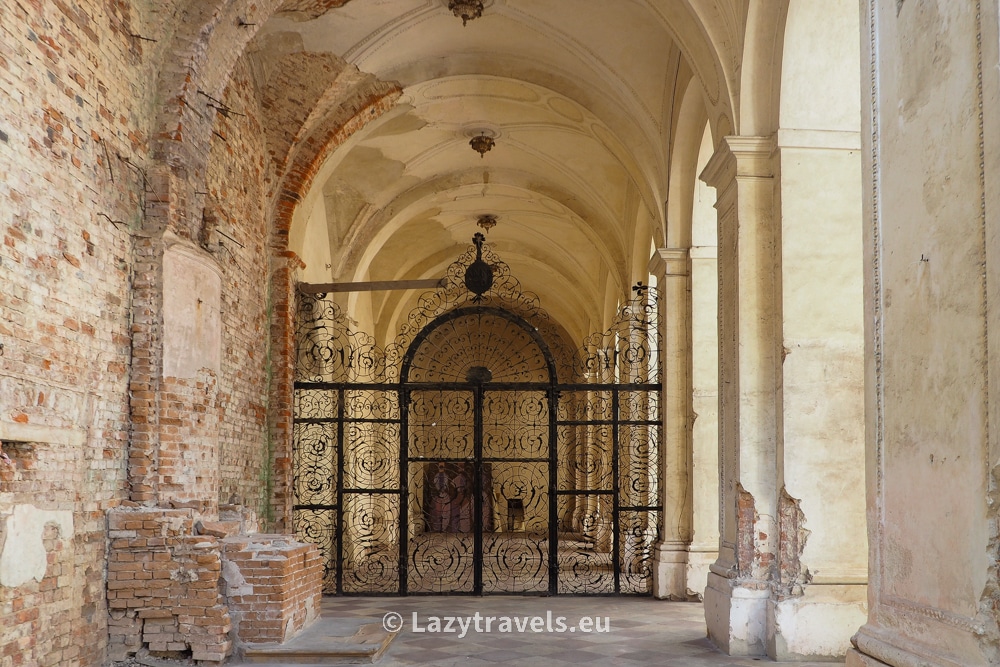
The church is like a shell, isn’t it? If you didn’t know any better, you would think it was still being built, but in reality, unfortunately, the opposite is true. It’s a desacralised place. Until the Second World War, it was still beautiful, albeit stripped of some of its paintings and expensive sculptures, but still magnificent. Unfortunately, after the Russians came, there is almost nothing left here except the walls.
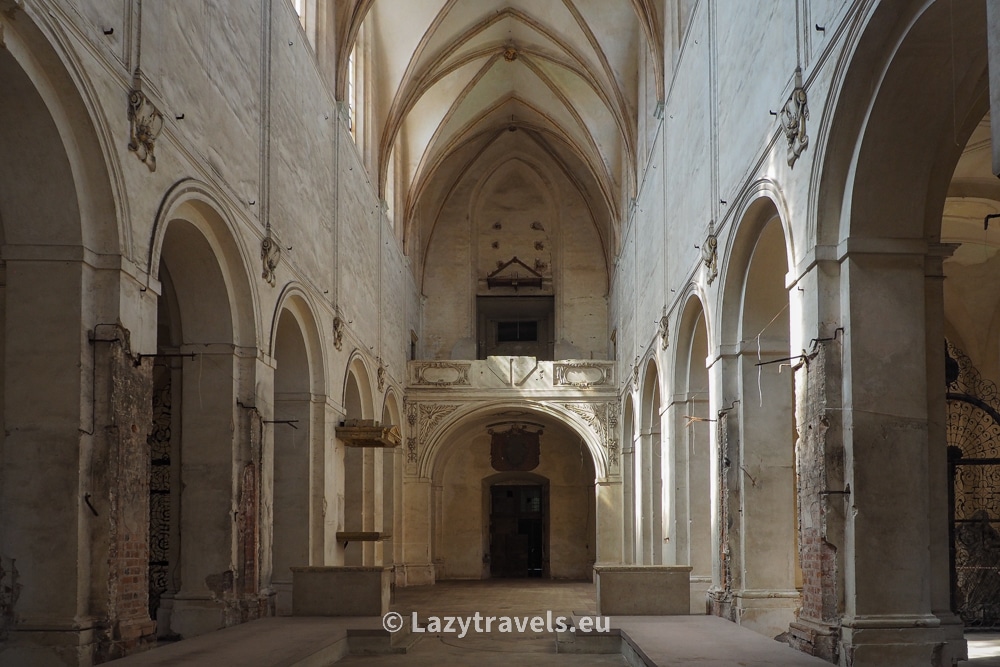
That space and what remains allow you to picture just how magnificent the place is. Even now, you can still find:
- The tombstones in front of the former altar,
- The mighty wooden frame from the painting, which by some miracle was not burned or stolen
- A metal and richly decorated partition that once separated the cloistered part of the church from the one open to the public
- In the basement, impossible to visit rest in sarcophagi the mummies of the Piasts, abbots and a brilliant artist (Willmann) buried here. They rest again, after all, the Soviet hoarders took them out of the sarcophagi after the war
- Ribbed vault
- Few decorations on the walls
Summer Refectory
When you visit the abbey, you’ll see the summer refectory at the end, which is a really special place. It’s where the monks would gather for meals, where they would read the Scriptures, and where everyone would be quiet. The monks would sit around the scripture reader, who would read verses in a whisper, forcing the others to be silent.

I have to admit that it’s hard to believe that this dining room looks more like a ballroom. The high windows let in plenty of light, and the polished floor reflects it, allowing you to see every detail. Take a look up at the ceiling, which was painted by Felix Scheffler. His painting is all about the feeding of the five thousand, which is a perfect theme for this place.

The decoration is completed by lovely medallions that can be seen under the ceiling, and which depict scenes from the lives of the founders of the Order, Saints Benedict and Bernard.
Soon, another place of exquisite beauty will be opened to the public: the Abbot’s Library. Well, that will give me a reason to visit Lubiaz and the local monastery again.
If you want to know more about the history of the monastery, as well as detailed descriptions of the decorations, take a look at this link. Site is in polish, but if you use google translate, you will be able to translate everything.
Tours, tickets, prices
- A ticket to the monastery in Lubiaz costs 25 PLN for a normal ticket and 20 PLN for a reduced ticket
- from April 1 to September 30 from 9:00 am to 6:00 pm
- from October 1 to March 31 from 10:00-15:00
- entry at every full hour
- visiting only with a guide
- it is not possible to pay by card, so take cash with you
- permission to take pictures costs 5zl. You pay separately for your camera and cell phone
Access to the monastery in Lubiaz
I’m afraid the only sensible way to get to the monastery and Lubiaz is by car, but don’t worry – there’s a big car park right next to the monastery. I had a look online for public transport options, but I couldn’t find anything. I did find some bus connections to Wolow, Brzeg Dolny and Wroclaw, but I couldn’t find any information about these.
So I’m afraid I can’t tell you about bus or train connections.There’s also no train station in Lubiaz, so you’ll need to walk at least 8 kilometres from the nearest one.