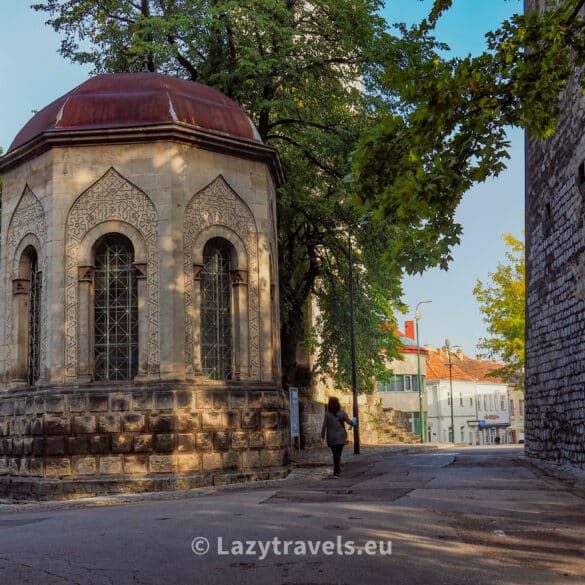
Chelmno is an ideal medieval city. The Teutonic Knights wanted to establish their capital here for a long time. Therefore, the city they designed was thought out in every possible detail. With wide streets, squares and access to the sun, it defies a medieval city! But about that in a moment.
When I arrived in Chelmno by bus from Toruń, the weather was poor and it was raining. I used the time to visit the local tourist information and get information about the city’s tourist attractions. After all, who if not them would know what to see in Chelmno? And indeed, I was armed with a tourist brochure and signed up for a free guided tour organized by the city for the next day. It is held every Sunday during the tourist season. Take advantage if you happen to be in town, because such a free initiative by the city is something to be appreciated.
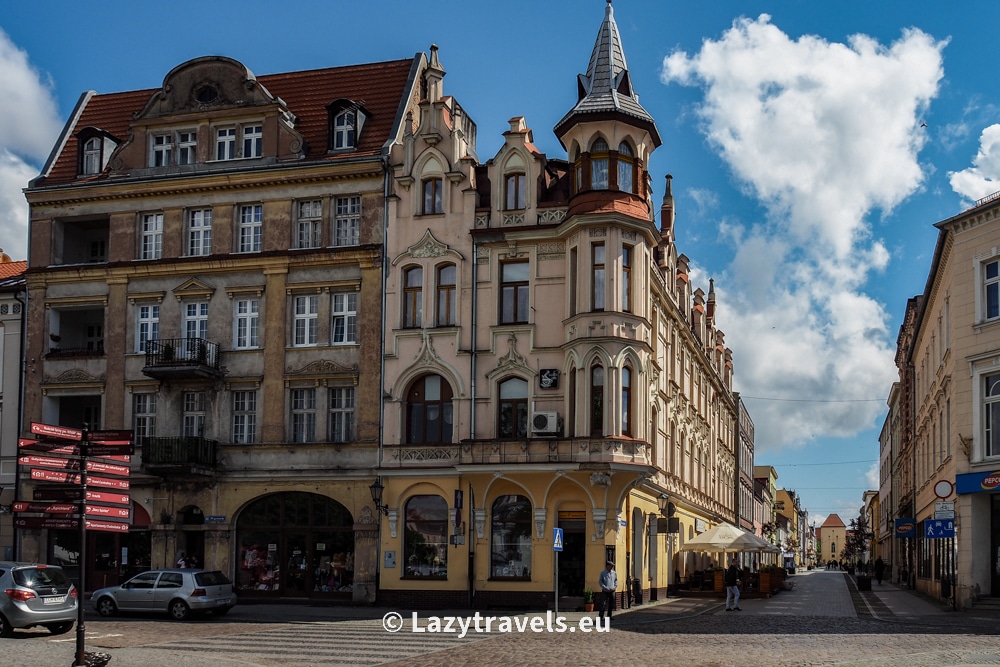
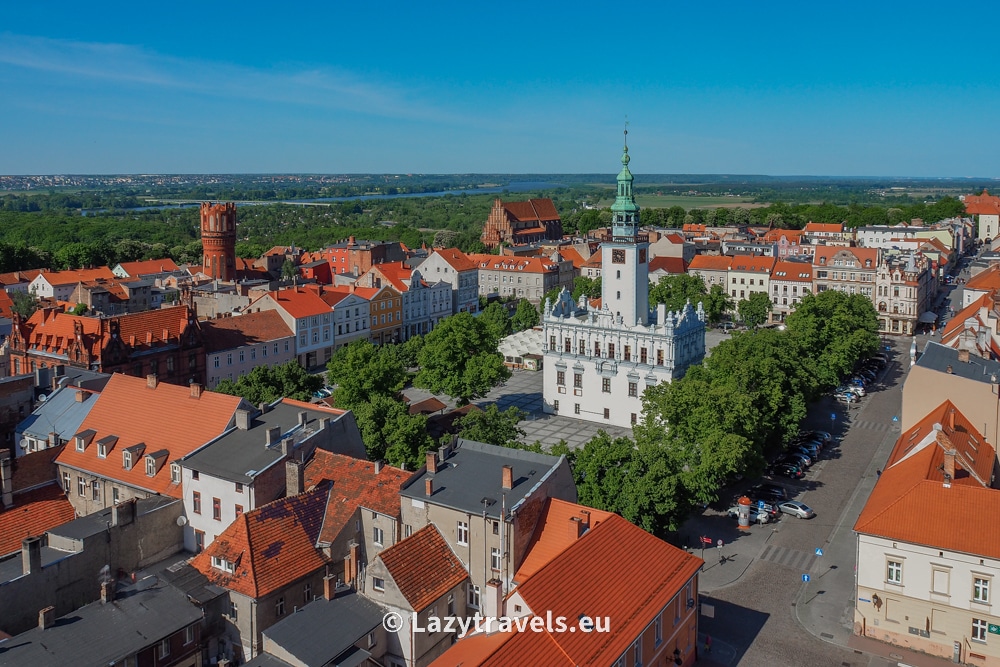
Chelmno town hall and market square
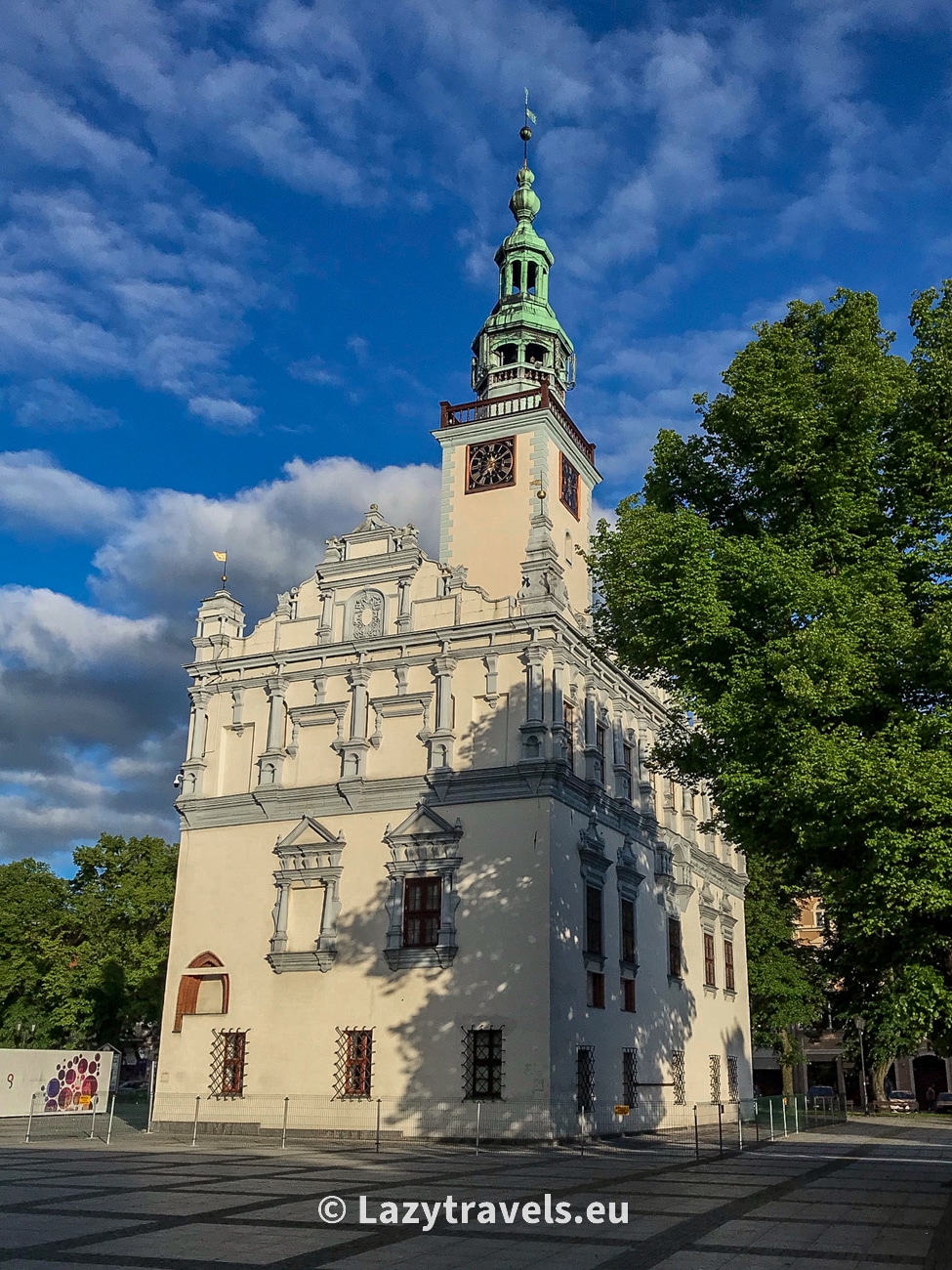
And since the rain was still drizzling, not wanting to waste time, I went to explore the interior of the town hall, which houses the museum. The current body of the building was built between 1567 and 1572 and is in the late Renaissance style. Importantly: it was not built from scratch, but is a reconstruction of the medieval town hall that previously existed here.
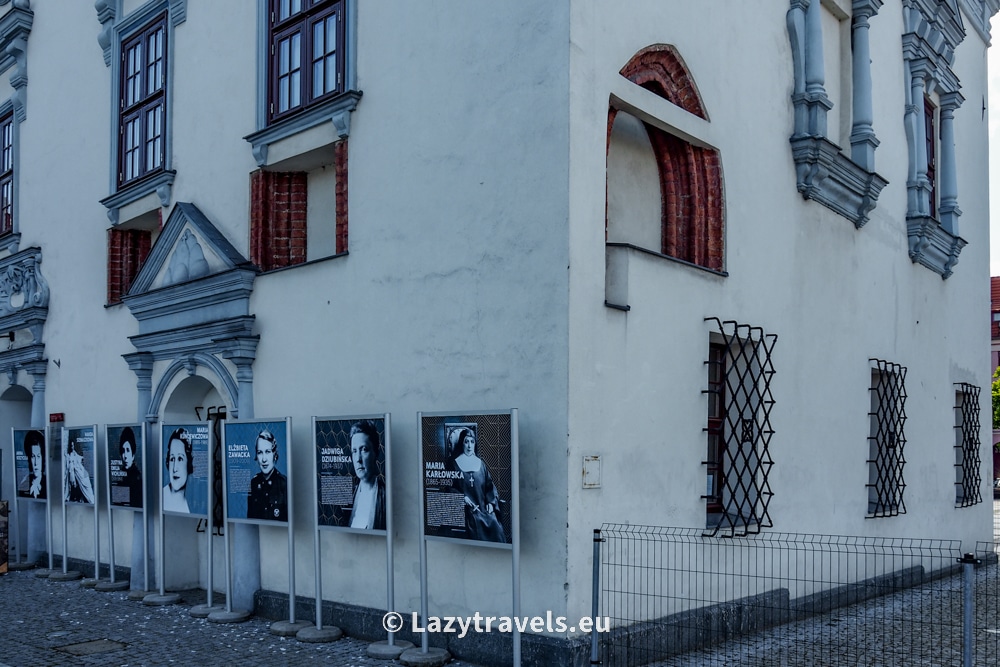
The traces of the reconstruction have now been uncovered so that you can take a look at them. You can see them when you go outside and look under the lower row of windows. And being outside, it’s worth going to the west side of the building and there you can see the pattern of the Chelmno rod. You will learn about what it is in the following paragraphs.
Today, after seven centuries of serving as the heart of the city, the town hall is home to the Museum of Chelmno Land and the aforementioned tourist information. However, I invite you to continue exploring the interior of the museum. On the first floor it is worth looking into the wedding hall, where you can see a beautiful Danzig closet and furniture maintained in the same style.
And when you enter the second floor, you will get acquainted with the history of the city. Particularly noteworthy here is the courtroom, covered with beautiful paintings. Take a look at it, because, for example, to the warning of the court, one of the scenes depicts Solomon’s solution.
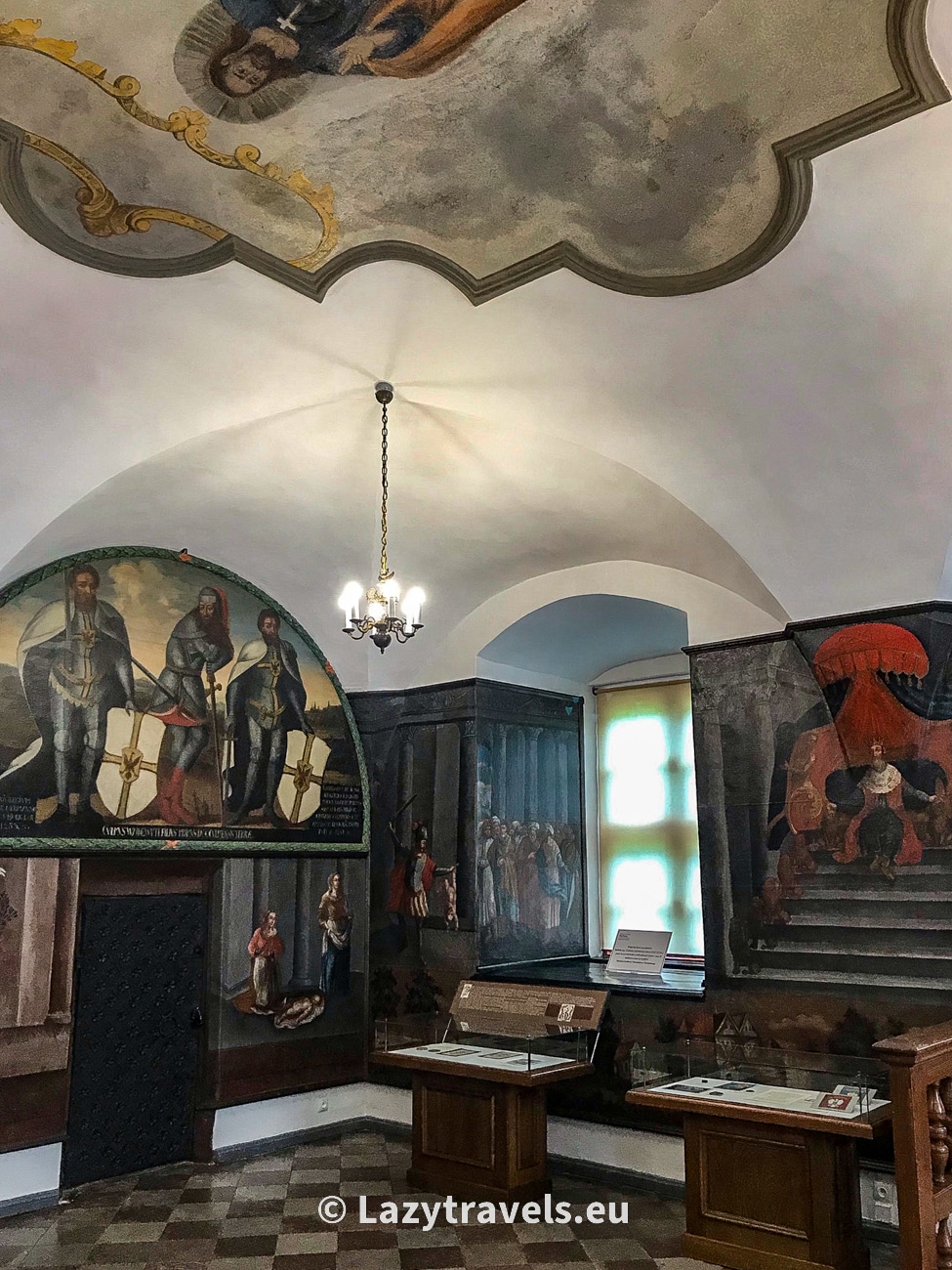
In the museum we will also learn what the Chelmno privilege was, as well as something about the city’s most famous citizens. One of them is the prominent professor of surgery at the turn of the 19th and 20th centuries, Ludwik Rydygier.
And if you are curious what the first city hall, erected around 1298, was like, it was lower than the current one and twice as small. It had two stories and a tower. It contained the city scales, a treasury and a representative chamber for councilors. It was modest, but sufficient…. Until the expansion started in 1567.
Town square
Chelm’s market square still remembers the Teutonic Knights. It was they who gave it its shape and purpose. This is where the life of the city took place and all roads crossed, all residents. You could drop in for shopping, but also for a show when a villain was punished under the pillory.
The market is 111 by 156 meters, or an area of about 1.5 hectares. From its earliest days its frontages were built up with merchants’ tenements. In turn, on the square stood merchants’ benches and stalls from which trade was conducted. In addition, there was also a merchant’s house, the aforementioned pillory and a fire pool.
Today the square is also alive, but this time thanks to the pubs located here, which may not boast of beauty, but attract tourists and local people. Here one sits down to drink beer or coffee, as well as eat lunch. Or just buy an ice cream and move on. Alternatively, sit under a tree, because fortunately in Chelmno the market square has not been cut down and on a hot day you can hide in the shade. From this vantage point, you can watch the children chasing each other around the fountain, or take part in some kind of festivities happening on the market square floor. When I visited Chelmno, firefighters were presenting their firefighting and rescue equipment here.
Chelmno: the perfect city, before it was fashionable!
If we think of the so-called ideal city, Zamość, not Chelmno, probably comes to mind. And it’s good that it comes to us, but it’s not that time and place. Well, several hundred years before the founding of what is probably the most famous architectural establishment in Poland, monks of the Order of the Blessed Virgin Mary of the German House sat down at the “drawing boards” and sketched out their new capital. Since they were founding it on the so-called “raw root,” they could do anything. This is how one of the most beautiful medieval cities, built in the Gothic style, came into being.
Chelmno was supposed to be a comfortable city to live in. Therefore, in accordance with the Teutonic, orderly spirit, the city was located under a new law. Chelmno law, about which in a moment. The most important thing for the appearance of the city to this day became the division of the city into orderly quarters. For this purpose, a new measure was used, the so-called Chełmno rod. The bar was about 4.35 meters long. Each street had a width of two and a half Chelmian rods. In turn, buildings began to be erected in squares with side lengths of two Chelmese ropes. A Chelm string was 10 rods long.
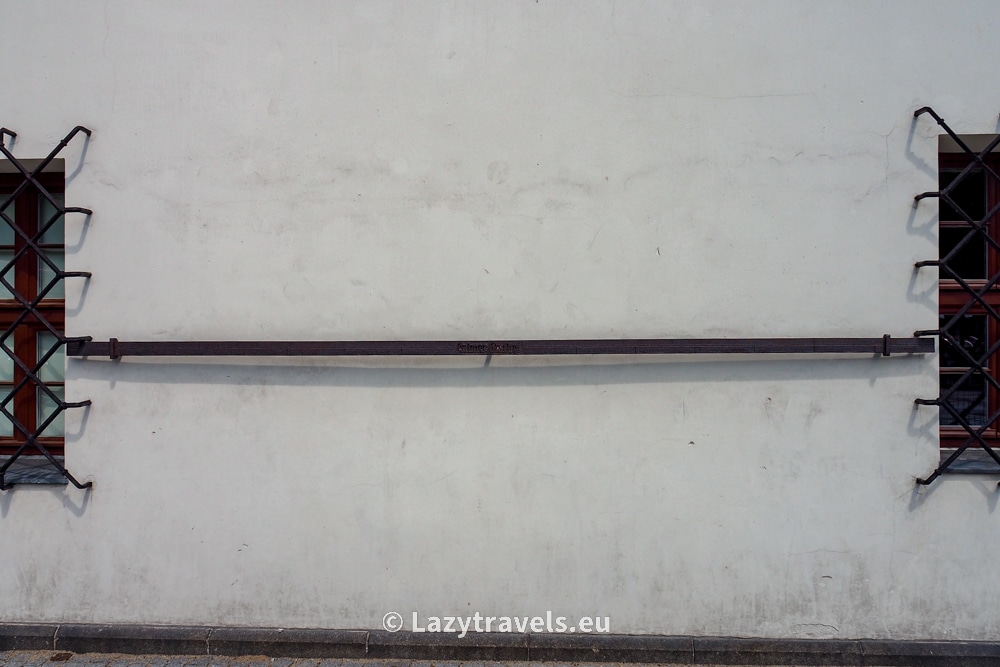
Today, the Chełmno rope pattern hangs on the wall on the west side of the city hall. As rumor has it, the rod standard once hung on the wall of the nearby parish, and was only moved in the late 19th century.
Today, admittedly, it is impossible to approach it, as it is fenced off from visitors by a fence. The town hall had begun to crumble and city officials, out of concern for tourists, fenced it off.
Churches of Chelmno
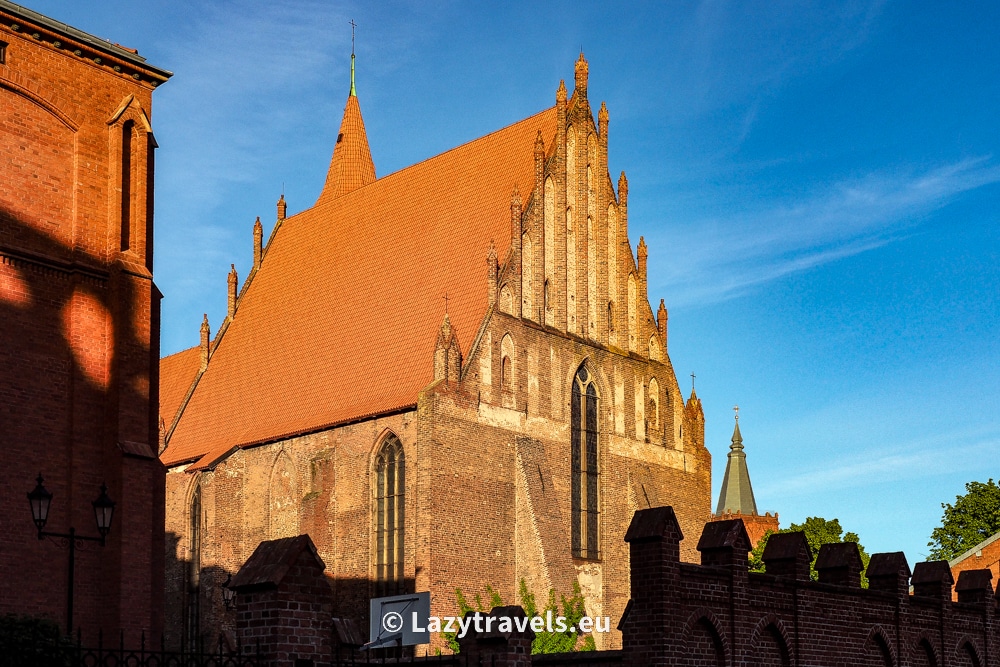
Chelmno at the time of its greatest splendor, i.e. in the 14th century, built as many as seven churches within the city walls! This is a truly impressive number for a city of this size and the enormity of the buildings built! And if we add that at the same time the massive city walls are being built, we can imagine how rich the city must have been, able to afford such an expense, in such a short time! Today, admittedly, most of the interiors are empty, but the vaults are still impressive, and at sunset the temple walls are quintessential brick Gothic. They mesmerize with color!
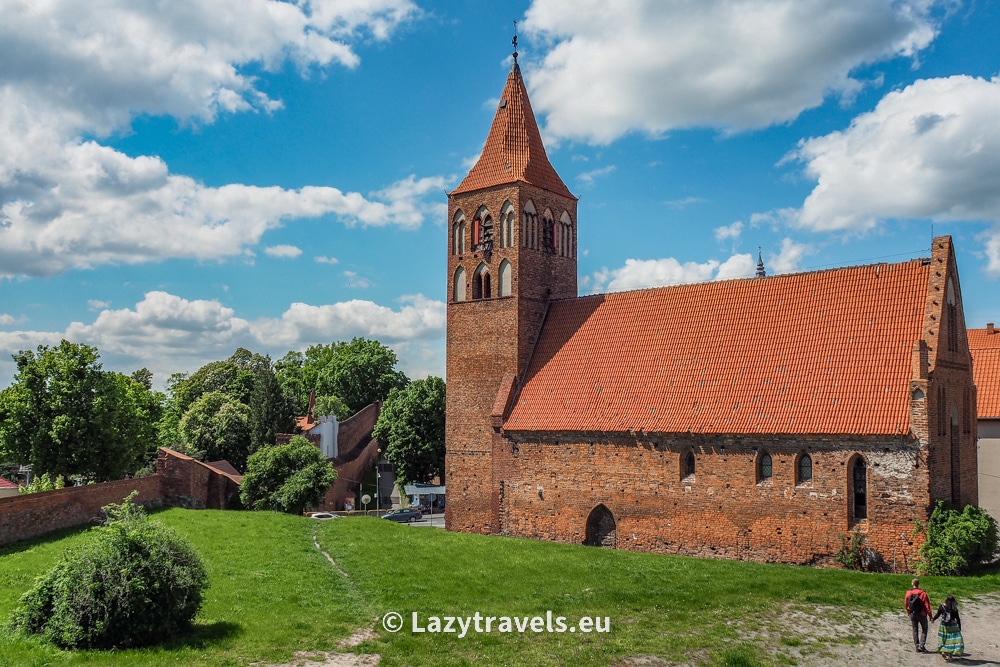
The Fara – this is where the deer predicts the weather!
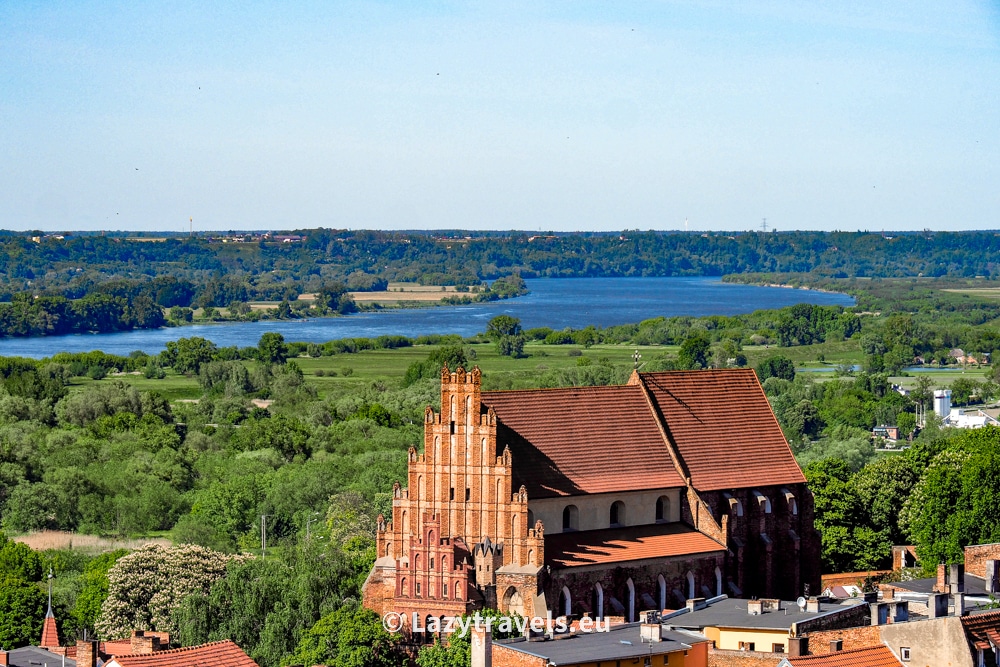
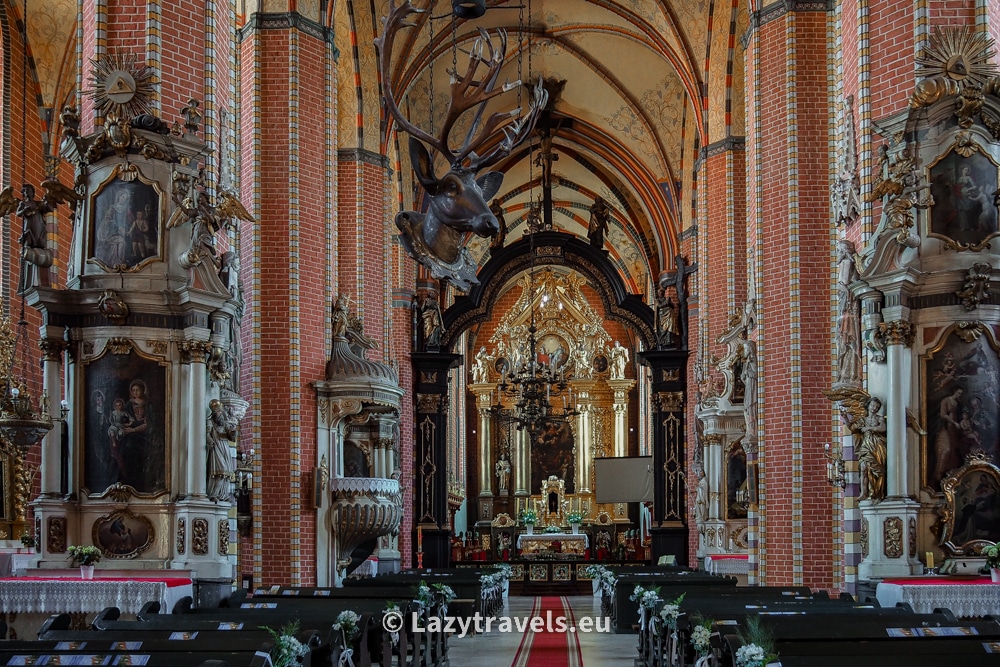
The largest temple of Chelmno is the Fara, or Church of the Assumption of the Blessed Virgin Mary. The temple was erected at an express pace, as it was built between 1280 and 1320. Importantly, it is one of the largest buildings in the brick Gothic style. The main nave is 18 meters high, and the only completed tower rises to a height of 60 meters. There was not enough money to complete the second one, although legend has it that it collapsed because the masons, having delayed construction, started working on Sunday. Which didn’t please God…
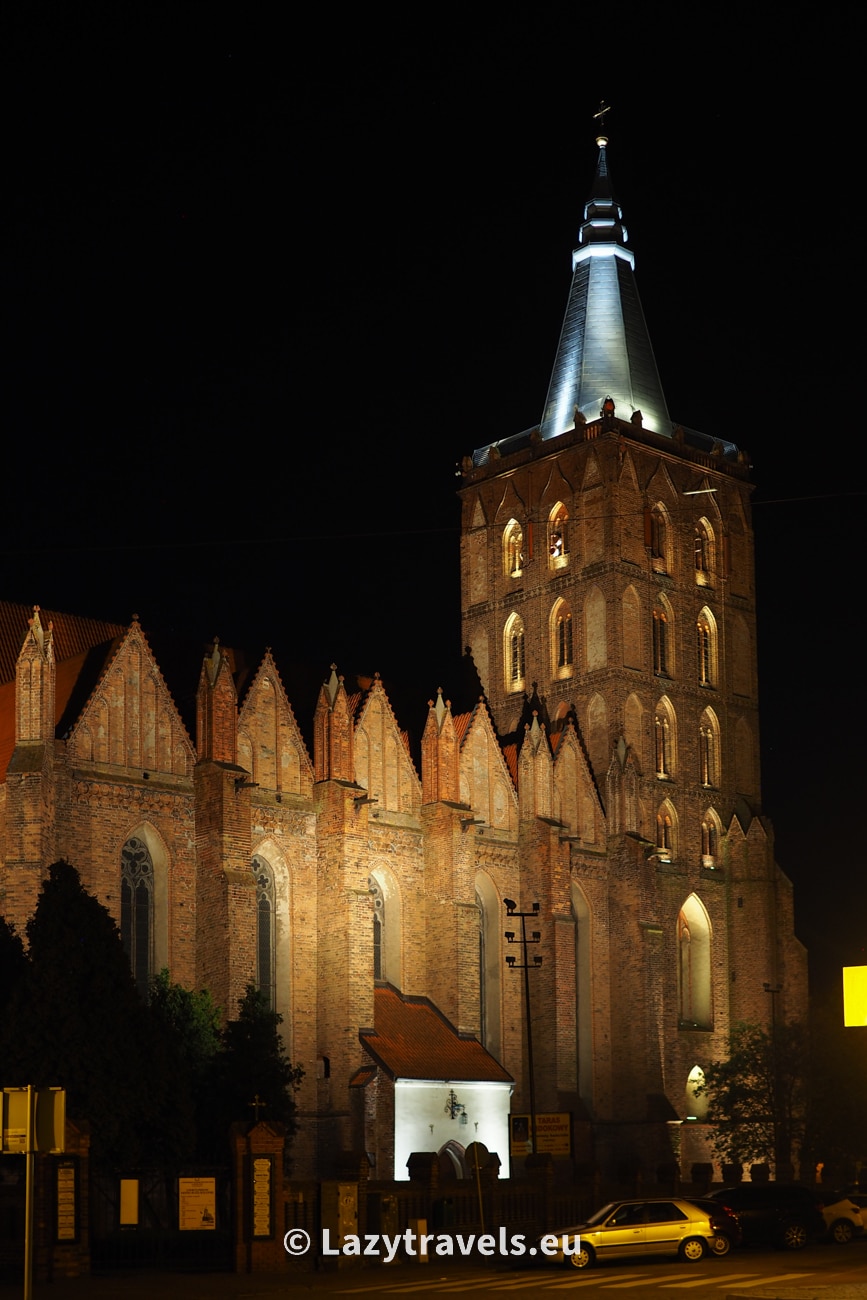
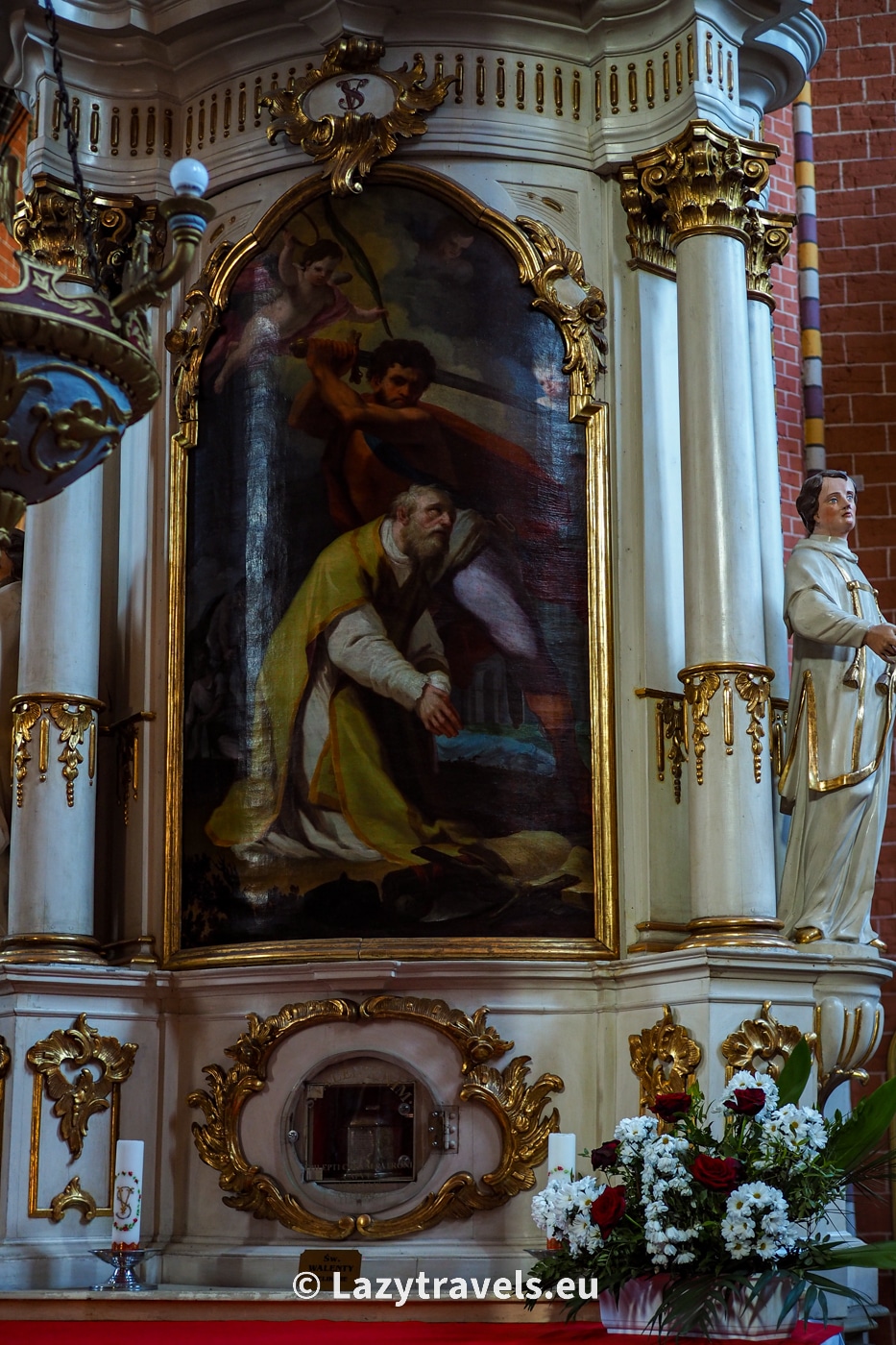
As for the interior, forgive me, but I do not undertake to describe it, all because I am simply not an expert in sacred art. What impresses me is the interior space. Impressive work of the old medieval masters. And if you add to this the rich furnishings that have accumulated over the centuries, being an art critic, you can spend a long time here. However, today the places that gather the most people are the miraculous image of Our Lady of Sorrows of Chelmno and the relics of St. Valentine. If you are looking for relics, pay attention to the painting, depicting the beheading of a man. This is the very place.
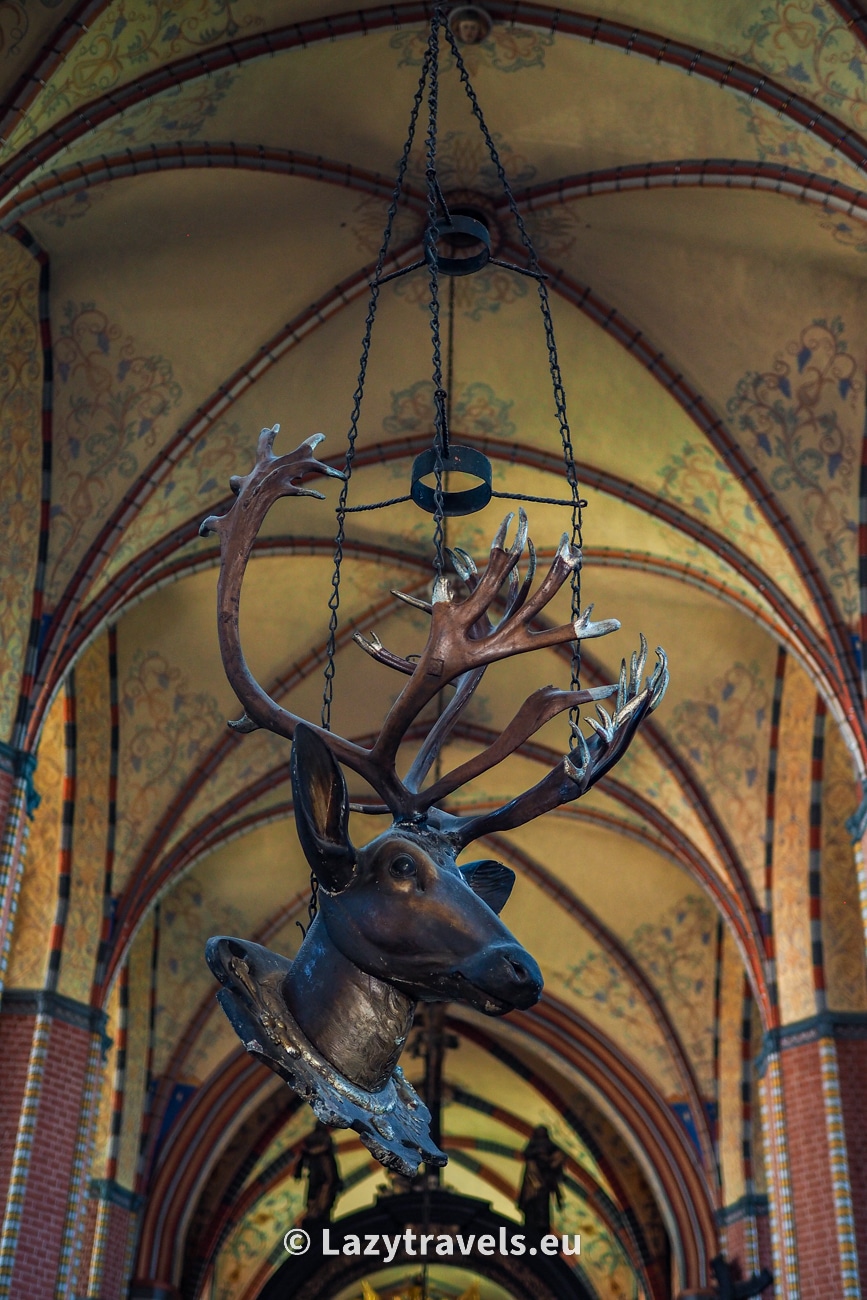
And the attention of non-believers is drawn to the deer’s head hanging at the entrance to the nave. This specific hygrometer, hung on a hemp rope, predicts the weather. If the head faces the door, it will rain. If toward the altar, it promises good, sunny weather!
Panorama of Chelmno from the church tower
While inside, don’t forget to buy a ticket (5zl normal and 3zl concession) to the church tower. It is from there that you can enjoy a beautiful view of Chelmno. From here you can see the old part of the city divided into quarters as if on your hand. The Teutonic Knights really had their heads on straight. As a matter of interest, I will also say that it is from here that you can enjoy the most beautiful view in the world. Swiecie is simply a town located on the other side of the Vistula River. There was also a Teutonic castle there, and if you have a good lens, you can easily spot it.
Before climbing the tower, it is worth listening to see if anyone is just coming down from the tower. The winding corridor is so narrow that it is practically impossible for two people to pass each other. Fortunately, such an inconvenience is only in the initial section of the tower, in the higher parts you climb the wooden stairs and it is easy to spot someone coming from the opposite direction.
The monastery complex of the Sisters of Mercy in Chelmno
Over the centuries it has borne various names. At first it was a monastery of Cistercian nuns, and after they changed the monastic rule, it became a monastery of Benedictine nuns. Today it is the headquarters of the Sisters of Charity.
Unfortunately, at the time I visited the attractions of Chelmno, the monastery was still closed to the public. Therefore, I did not have the opportunity to see the interior of the church and the treasury. I was left with only viewing the exterior of the building. All because of the coronavirus outbreak and the closure of the interior to tourists due to the safety of the nuns staying there.
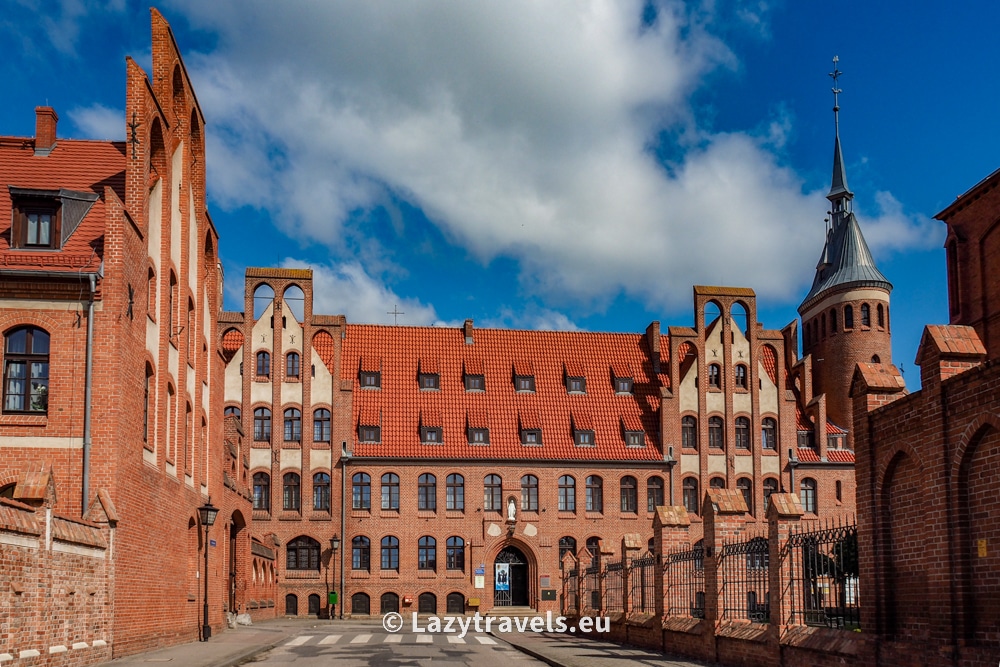
And the history of this place is fascinating, because the Cistercian monastery was founded in 1266. The monastery grows in strength, impressive buildings are built thanks to endowments and donations. Meanwhile, the monastic rule changes and there are no longer Cistercians, but Benedictines. The Reformation results in only a few nuns living in the monastery. Revival is brought by the appearance of the charismatic Sister Magdalena Mortenska. She reforms the order and it experiences a revival.
New sisters appear, and Rev. Mortenska is soon subject to convents throughout Poland! And what did she introduce that was interesting? For example, schools for girls began to be run at the convents. Of course, not those from the lower social classes, but it’s still a change, because until now women were deprived of opportunities for education.
Other churches
The other churches are not as spectacular as those mentioned above, but they will still impress you. If not because of the interior (often already decayed), then certainly because of the monumental exterior facades.
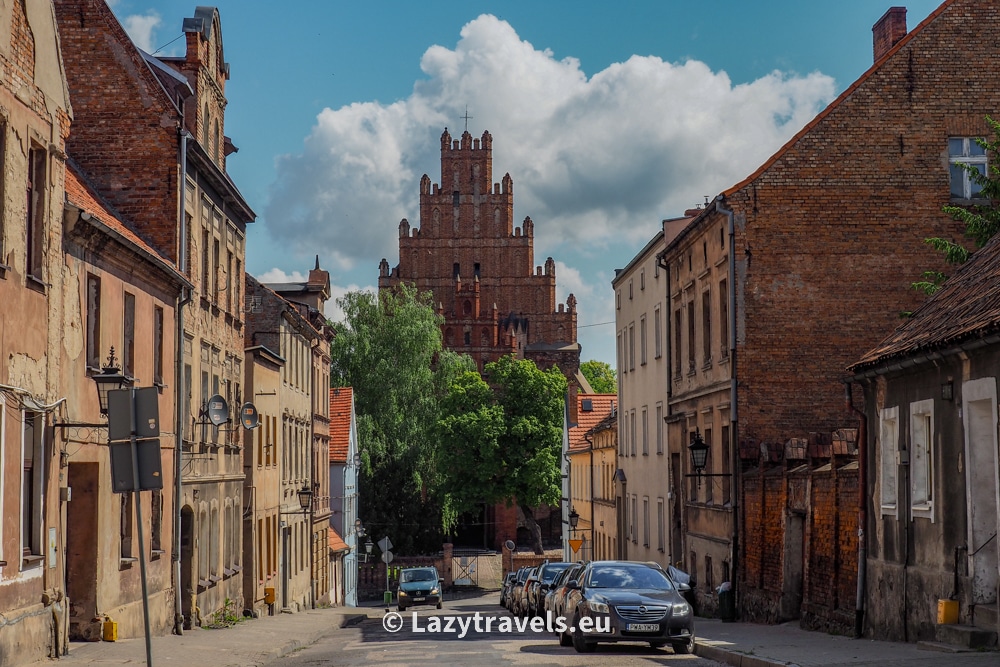
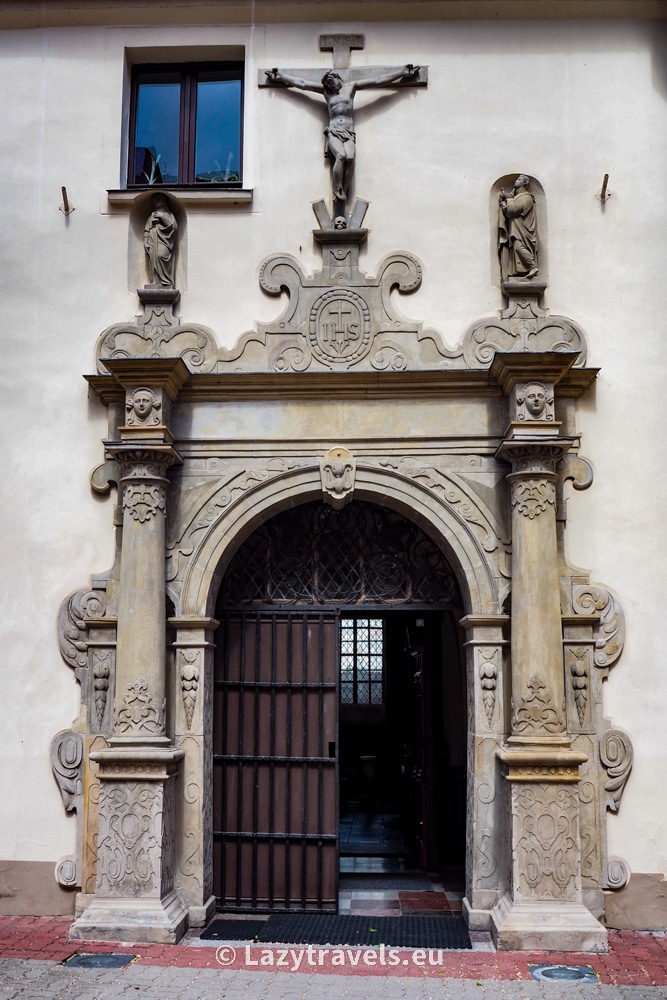
Thus, for example, the Roman Catholic Church of St. Peter and St. Paul has a less spectacular interior, but the exterior is still impressive. Especially the façade, on which, if the guide is to be believed, was based the rebuilt Warsaw Cathedral in the Old Town. In fact, as I compare, the resemblance is apparent at first glance. And is it worth going inside! By all means! Yet how!
Because, after all, on the walls are preserved medieval polychromes, with which the church was once probably covered in full.
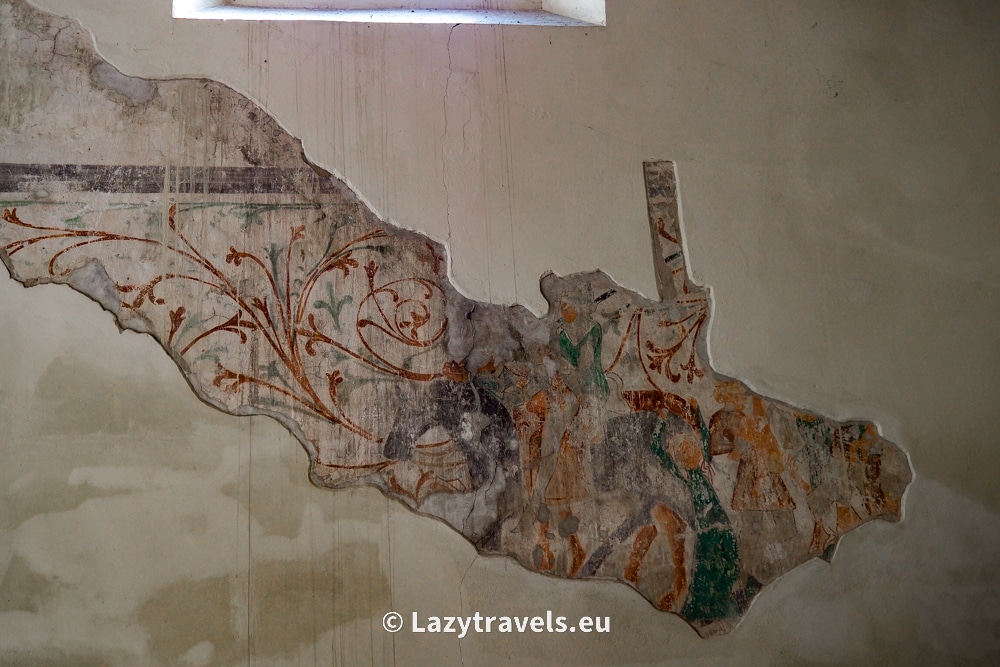
The same is true of the Church of the Holy Spirit. Not much remains inside. Even the roof is concrete and lined on the inside with some boards. In turn, a few symbols and a barely visible fresco remain on the walls. Not much for a former church that housed a hospital. Of course, hospital is a rather conventional name. Admittedly, the Teutonic Knights had it in their monastic rule that they would heal the poor, but the hospital was a place where one died closer to God and in less suffering, as pain was relieved with herbs. Today, unfortunately, nothing remains of the hospital buildings, but the brick block of the former temple is impressive.
Defensive walls of Chelmno
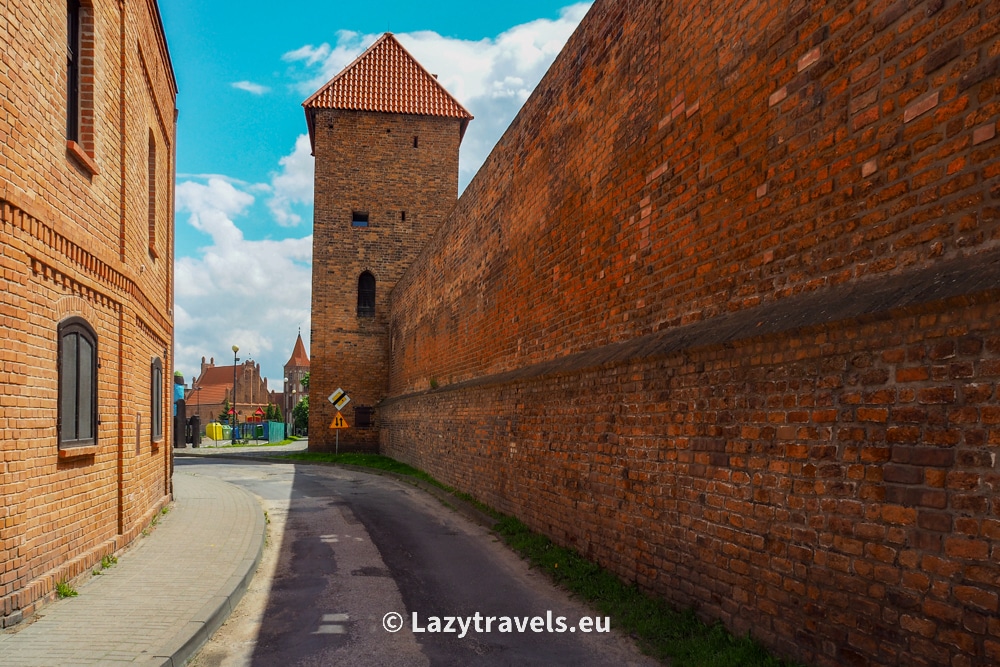
Chelmno’s defensive walls are now 2270 meters long, which is about 90% of the original length. So, as you can see, they have survived to the present day almost completely. The entrance to the city used to be made possible by 7 gates, of which only 2 have survived to this day: the Grudziądz Gate (leading, of course, to Grudziądz) and the Merseburg Gate, the others having been demolished in the 18th century.
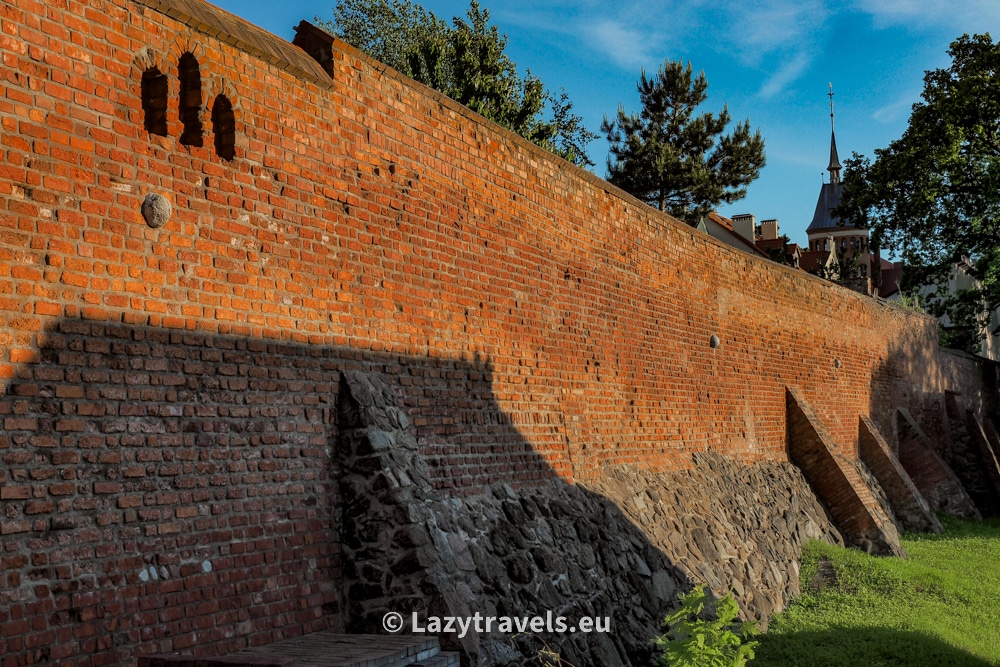
The defensive walls began to be built in the 13th century – they are brick, but the base is in every case stone. You can’t always see it because of the tall grass, but if you look carefully, you’ll definitely spot the stones. Originally the walls were relatively low, so in 1563 they were raised. You can see this perfectly by looking at the upper parts. The colors of the bricks filling the former blanks are different. The lighter one is an addition from the 16th century.
It’s worth taking a walk along the walls, because first of all, you’ll see the remains of the former moat in the Old Planty area. Yes, that’s the pleasant park! Secondly, near Rybaki Street, stone cannonballs were incorporated into the walls. It is worth adding here that at night part of the walls are picturesquely illuminated, so it is worth taking a romantic walk here.
Chelmno. A brief history
As I have already written, Chelmno was to become the capital of the emerging Teutonic state. And although the capital was finally located in Malbork, Chelmno was thriving! Little did it take, and a university would have been established here as well. But let’s go back to the beginning.
The first Chelmno lay somewhere else entirely! Well, the Piasts, near the present village of Kaldus, built a fortified town, so powerful and important that they even built a basilica there! And if we add that this happened during the reign of Mieszko II, it is really impressive, because it was one of the first and most important Polish cities and Polish statehood began there.
Golden years of Chelmno
After Conrad of Mazovia in 1226 meant well, but unwisely did wrong (for himself and Poland) and invited the Order of the Blessed Virgin Mary of the German House, or so-called Teutonic Knights, to the Chelmno Land. In turn, they first located themselves and their castle near the present-day village of Starogrod. And precisely because there was a castle in Starogrod, the Teutonic Knights did not build a massive castle on the site of the new location of Chelmno.
It would have been devilishly expensive, and they were reasonable. Of course, the new city was powerfully fortified with defensive walls, which have largely survived to this day. It is also worth mentioning here that Chelmno was built with reference to symbols, for what else but this is the construction of 7 city gates? It’s a reference directly to Jerusalem.
The Teutonic Knights weren’t so blind and did everything to attract new settlers to Chelmno. However, they did not mean just anyone, but wealthy and enterprising people. Therefore, as a curiosity, I can tell you that residents were allowed to hunt in the surrounding forests. In return, they only had to hand over the right shoulder of the game they hunted, they could fish in the Vistula (but for their own use), and if a river flowed through their land, they could erect a mill on it. Well, and above all, they guaranteed property rights! Not only in the male line, but women could also inherit. These and other privileges made the city powerful in the Middle Ages, as it had a population of about 4,000. Let the 7 churches built attest to the fact that it was rich!
And what was Chelmno’s greatest asset? It was the Vistula River, which flowed right next to the city at the time. Today it is about a kilometer and a half away from the city, but back then Chelmno had a large river port, thanks to which the city belonged to the then powerful trade association, the Hanseatic League!
The crowning achievement of importance was that the city also applied to Pope Urban VI for a bull of February 9, 1386, which allowed the opening of a university in Chelmno. The political situation, however, meant that the Teutonic Knights had more important worries on their minds than founding a university.
Twilight of the city’s power
For a city to develop, it must have a powerful administrator and a strong state organism within which it exists. Chelmno, on the other hand, became a city on the border of two powers. The Republic of Poland on one side, and the Teutonic state on the other. As we know from history, conflicts between the Poles and the Teutonic Knights were inevitable. Also for trade, Torun was becoming much more important, which affected the income of the city’s coffers.
After the Battle of Grunwald, the city officials concluded that they would be better off with the Polish king. However, the provisions of the First Peace of Torun assigned Chelmno to the Teutonic Knights. However, the hard-line policy of the monastic state provoked great resistance from the townspeople, who looked much more favorably on Poland. The Commonwealth provided much greater freedoms, and allowed them to get rich by brokering goods from deep within the vast country. In 1454 Chelmno joined the uprising against the Order and, as a result of the provisions of the Second Peace of Torun, became part of the Kingdom of Poland. The city again experienced growth.
However, it is interrupted by the invasion of the Swedes. The city is repeatedly invaded, the inhabitants are forced to pay ransom. Pestilence rages in the city, claiming almost a third of the population. And finally, the year 1772 occurs, as a result of the first partition of Poland, Chelmno becomes part of the Kingdom of Prussia. And this is the impetus for another period of development of the city.
Chelmno returned to Poland only as a result of the Treaty of Versailles – it becomes so in 1920! It is still worth noting that the warfare of the last great war (1939-1945) fortunately does not destroy the city. It is, of course, about buildings, because the murders of the Polish population continue at their best….
A beautiful view of Chelmno
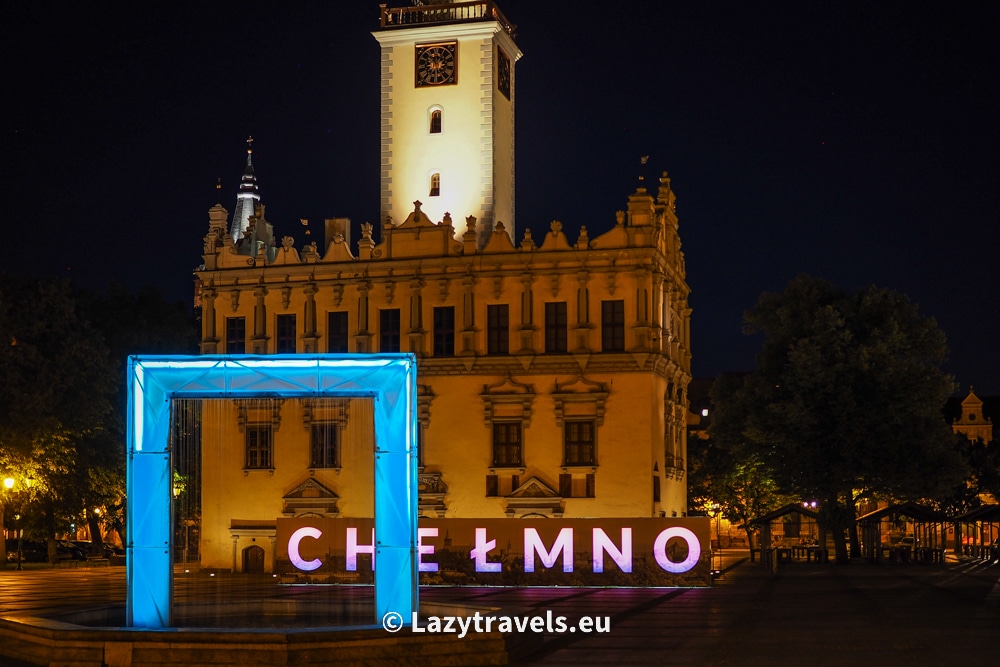
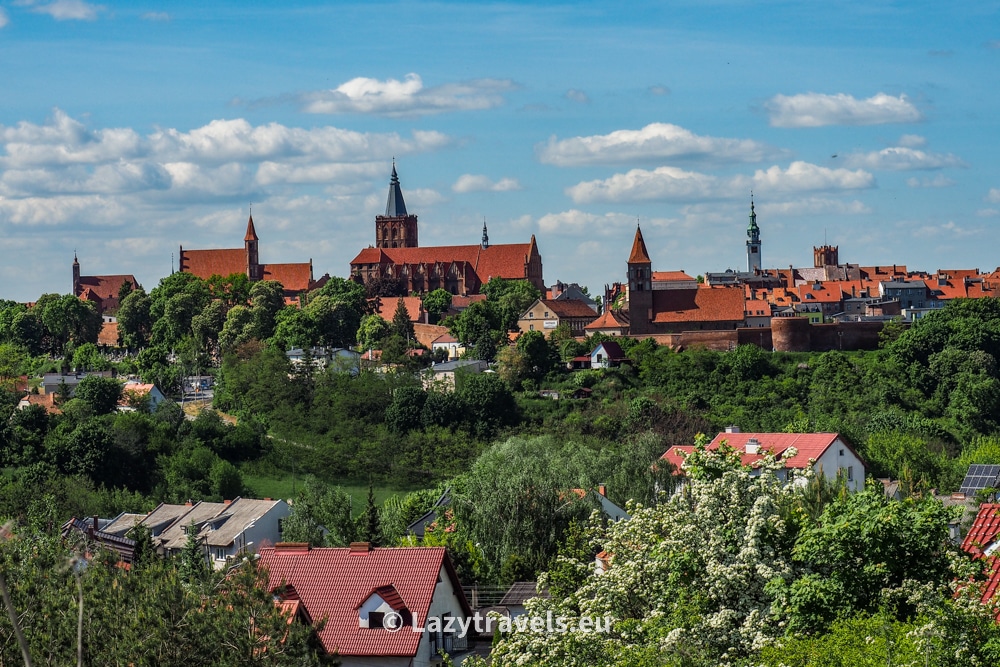
Standing in front of the city hall, I saw a large sign “Chelmno” against the background of a beautiful panorama of the city. Looking at the alignment of the historic roofs of the buildings, I came to the conclusion that this is the view from the south side of the city. So, thinking little, I simply went to the outskirts of Chelmno to take a similar photo. Well, I may not have ended up in exactly the same place, but I admit that the panorama of the city I managed to take is also very pleasing to me. If you want to take a similar photo go or drive to Zurawia Street and then Dworzyska Estates.
Chelmno. The city of lovers and… madman
Chelmno promotes itself as the “City of lovers.” All because of the fact that in the local parish church rest the fragments of the mortal remains of Saint Valentine. And this one, as is widely known, is now the patron saint of lovers. The famous Valentine’s Day is in his honor. Only the snag is that the patronage of lovers is a creation of recent years, and originally Saint Valentine was the patron saint of the mentally unbalanced and epileptics. Therefore, one might as well assume that Chelmno could be called the “City of Madmen” 😉 I’m simplifying, of course. But isn’t falling in love a kind of madness? 😉 How many stupid things people have done for love!
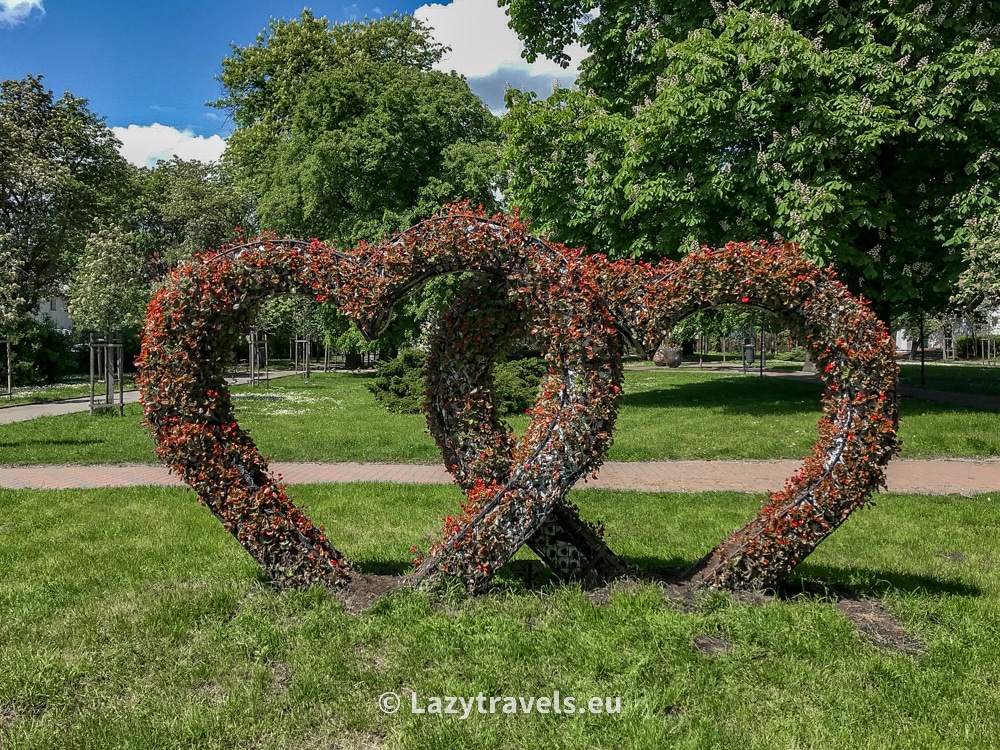
Chelmno, however, chose the more optimistic option, and that’s why in several places in the city you will come across benches for lovers, as well as hearts formed from plants. All places are photographed in excessive numbers by visitors.
Teutonic castles miniature park
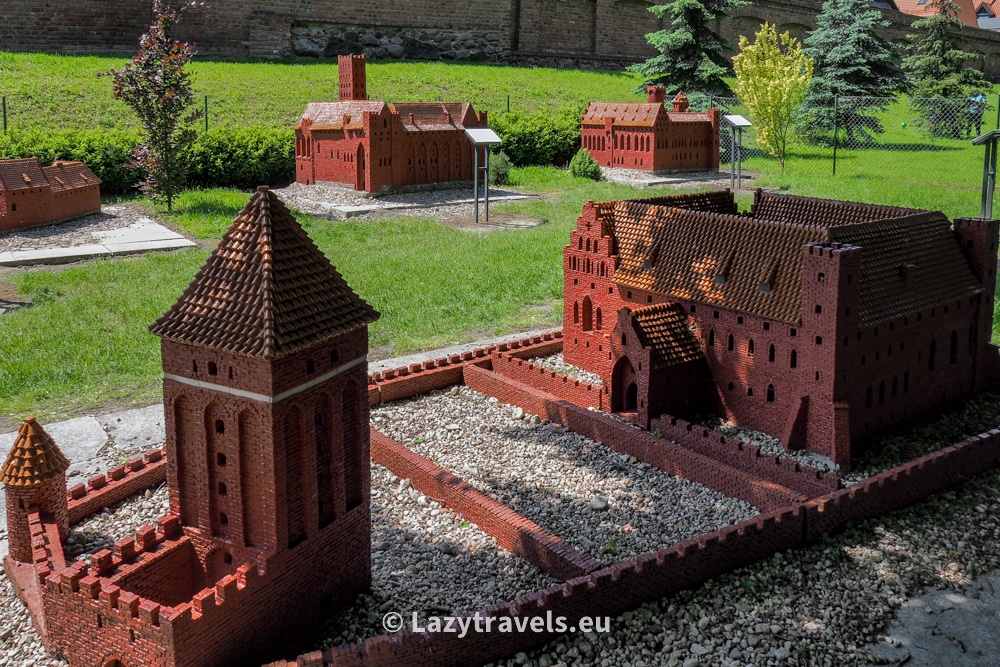
Right next to a fragment of the former city walls is a very interesting miniature park. Here, behind an undersized fence, are miniatures of Teutonic castles built by knights with a black cross. If I remember correctly, there are 13 miniatures here. The mock-ups are made on a scale of 1:30 and thanks to them you can perfectly see how powerful these fortresses were. Of course, the Malbork stronghold leads the way here (there is a tall castle on the mock-up), but almost as powerful is the fortification from Radzyń Chełmiński.
Chelmno rights and Chelmno privilege
On December 28, in the year of our Lord 1233, the national grand master Hermann von Salza and the second national grand master Hermann Balk issued a foundation document for Chelmno and Torun. And this act of founding the city became a landmark legal act not only for the area, but also for the Republic of Poland (Rzeczpospolita) at that time.
The Teutonic Knights took all the best from European legislation. In the new legal document, they sought to regulate the political, economic and social life of the towns they founded. There was supposed to be order! People were to be able to get fairly rich, but also to expect the courts to stand on the side of justice. The Chełmno Rights, also known as the Chełmno Privilege, was supposed to encourage people to settle in the newly established city. Thus, for example, it introduced, among other things:
- inheritance for both men and women
- determined the right to mint a coin (Chełmno denar)
- exempted the Chelmno Land from customs duties
- its own system of measurements
- ownership of land was linked to knightly service
Of course, there were many variations of Chelmno Rights in subsequent years, but the reference point was one. This law was so good and flexible that 225 towns and 1364 villages were logged under its rules. Interesting fact: Warsaw was also located under Chelmno law. And let the fact that this law was good be proved by the fact that it was in force in Royal Prussia (in polish Prusy Królewskie) until the partitions of Poland in XVIII century.
Accommodation in Chelmno
Maybe the accommodation base of Chelmno is not particularly extensive, but it doesn’t have to be more so either. You can easily find accommodation in a four-star hotel, but also cheap accommodation without many stars, but comfortable and right by the old walls. And that’s where I stayed for two nights: the Hotelik hotel (for that’s its name) with a tasty breakfast every morning. If I were to return to Chelmno, I would definitely settle right here.
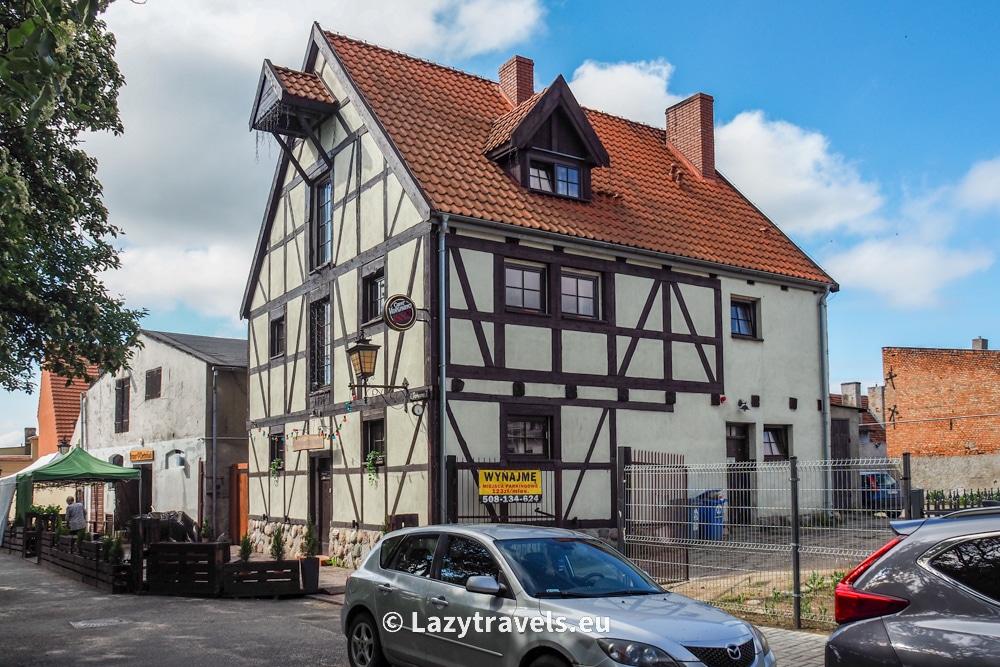
However, if you are looking for something more expensive and of a higher standard, choose the Chelmno Apartments in a renovated 17th century building.
A hotel option certainly worth considering is the Chelminski Inn. Spacious comfortable rooms in several standards to choose from.
Restaurants and where to drink coffee
After sightseeing or maybe even during, you are bound to get hungry, or at least I feel hungry once in a while and look for a good restaurant. In Chelmno, of course, you will find several tasty ones. I highly, but highly recommend a place that is about 600 meters from the Grudziadz Gate. The restaurant is called Bread and Salt, it is located in a building that can hardly be suspected of being a restaurant, but it is a restaurant and they feed in it superbly. Also, the wait staff is of a good standard. It is worth saying that on the second day they remembered what I ate on the first day.
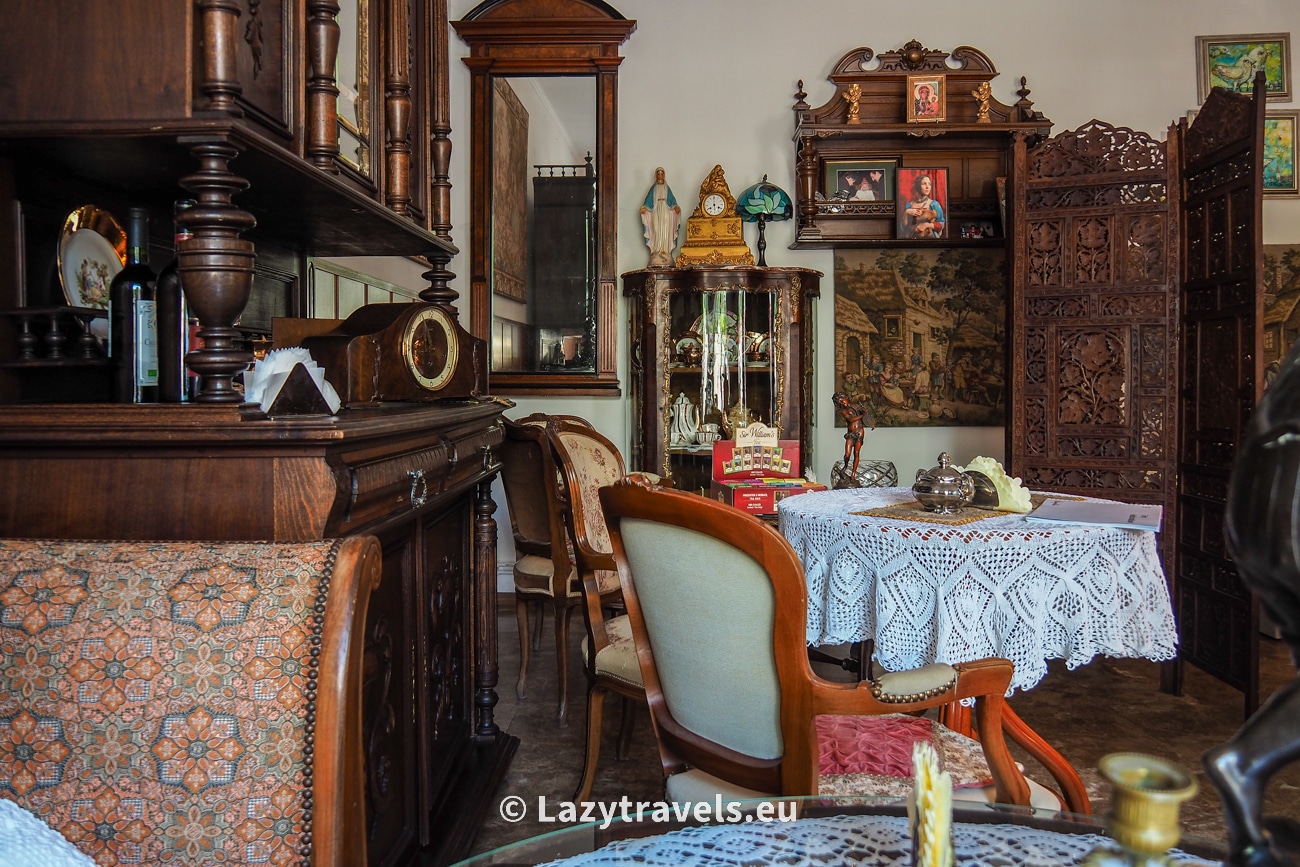
On the other hand, if you want to go for a good coffee with a pastry in Chelmno, I recommend the Staropolska Cafe. The decor is so atmospheric that you just want to sit there. Good coffee is served in beautiful cups, and a piece of cake in many a pastry shop would be split in two and sold that way. An excellent cafe, highly recommended!