

What can you say about Travnik, a city where you were surprised by a downpour? Is it possible to describe a city that you haven’t seen as much as you would like to? Something probably can, I’ll try….
Travnik is not a city for a full day of sightseeing and I knew it, before I came. I was already slowly returning from my trip around the Balkans and heading towards Banja Luka, from where I had a flight back home. Travnik, it’s not a big city and it’s easy to get everywhere on foot. I put this plan into action as soon, as I left my main luggage at the bus station. A slow stroll allows to not only enter the city, but also to gradually gain knowledge of its history.
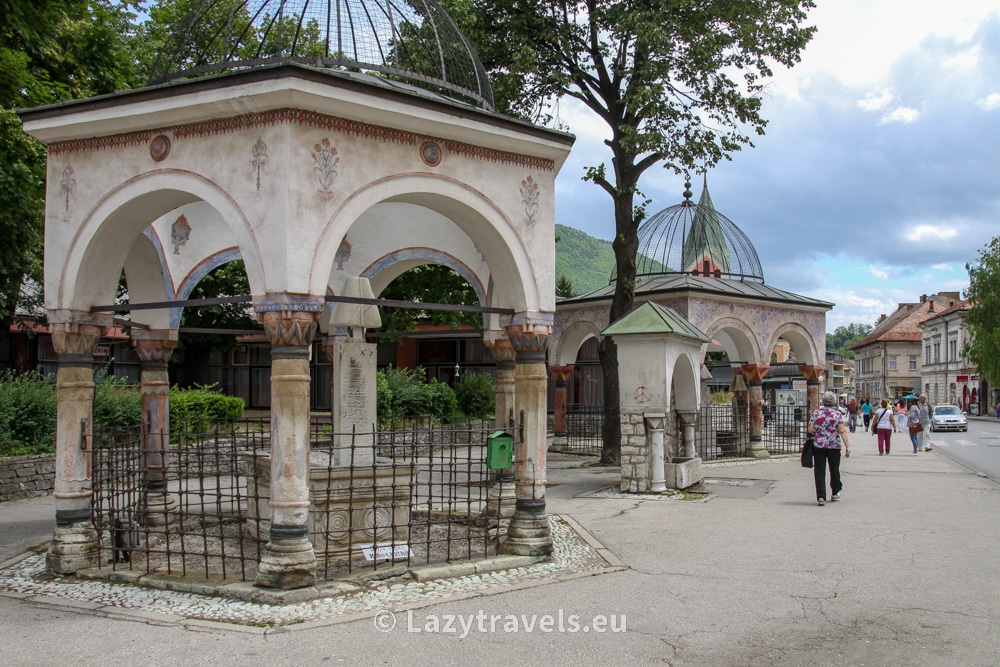
Just after leaving the station, I head east towards the older part of the city and immediately come across two old Ottoman tombs. These are remnants of the Turkish occupation of the area. I continue along Bosanska Street and observe the slow, lazy life of the small town. In the cafés, as is standard in the Balkans, people sit and discuss over cups of coffee. There is also a small crowd in the patisseries, because it is warm, so mothers with children buy ice cream. Not to be outdone, I pull out a few brands and buy two scoops.
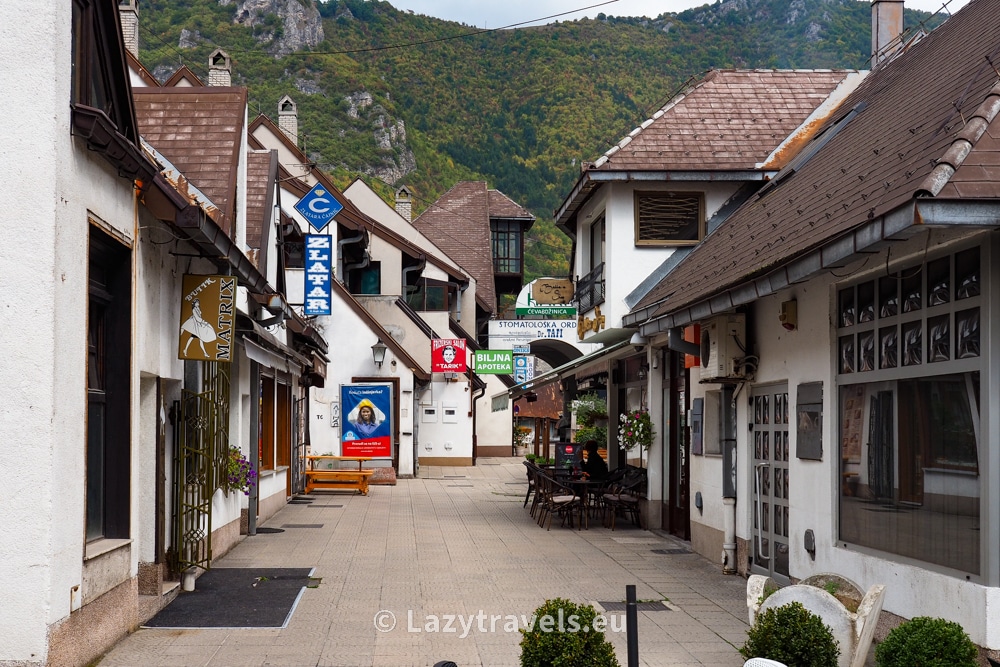
I focus my attention on a wafer and suddenly, out of the blue, I realise that this is almost the end of Travnik, that I have reached the end of the part that is of interest to tourists. Further on there is only the route to Sarajevo and…. Plava Woda, but I have a plan to go there at the very end of my visit in the city. Now I want to go to the castle.
Visiting the Travnik castle
Walking down a narrow street that creeps uphill, there is no car traffic at all, not even people. Which is perhaps not even strange, because after all they are probably at work. Although on the other hand it is strange that there are no children either. But… who would go to the castle there? After all, it’s been standing there for several centuries and will stand for a few more. The stones don’t erode that much, as evidenced by Angkor in Cambodia, for example, but that’s a different story.
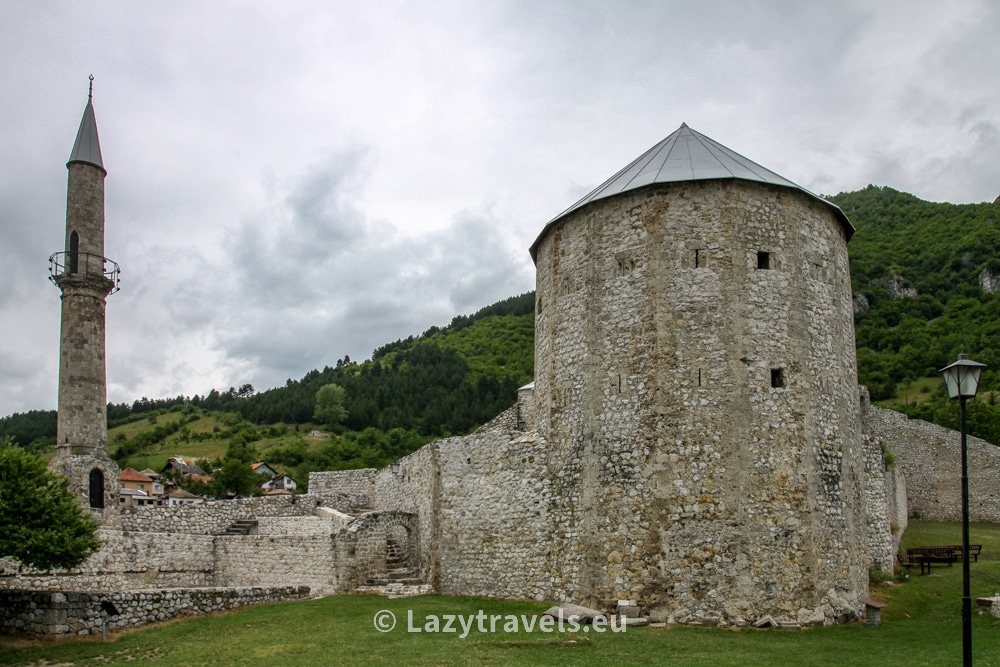
The one moment I remember most from all the climbing and viewing of the castle, was when my gaze drifted slightly to the left and I saw a large inscription on the grey wall: „Srebrenica will not be forgotten”. This inscription is like a mantra, it appears all over Bosnia. It is like a great reproach to the whole so-called western world (and especially to the Dutch) who stood by and watched the massacre of several thousand Bosniaks by the Serbs. And with these cloudy thoughts I turn to the castle.
It is large and stone, as castles often tend to be. At the entrance I buy a ticket for (the price is 2.5 KM for a normal ticket, discounted – 1.5 KM) and lo and behold, all these stones are mine alone, as it turns out I am the only tourist here. Yes, Travnik is not very popular, which is a shame. I peek into every nook and cranny, climb all the walls and into each of the towers. It turns out that it is very good that one of them has been rebuilt and converted into a museum. It’s also good to be under a roof, because what at first scared a few drops of water flying from the sky suddenly becomes a wall of rain.
I run into the tower and see two guys rushing behind me, who, as it turns out, are doing my competition here and taking up space while visiting the fortress ;). But there’s enough room for everyone. We quietly explore the interiors, waiting for the downpour to pass. On the walls hang pictures of the old Lawn and graphics depicting the area. It makes the time more pleasant when, while looking out of the tiny window, which is basically a shot hole, you can see the deluge. You can also see how thick the stone walls are.
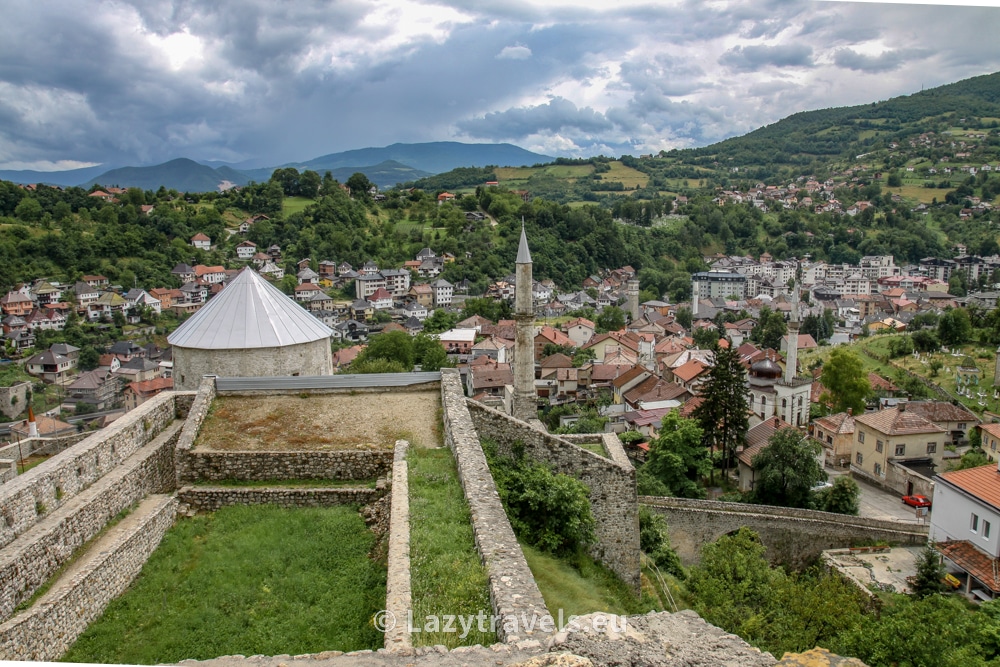
The rain is slowly stopping, so I step outside from the temporary prison and, taking advantage of the weather, take some photos. It has to be said that the view from Travnik Castle can be pleasing. Beautiful mountainous, green surroundings to the horizon, and directly below me lies the city. I can see numerous mosques, as there really are quite a few here, I notice old Muslim cemeteries and traditional buildings.
Admittedly, there is no denying the fact that there is also quite a lot of new construction here and it is not as coherent as, for example, the view of Berat in Albania, but you can’t have everything. Since it’s not clear whether the rain-free weather will continue, I head downhill again, towards the main buildings of the town. I walk to the area around the mosque.
The Painted Mosque in Travnik
The Suleymanije Mosque or Painted Mosque from the 16th century is, after the castle, probably Travnik’s biggest attraction. Indeed, a mosque beautifully painted in floral patterns is not an everyday occurrence. Having been to Iran or Uzbekistan, I have seen many mosques, many of them externally tiled with beautiful tiles (usually blue), but nowhere have I seen a mosque painted with polychrome vine motifs. It’s nice to look at!

History of the mosque
It is interesting to note that the full history of this mosque has not been preserved. It is known that at the end of the 16th century, a mosque was built on this site by Gazi-aga and under this name it was known. This was until 1757 when it was rebuilt from scratch, and only the minaret was probably left of the old mosque. The new construction was unique in that it combined secular and religious purposes. The builders built a bezistan or something like a department store with 25 shops in the lower part. The upper one was for the glory of the god and served as a place for prayers. Interestingly, a water pipeline was also connected to the temple!
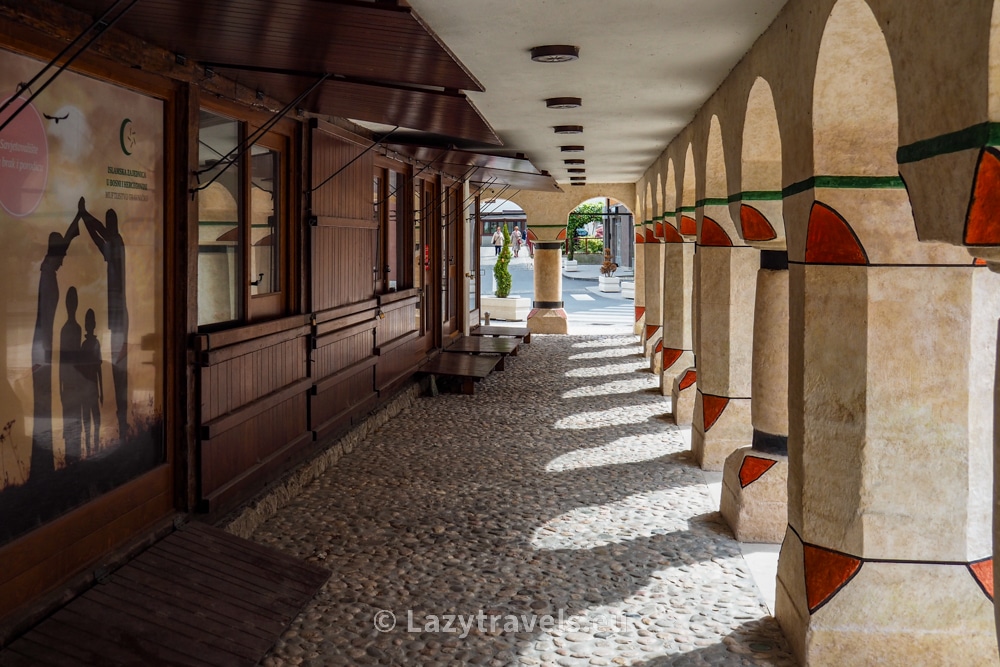
In 1815, a fire broke out in Travnik, also consuming the mosque. Somehow it happens that people, right after they rebuild their own houses, immediately take to rebuilding temples. It was the same in Travnik. The new mosque made use of what was left of the old one. And there was a lot left, because the stone lower floor survived the fire. It was therefore restored to its commercial function, which in fact continues to this day.
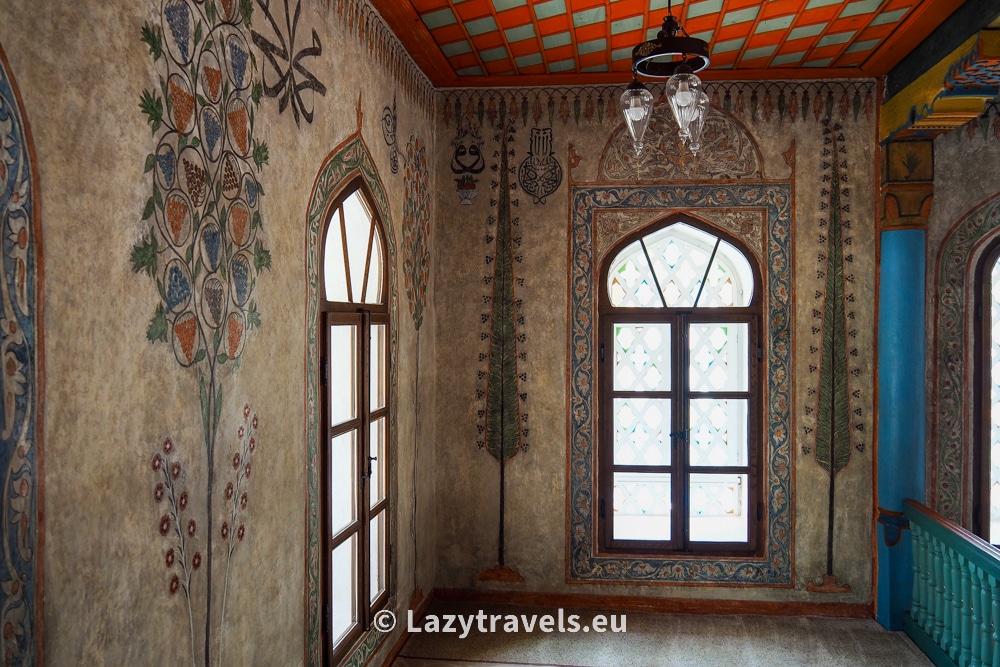
It was then that the building gained beautiful designs and decorations both inside and out. If you go inside (don’t forget to take off your shoes!), look out for the ornamentation of the mihrab and above the mihrab. The spaces above and beside the windows are also beautifully decorated.
The colourful or painted mosque has undergone extensive renovation in recent years. Part of it was donated by Turkey and part by Bosnia and Herzegovina. It is thanks to this that today the colours are vibrant and the leaning parts of the interior, have regained their former splendour. Just as the cracks in the walls have managed to be undone and protected.
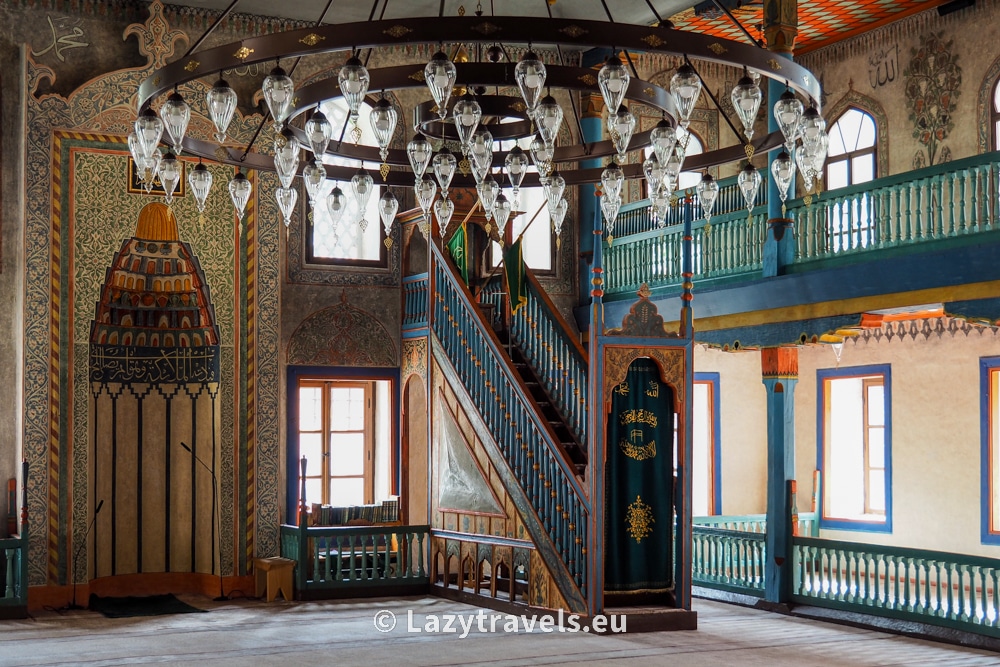
It is said that a valuable artefact – a roll of Mohammed’s hair – is stored inside! Another interesting thing about the mosque is that, unlike standard mosques, this one has a minaret not on the eastern, but on the western side. A pleasant bazaar is set up in the arcades of the temple, which surprised me a little – but this is a long-standing tradition, as you read above.
Walk through Travnik
It’s also worth poking around and seeing the nearby houses, most of which have bakery-type pubs, cafes and restaurants on the ground floor. But the whole gives a very coherent impression. This may be due to the fact that Travnik, like few towns in Bosnia, escaped destruction during the civil war. There was no heavy fighting here, and consequently the town was not destroyed like, for example, Mostar or nearby Banja Luka.
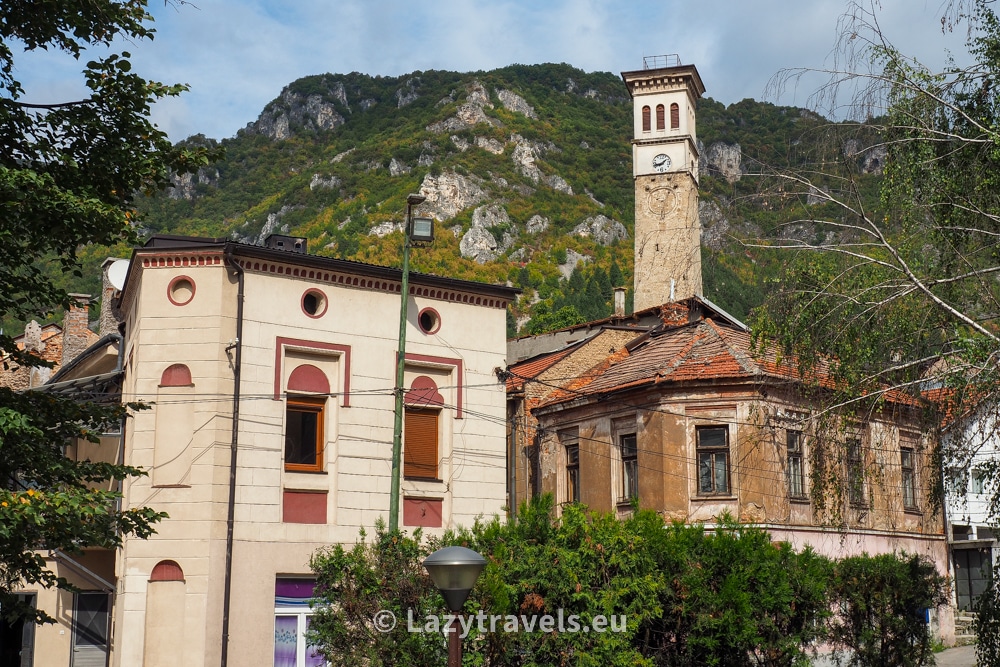
Fact: Travnik is said to be the only place in Bosnia with two clock towers. Although to be honest it is moderately interesting. Maybe they want to measure time that much, because only the lucky ones don’t measure time? 😉
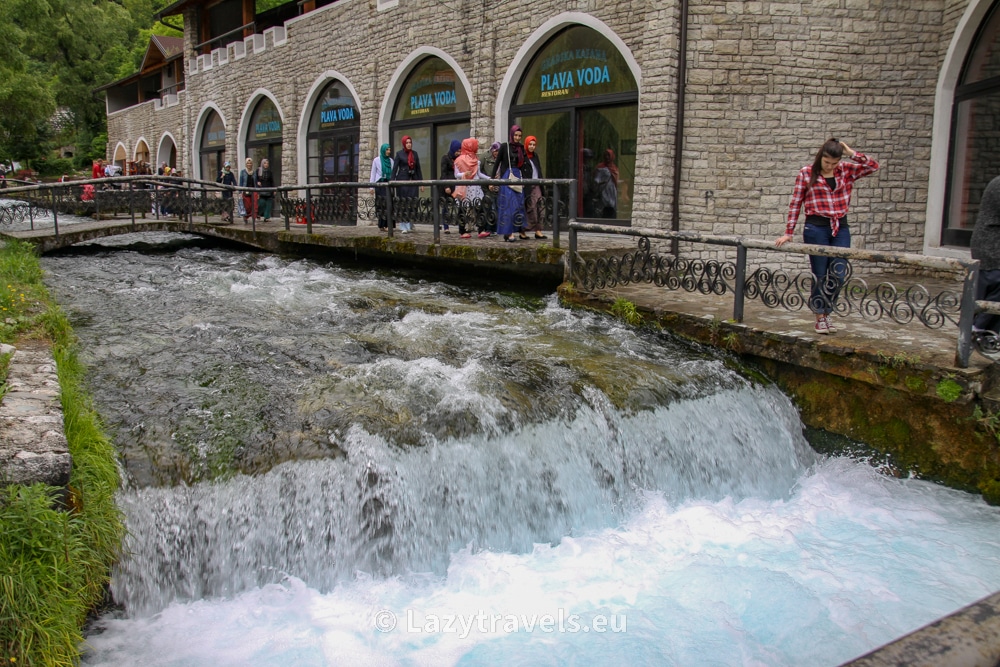
Finally, I jumped a few hundred metres further west, as this is where Plava Voda is located, which is a stream that flows with quite a lot of force through numerous ponds. Quite interesting, as in each pond we see fish. Well-fleshed specimens that feel… like a fish in water 🙂 However, I have all too much water, as it is just starting to rain. Time to run away.
I go to the bus. I do not stay in Travnik for longer, because there is rather nothing to do. Now I’ m going to see nearby Jajce. There is a nice castle and an interesting old town too.
My second visit to Travnik
I returned to Travnik after a few years, as you can also see from the photos above. I have a comparison of the mosque before and after the renovation. It is proverbial heaven and earth. Today, it is one of the most beautiful mosques I have managed to see. And certainly one of the most original.
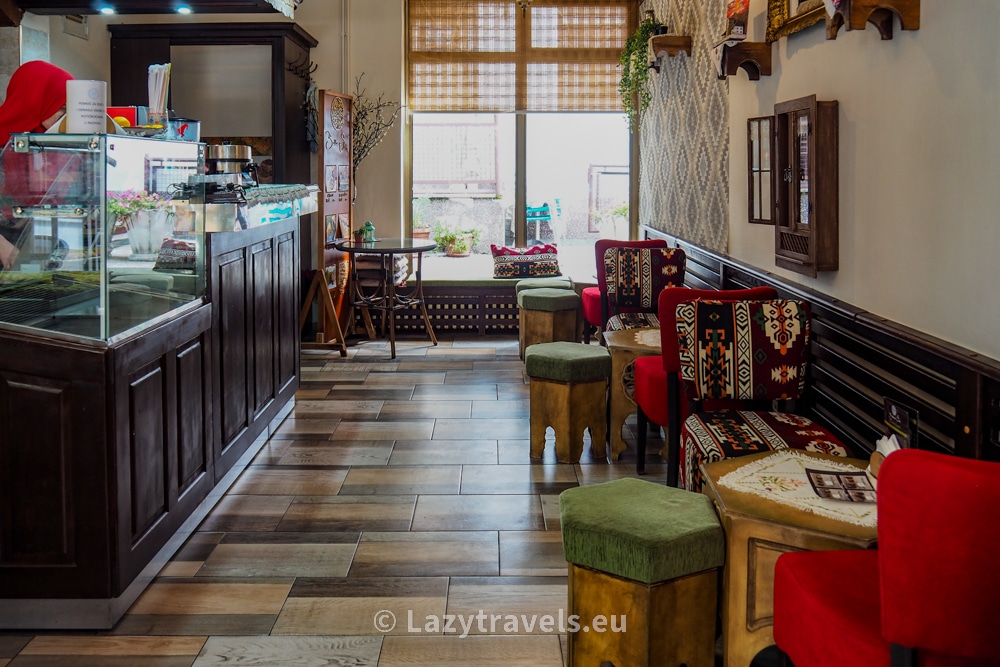
My friends and I also went for a pastry in a café. A café right next to the mosque, where we took local sweets in addition to coffee. And here I warn you: it is certainly worth going in and taking one cake, but don’t take three, as we did. We totally sweetened ourselves. But it was certainly as tasty as it was sweet 🙂
Travnik Hotels – accommodation in town
If, however, you want to spend more time in Travnik, take a walk here in the evening and only the next day go further in peace or explore the surroundings, I recommend accommodation in a flat where friends have slept and praise it very much. Flat Vremplov is a good value for money.


