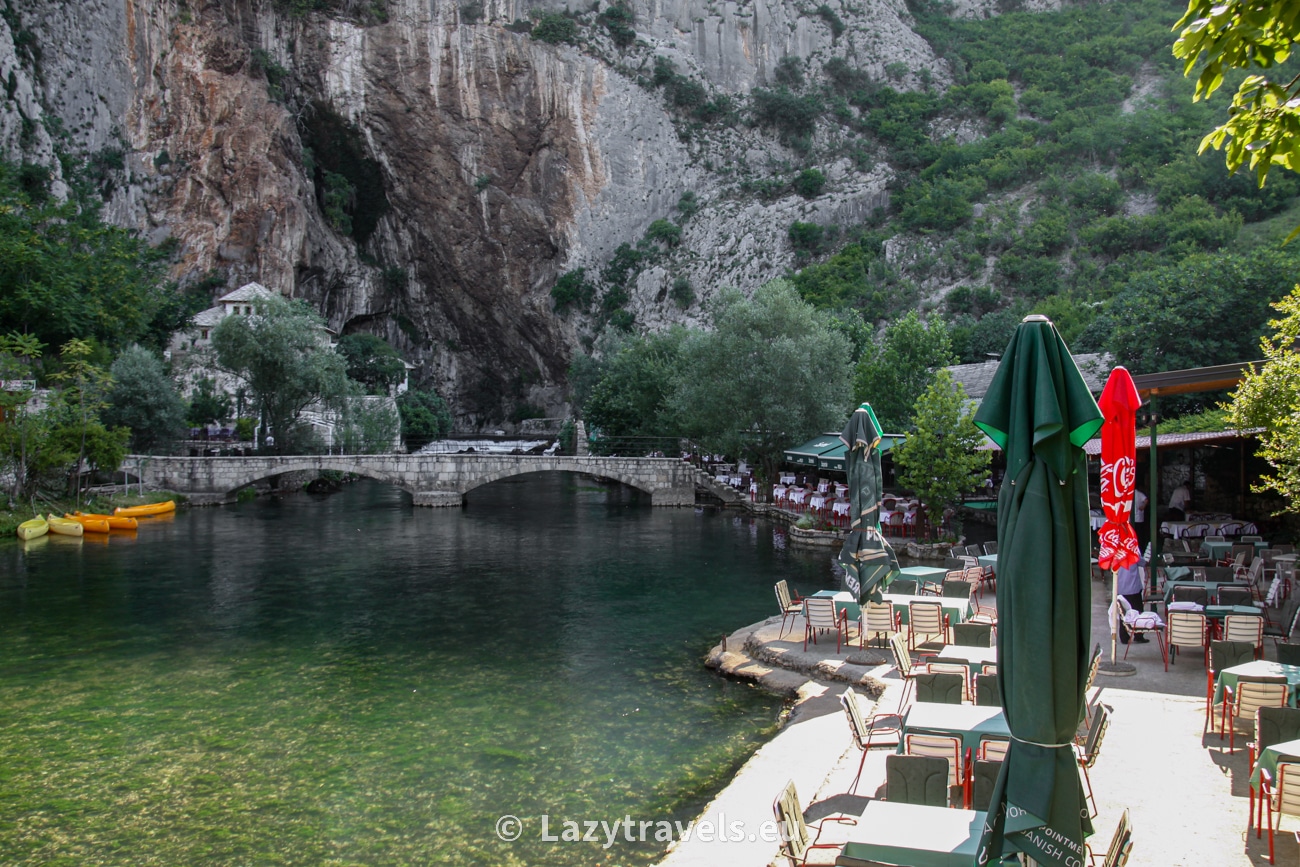
Blagaj… the white walls of the dervish monastery reflect in the surface of the water. Right next to it, the Buna River flows straight out of the cave. For now, there are no hordes of tourists here… yet. It’s too early. The influx will come in a while. In the meantime, hundreds of tables are being prepared for them, white tablecloths fluttering in the hands of the waiters as if they wanted to surrender.

Heading to Blagaj!
This time I didn’t fall for it, this time I wanted to choose how and when I would get to Blagaj. Traveling in Bosnia is most problematic during weekends. Fortunately, this time, despite it being Sunday, there were no issues. The fact is that in Mostar, I got up for the first public transport, which meant I was already on the bus by 8 AM at the bus (and train) station, heading towards Blagaj to see the famous dervish monastery. Besides, it’s one of the attractions around Mostar, so it’s worth considering other similar short trips.
I get off the bus at the last stop, where it turns back towards Mostar, and all I can do, is scratch my head, wondering where to go to see the monastery. Unfortunately, there was no signs, but I assume that since it should be by the water and the Buna River originates directly from the cave next to the monastery in Blagaj, if I walk along the stream, I will reach its source. Simple, isn’t it? 🙂
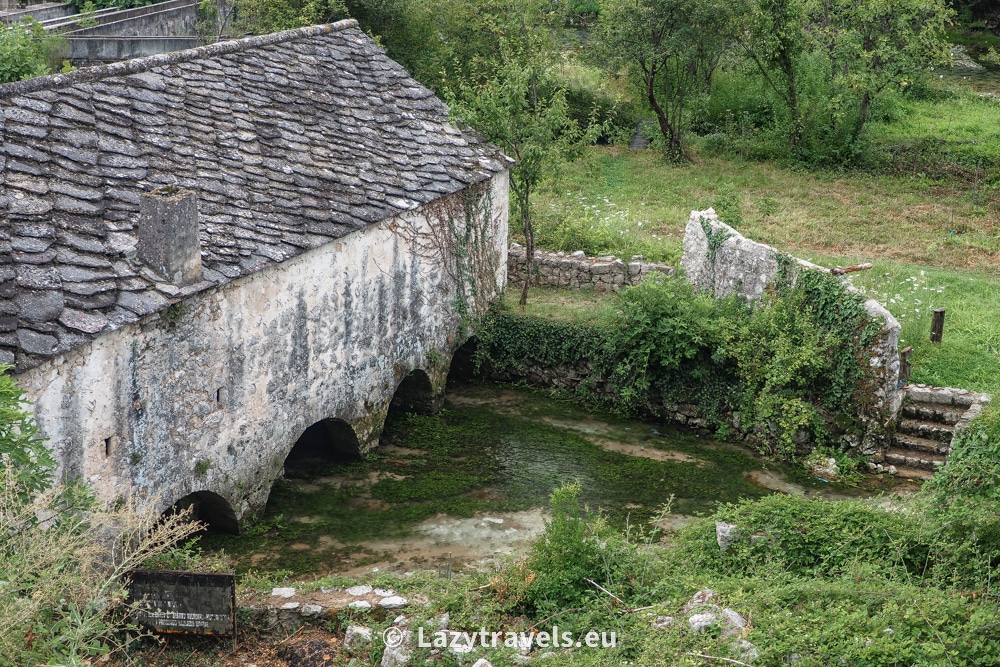
This brilliantly simple strategy paid off! However, first, I had a very pleasant walk along the aforementioned stream. I walk along a narrow road, passing an old mosque that remembers long-gone years of glory. It becomes particularly interesting in the middle part of the route, as just beyond the stream, you can see old Ottoman buildings – characteristic houses, preserved to varying degrees and differently affected by time. But the whitewashed houses peeking out from the dense gardens look amazing. Yes… like and finally, on the horizon, there is the monastery, the destination of my trip to Blagaj.
How can you tell that you are in the right place? Well, by the so-called tourists… first, we will be greeted by stalls with all sorts of junk, and then the restaurants will stretch out. But they will open later. I am here early enough that, first of all, it is not hot, and secondly, the stalls are still closed. They will only start setting up when I am already on my way back. Now, I am making my way through the restaurants covered with white tablecloths towards a raised area, from which I can get a better photo.
Of course, I don’t yet know that this is pointless because a better shot will be from another spot. A place on the other side of the stream – I will find that out later. For now, I am heading to the monastery. Interestingly, I am probably the first tourist of the day; they are just now setting up tables, laying tablecloths, and preparing the infrastructure for the influx of tourists. That will happen in a few hours.

The Dervish Monastery in Blagaj. A fairy tale!
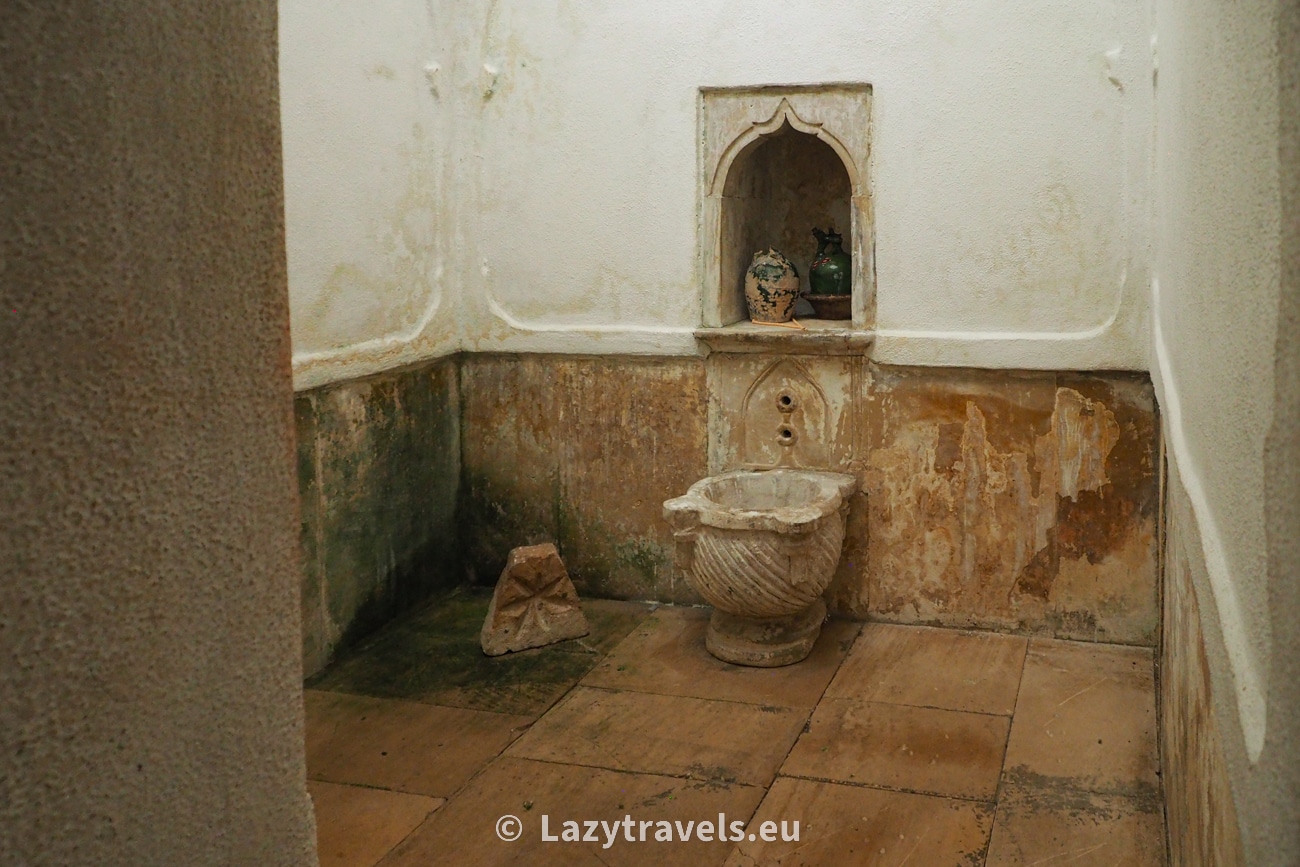
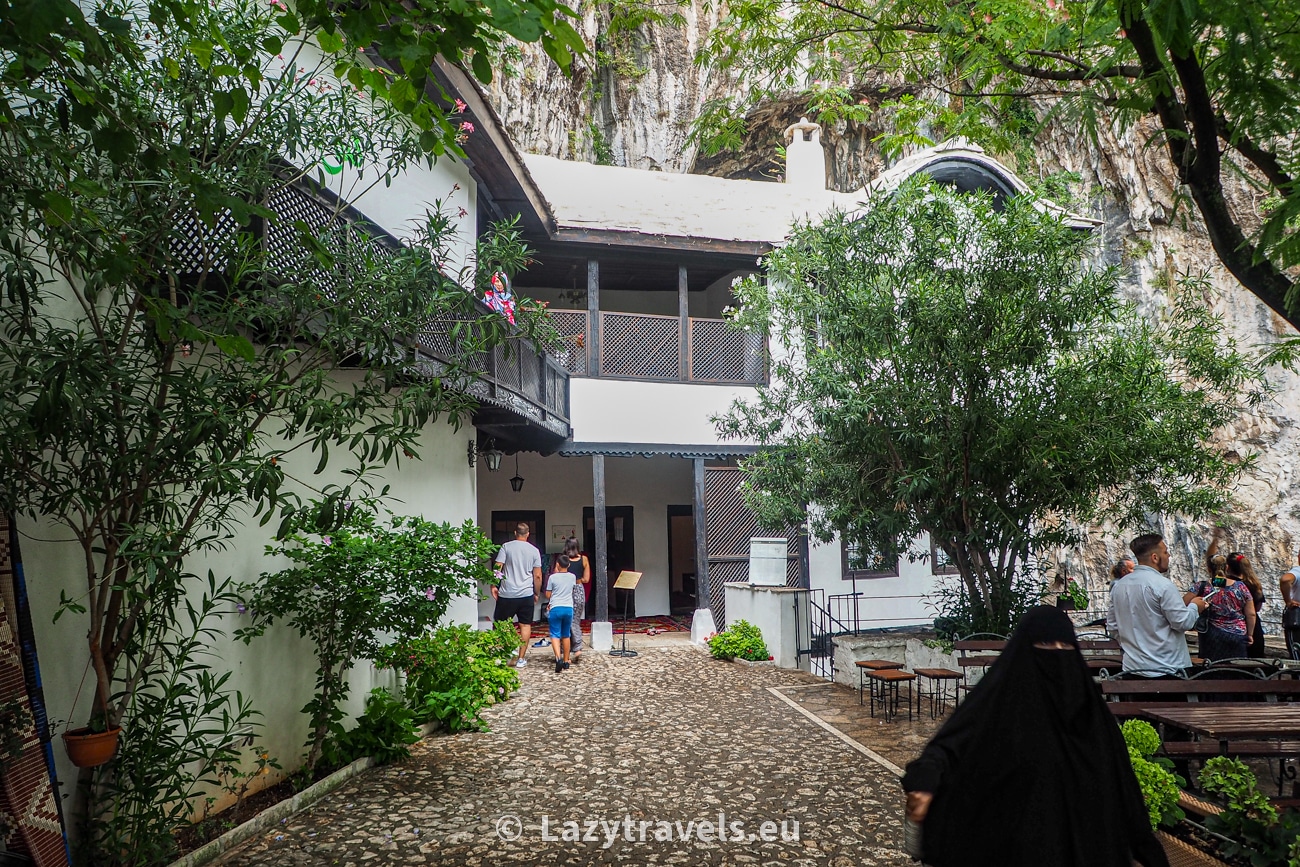
The dervish monastery in Blagaj was built in the 15th century, and at first glance, the Ottoman influences are evident. The characteristic white walls and dark wooden beams leave no doubt. No one stands at the door, no one collects fees, so it invites you to enter deeper and see the building from the inside. Inside, there are traditional rooms filled with old furniture, a Quran laid out somewhere, doors leading to small living cells, and further on, a place for ablutions.
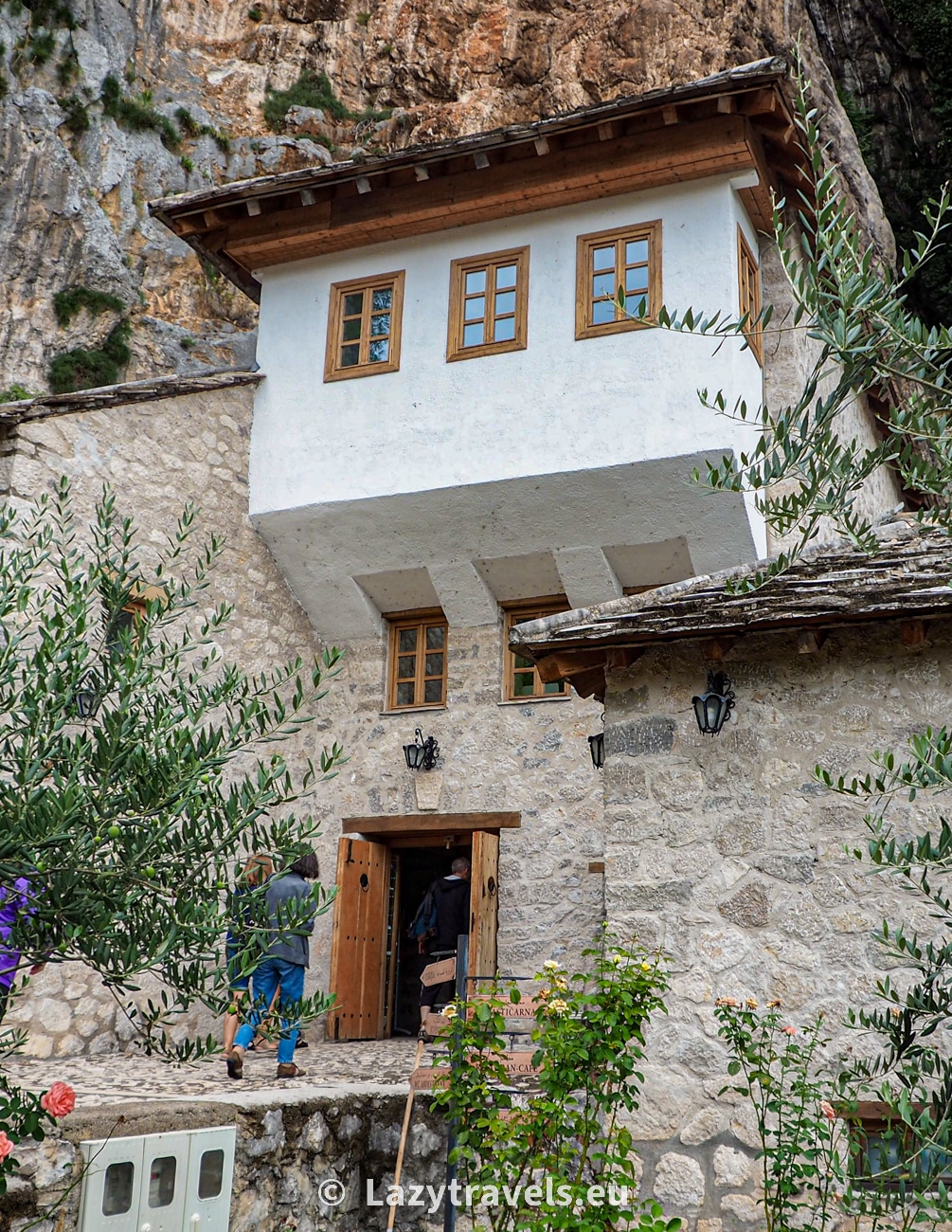
The dervish monastery in Blagaj was built in the 15th century, and at first glance, the Ottoman influences are evident. The characteristic white walls and dark wooden beams leave no doubt. No one stands at the door, no one collects fees, so it invites you to enter deeper and see the building from the inside. Inside, there are traditional rooms filled with old furniture, a Quran laid out somewhere, doors leading to small living cells, and further on, a place for ablutions.

The best view of the monastery
The best view of the cave from which the Buna springs, as well as the historic building itself, is on the other side of the stream. You need to leave the monastery, cross the small bridge on the left, and then turn left behind a garage. It’s the only path, so it will definitely be easy to see where to go. After that, all that’s left is to take photos and calmly observe how the water flows out of the cave and how beautifully the monastery is reflected in the water’s surface.
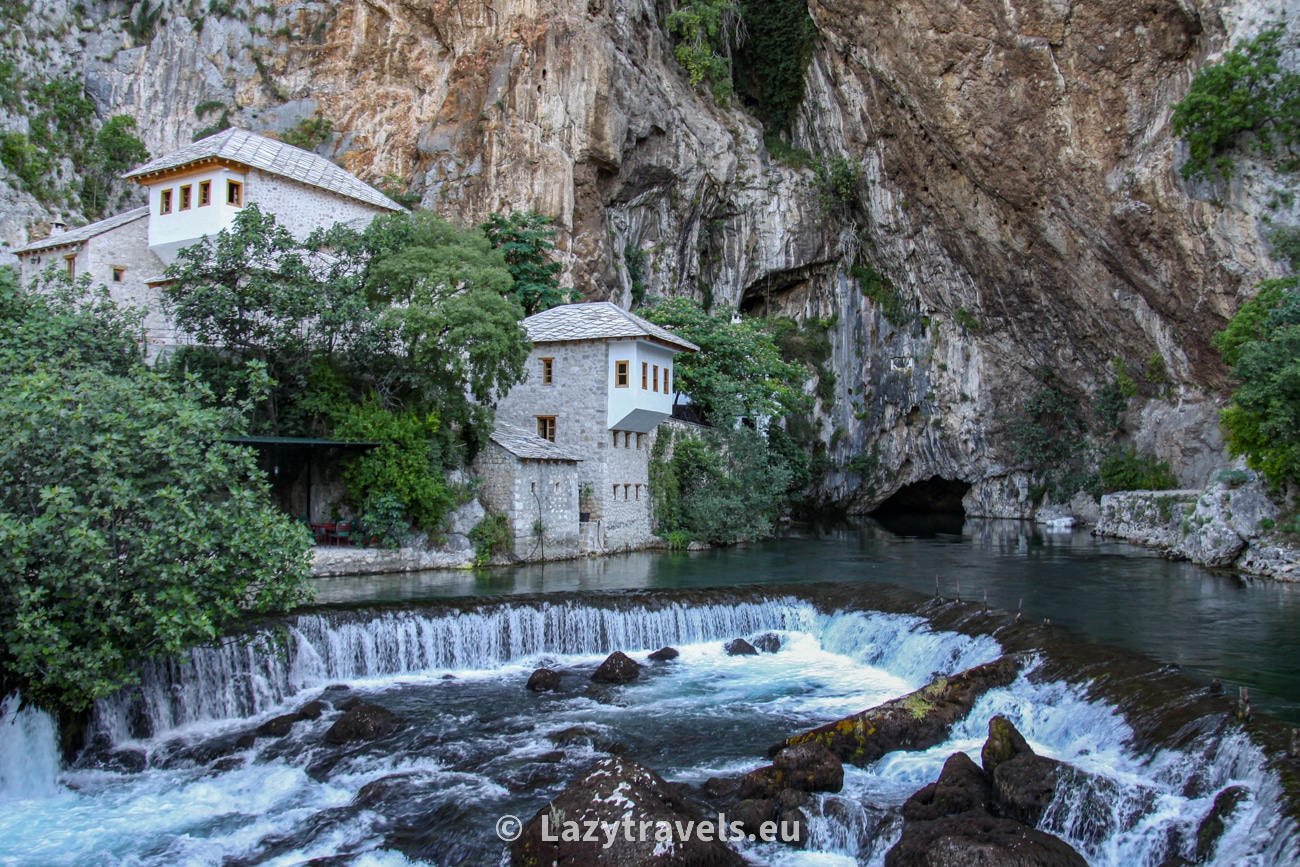

If we come later, we will likely also be able to enter the cave. At this spot, a man with a raft provides services. Unfortunately, when I sat here for half an hour, the raft had no owner, and I don’t know what the inside of the cave looks like.
Tourists are starting to gather. That’s a sign that I will be evacuating to Mostar.
History of the Dervish Monastery
The monastery was built probably around 1470. There is no specific date of its establishment in the archives. Of course, over the centuries, the building has been expanded and altered. It also served various functions, as on one hand it was indeed a dervish monastery (a Muslim religious brotherhood). On the other hand, it was also a place where travelers could stop. The name „tekke” refers to such a place.

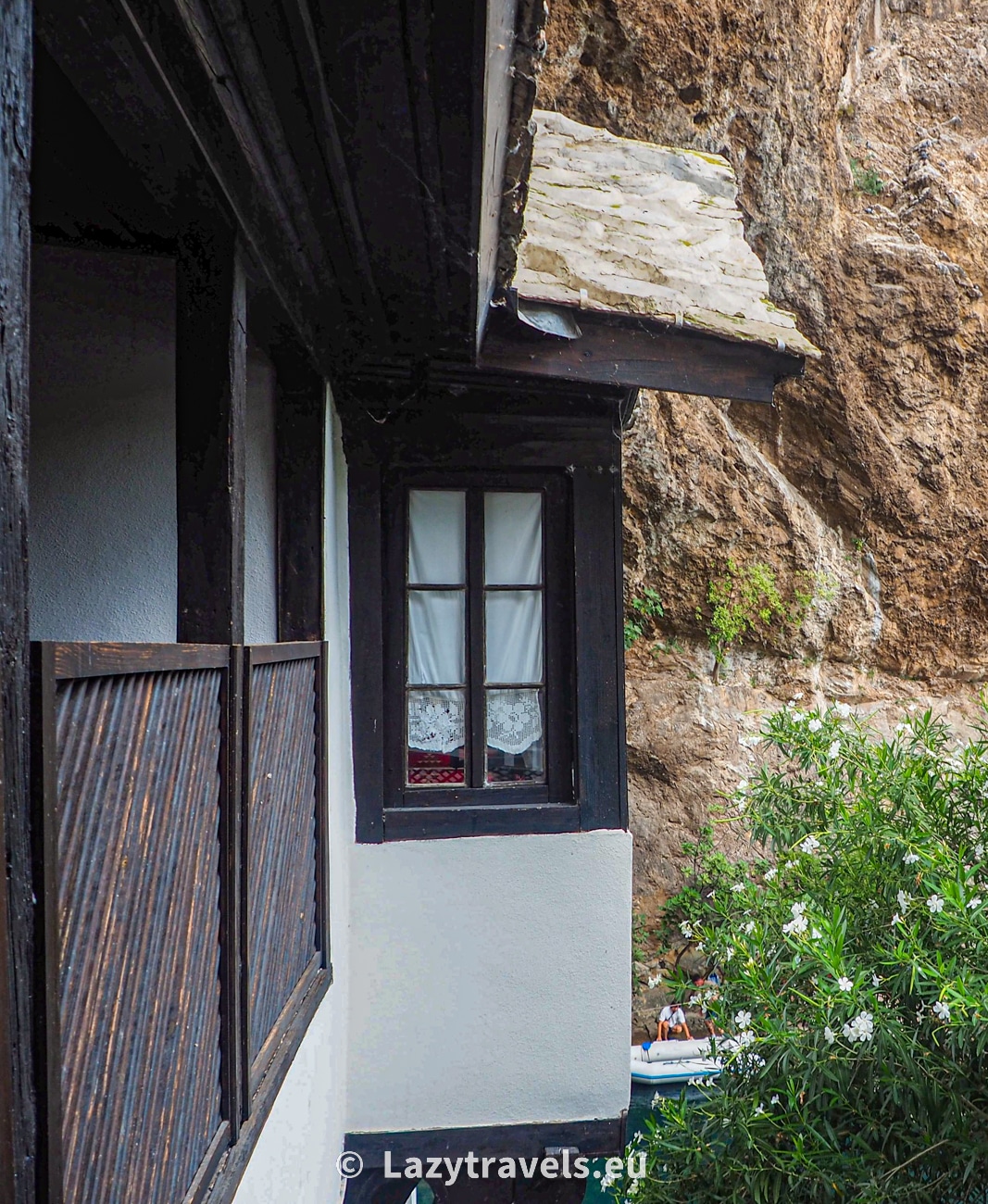
Originally, the monastery was a group of buildings. To this day, one has survived, namely the Musafirhana (which would be an inn for travelers today), as well as tombs and places for ablution. The tombs can only be viewed from a distance through the doors. Moreover, the fact that the monastery has survived is due to its location, as during the war in former Yugoslavia, Croatian forces fired rockets at it. Fortunately, its concealment under a massive rocky cliff protected it from destruction.
How to get to Blagaj
The most convenient way to get to Blagaj is by car. You cannot drive directly to the monastery, but there are large parking lots a few hundred meters before it. Of course, they are paid, but it’s not a huge amount. Visiting the monastery takes at most an hour, so having a car also has the advantage that you can go further and see, for example, the cemetery in Radimlja near Stolac (a remnant of what was here before the arrival of the Turks). Another option is to see Počitelj and then head to the Kravice waterfalls, where you can swim.
If you want to get to Blagaj by public transport from Mostar, there is a bus stop opposite the bus station, from which a bus runs once an hour. The journey takes about half an hour, if I remember correctly.