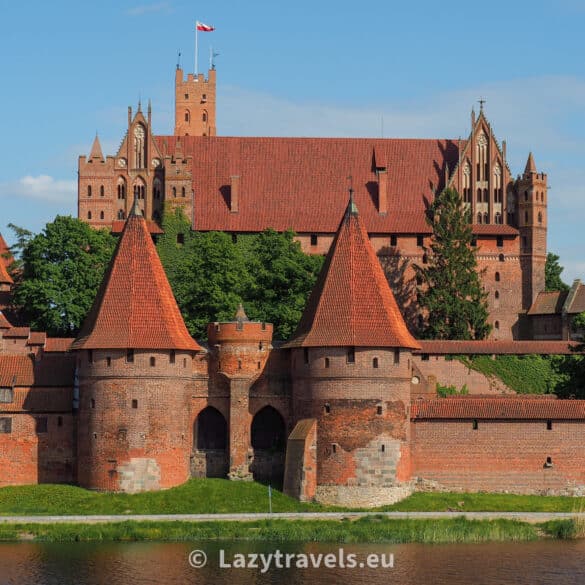
The castle in Hunedoara made me travel through the whole of Romania just to see these medieval walls with my own eyes. The castle is one of the most beautiful I have ever seen. The epitome of beauty!
There is something magical about the Corvin Castle in Hunedoara. The first time I visited Romania I wanted to see the castle in Sinaia, but this time I wanted to go to Hunedoara and see the medieval castle that looks like something out of a fairy tale! Yes, that was the main reason for my trip to Romania.
Hunedoara – a fairy tale castle
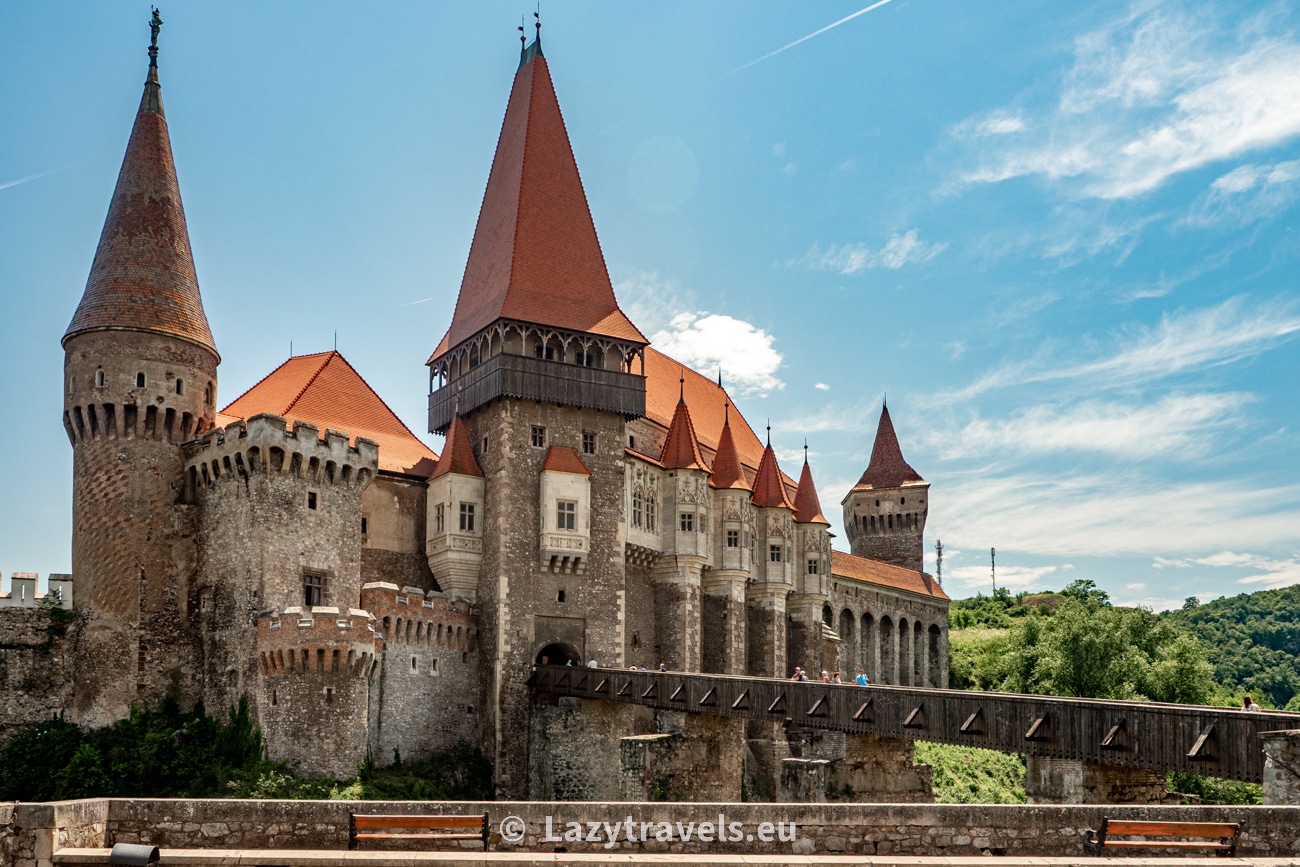
I still remember the moment when I saw the castle in Hunedoara for the first time. I walked through the gate into the courtyard with the stables and then I looked to the left and there it was, in all its glory! It was just as beautiful as in the photos! And I didn’t care that the sky wasn’t blue, that it had been raining for an hour and that when I drove here from Timisoara there was no sign of a nice sunny day. Fortunately, it didn’t rain anymore and the gray clouds lifted. Then the sun came out. But now I’m just admiring the castle. The narrow bridge leading to the gate, the orange roof tiles, the gray stone and the light sandstone. It all harmonizes magically. I’m not even a little bit disappointed, the reality is better than the pictures!
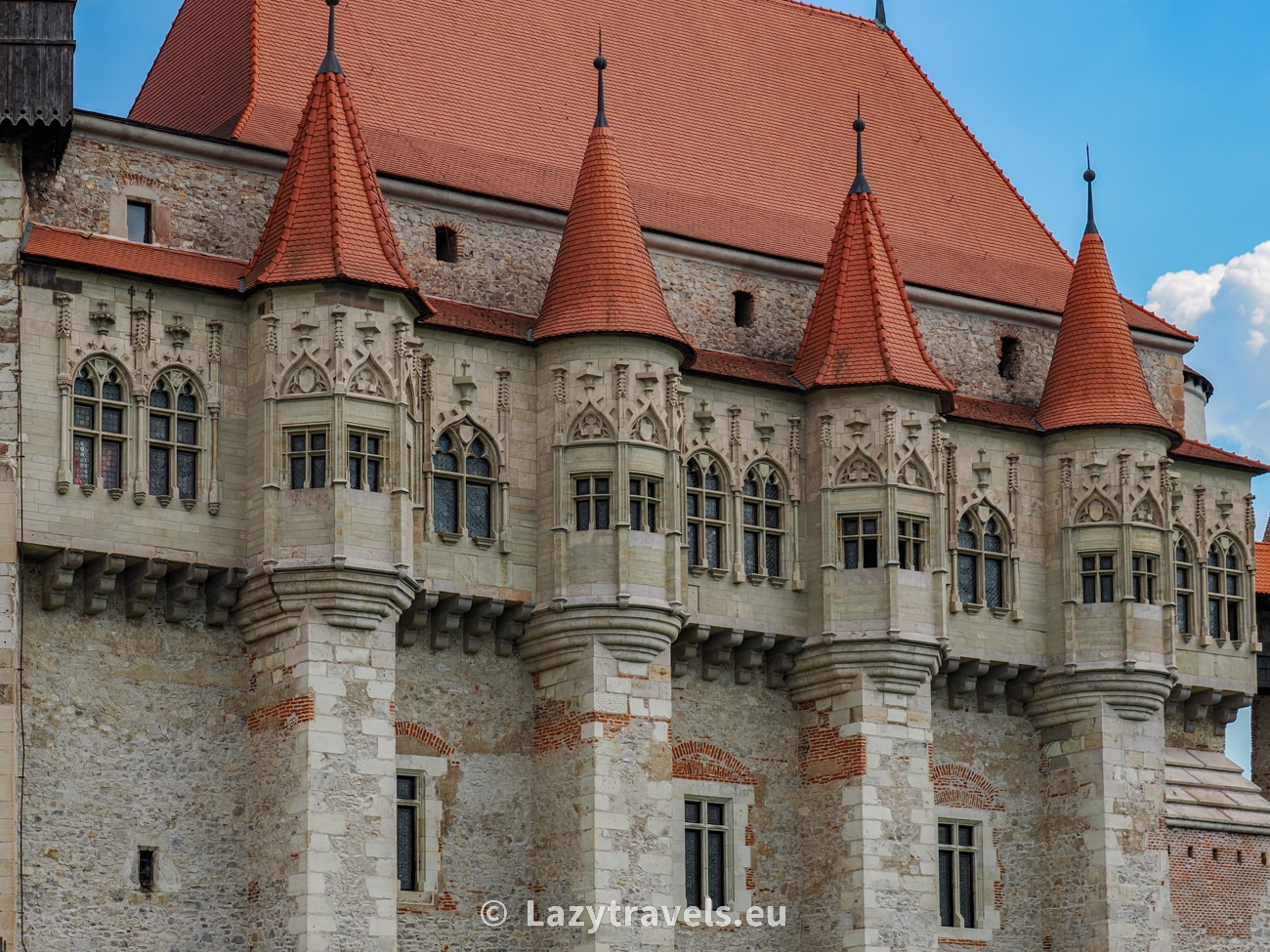
I decide to walk around the castle before going inside. It is not the easiest route, as the castle is not always visible from behind the fences and houses. There are no fantastic viewpoints or cafes with a view of the fortifications, but the Hunedoara Fortress is still impressive from every angle. I even go where few tourists go, because you have to go off the beaten track. You have to walk around the castle to get to the moat. Stand by the river, look up and think that this castle could not be conquered from this perspective. That the only way in was over this long bridge supported by pillars. A bridge over a dry moat and a wet moat, a footbridge that could easily have been set on fire to feel safely cut off from the attackers.
Hunedoara Castle – a tour of the palace courtyards I don’t know why the ticket office is located in a shabby container.
Hunedoara Castle – visiting the palace courtyards
Maybe so that the tourists can appreciate the interior and the courtyards even more? As soon as we pass the turnstile, we enter a wooden bridge. From that moment on, you can feel like a tourist storming the fortifications. Unfortunately, there will be an obstacle, because for me there have been huge groups of tourists who, with the strength of one or two buses, think that because there are so many of them, they can do anything. Including blocking the whole bridge because their majesties are coming. Or rather, crawling, because for some unknown reason, large tour groups move at the speed of a racing turtle.
It’s a fantastic feeling as we slowly approach the castle and you can imagine how the attackers must have felt when they had to charge through such a narrow strip of wood towards the gate. Under fire, of course. Fortunately, we can walk through the gate of Corvinus Castle in Hunedoara without fear. Right at the entrance, there is a staircase leading down to the prison, where a „cheerful” exhibition has been set up showing how people were tortured in the past. In fact, every castle I have been to has such a chamber. Think castle, think torture chamber. No princesses here! Blood, sweat, guts and hooks.
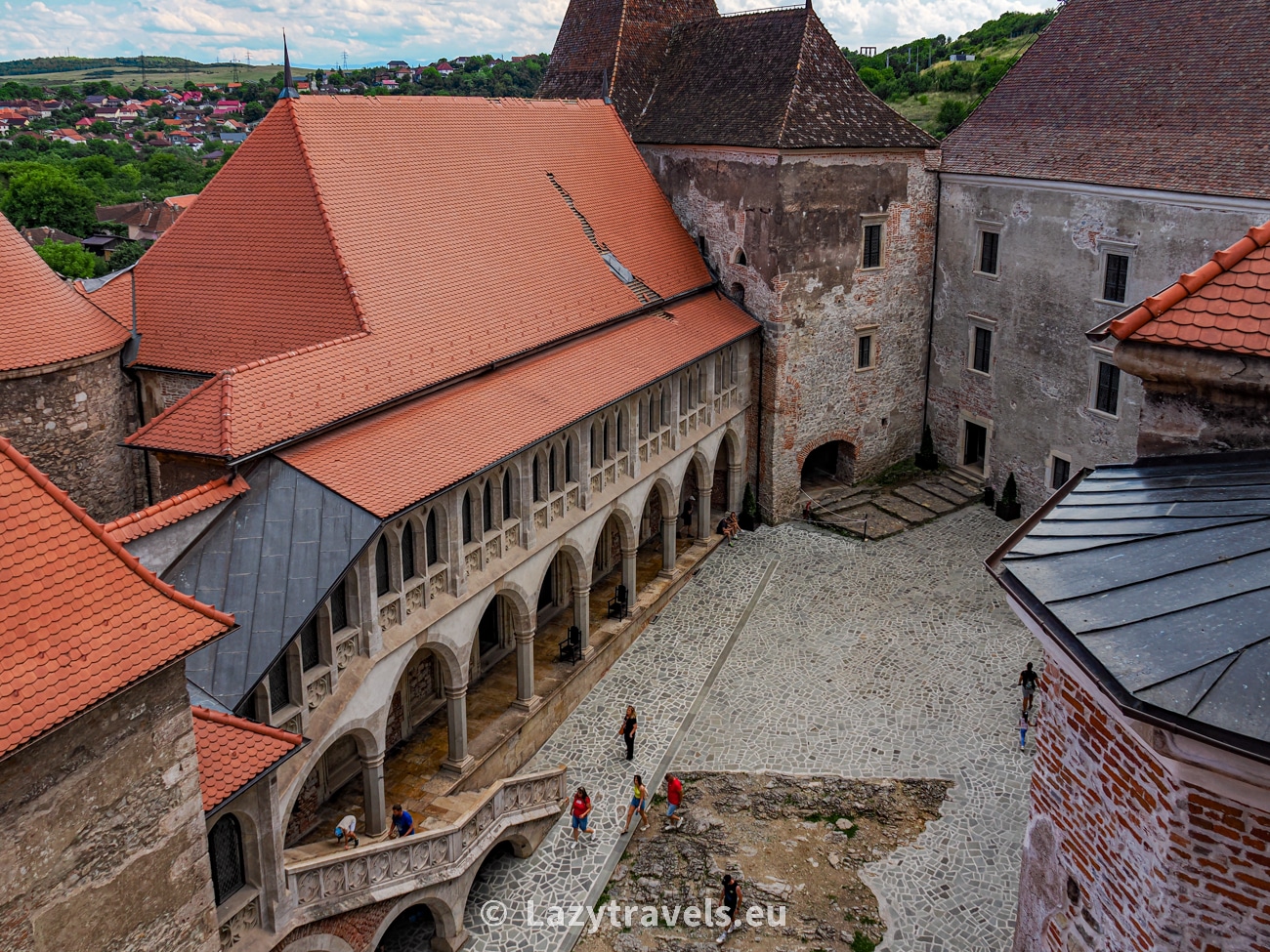
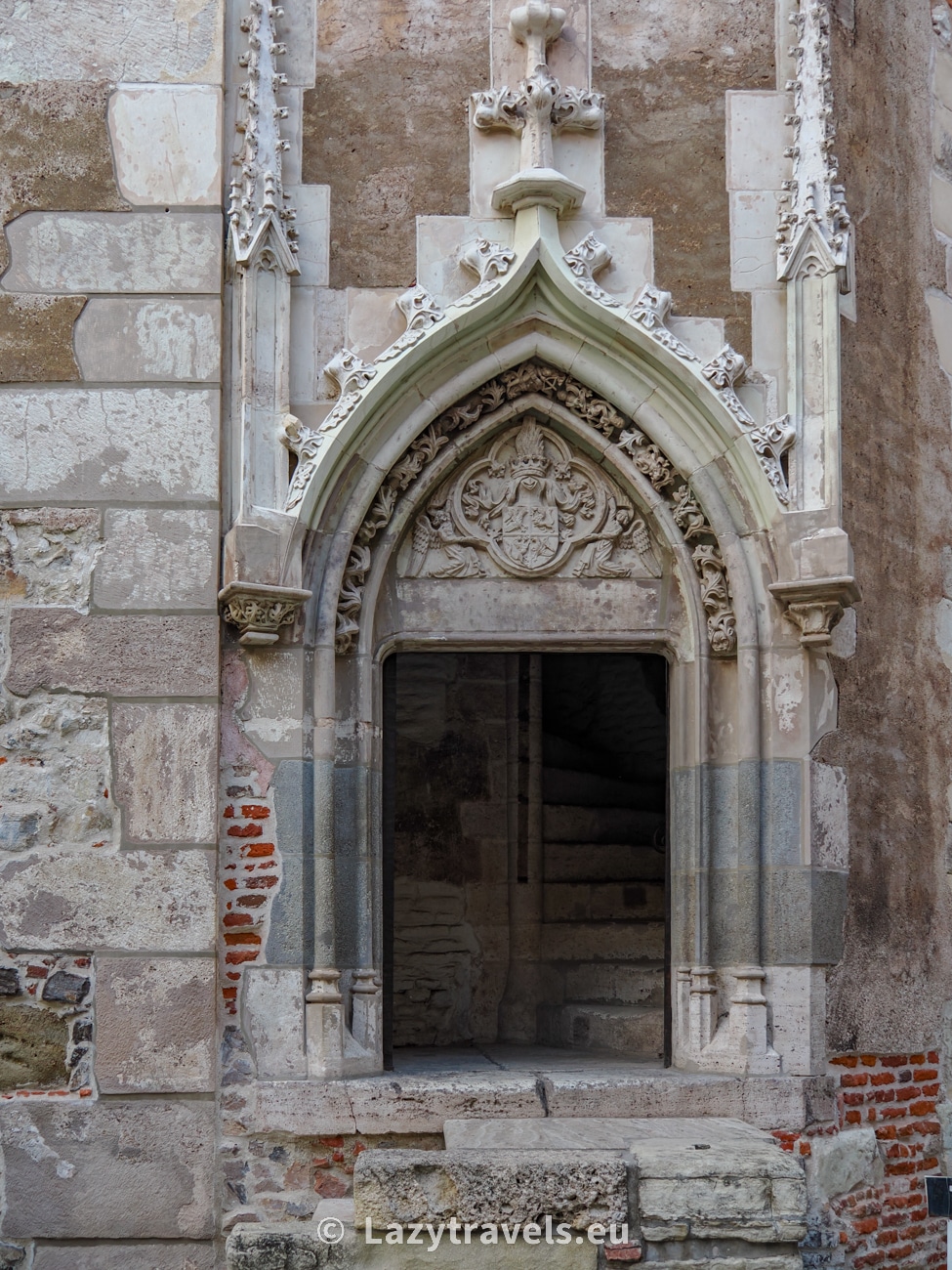
That’s why I took the liberty of skipping this place of dubious beauty and hurried on to the courtyard. It’s beautiful here, and I don’t even mind that all kinds of architectural styles are mixed together, from Gothic to Baroque. Anyway, take a look at the photos for yourself. However, taking advantage of the fact that the organized tour groups had disappeared somewhere, probably listening to the guide’s stories, I decided to take the opportunity to explore the interior, and Hunedoara Castle has plenty of it!
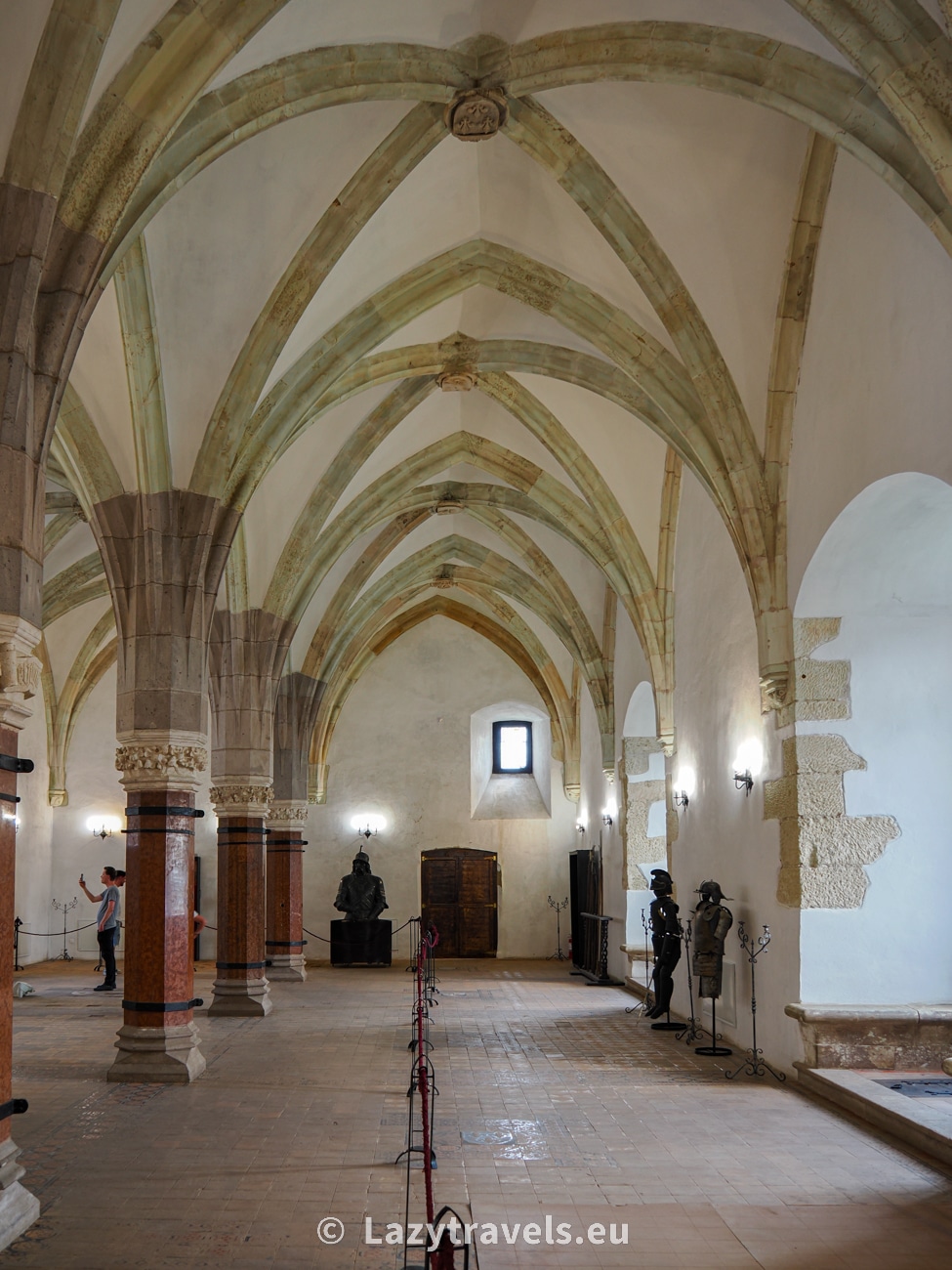
I walked through the first door I came across and entered another world! I was standing under the vaults of the Council Hall. I have always been impressed by these constructions, especially those built in the 15th century. A cross-ribbed vault supported by seemingly delicate columns, with the remains of ancient frescoes on the walls. All around are a few display cases of ancient weapons. In the window sits a man in period costume, holding a medieval-looking instrument on his knees. Too bad he’s not playing it. This room was used for feasts and balls, and important matters were discussed here – the Council Chamber speaks for itself.
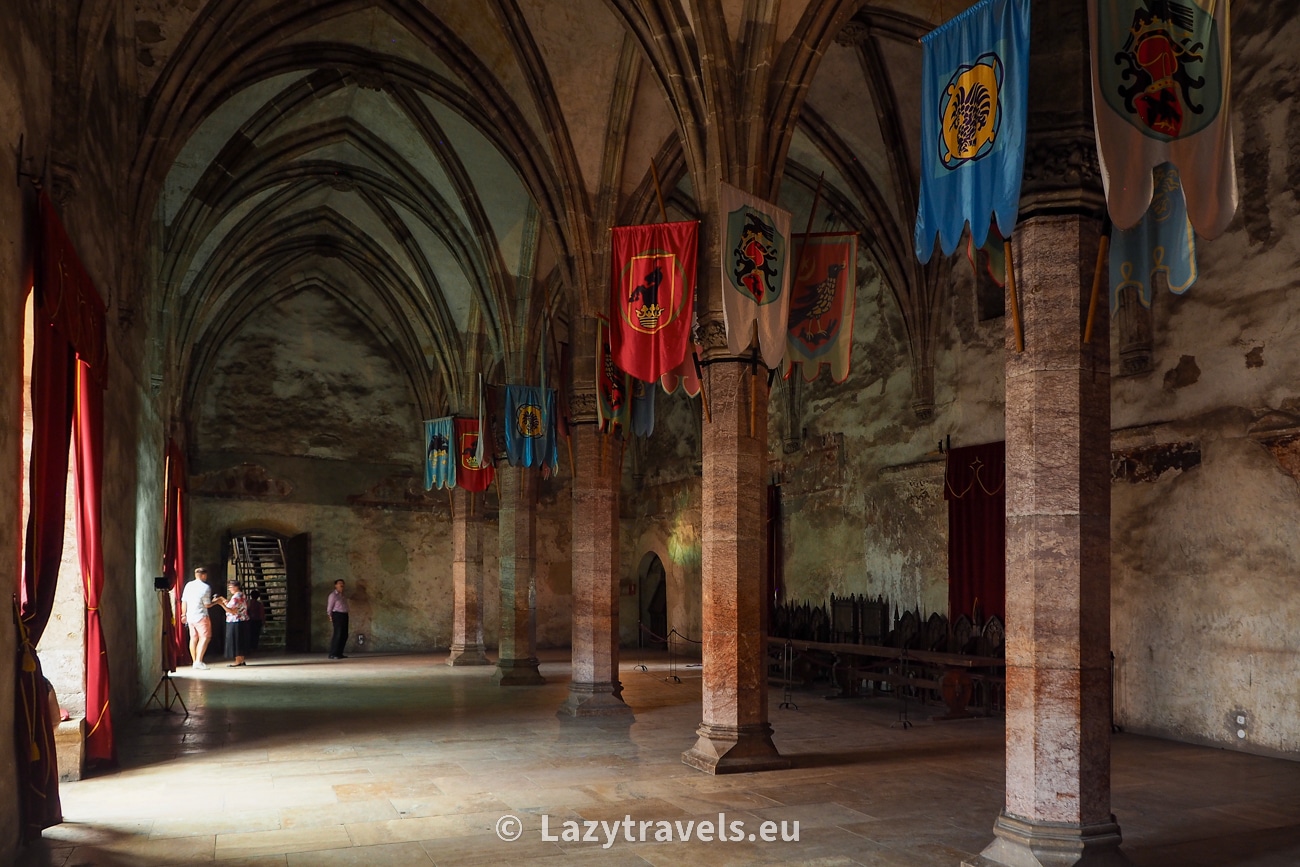
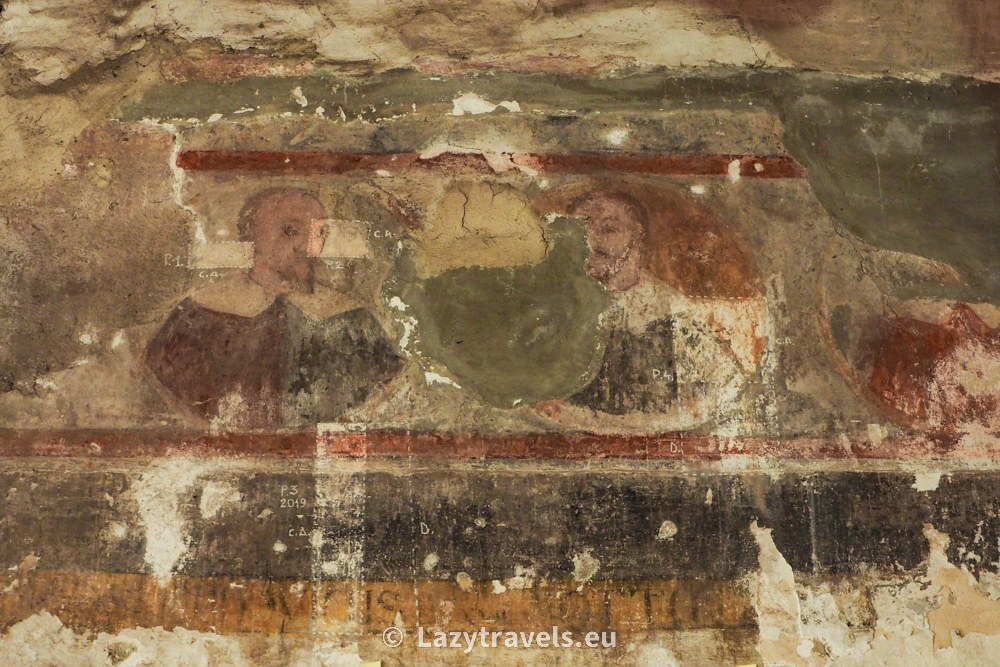
Then I go to the next room, this time the Royal Hall, which is located above the Council Hall. This room has a similar cubic capacity, but its design and preserved decorations impress me even more. Colorful banners with coats of arms hang on the walls next to the columns, and decorative benches are placed against the wall, as if waiting for the monarch’s arrival. At dusk, it is also worth approaching the walls to take a closer look. On them you can see the former splendor – the rich frescoes that once surrounded the room. Unfortunately, not many of them have survived.
Apart from these two most representative rooms, it is worth taking a walk around the Corvinus Castle in Hunedoara and looking into the proverbial mouse holes. You will certainly come across the artillerymen’s terrace. But before we get there, it is worth stopping at the castle well. It has a legend attached to it, because what castle does not have a legend? Well, apparently the well was dug into the rock for 15 years by three Turkish prisoners who were promised freedom by the king if they dug the well.
So the poor wretches drilled into the rock for 15 years, and they did it! Unfortunately, the king had died in the meantime, and his wife, who took over, had no intention of keeping her word. In an act of revenge (a bad revenge, to be sure), the prisoners carved the inscription „You have water, but you have no heart. In reality, the inscription says something else: „Hassan, a prisoner in the fortress near the church, dug here.”
This is not the first time that legend has nothing to do with reality.
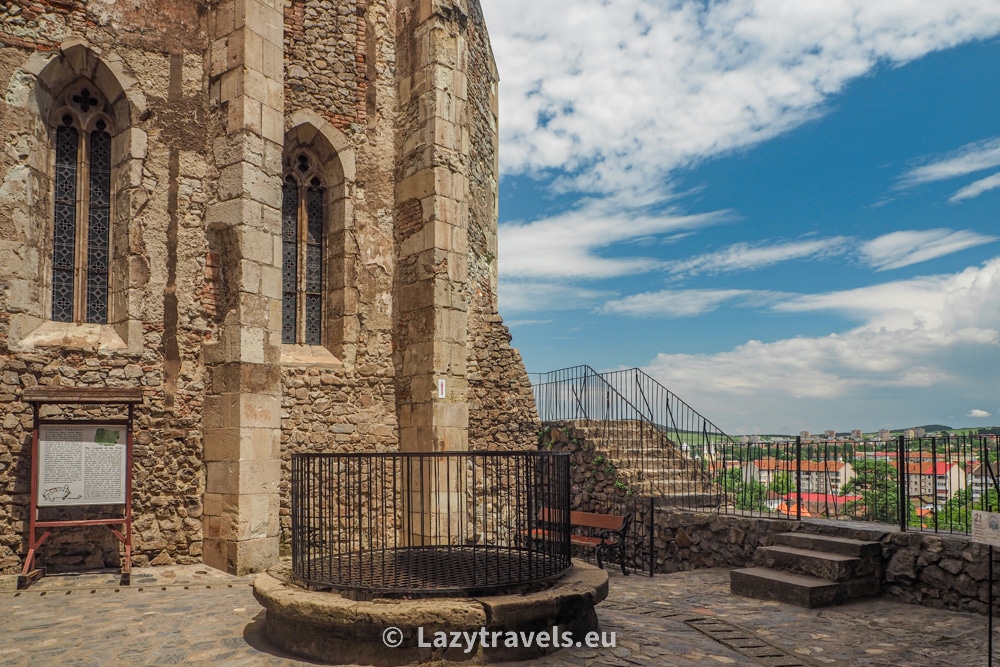
However, the artillery terrace does offer a panoramic view of the surrounding area. But since you are at the most beautiful place in the area, everything you see is simply uglier. Therefore, it is worth paying attention to the exterior details, of which the castle in Hunedoara has more than enough, and they are clearly visible from here.
History of the Corvin Castle in Hunedoara
I am not a big fan of discussing the history of castles in detail, because from today’s perspective it does not matter whose hands the fortresses passed through some 500 years ago. The families have long since died out, but their memories have survived, thanks in part to these stacked stones. And, of course, thanks to the chroniclers of that time.
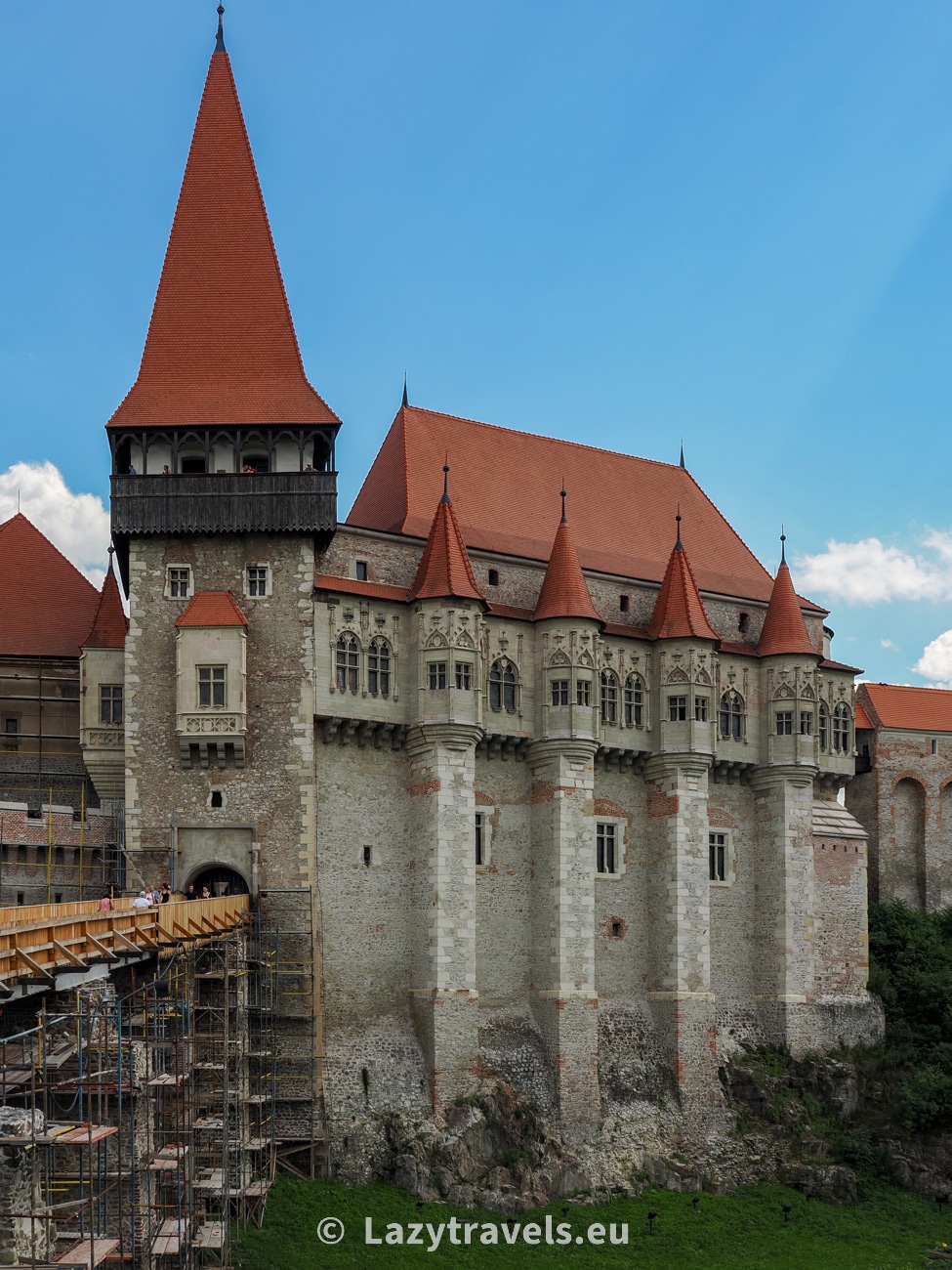
As a chronicler, I have to say that the hill where the castle was built was occupied by fortifications for a long time. But it was John Hunyadi, the ruler of Hungary at that time, who decided to build a real fortress here. Construction began in 1440 and was completed only six years later. And what a mighty fortress it was! Surrounded by a double ring of walls and defense towers. Such fortifications, built in such a short time, must have consumed the ruler’s fortune and were a vivid manifestation of his power.
It is worth pausing here to explain the origin of the castle’s name: the Castle of the Corwins. The name comes from the Latin name of John Hunyadi’s family, Ioannes Corvinus. In Hungarian it is János Hunyadi. So it could be translated into Polish as Jan from Hunedoara. And let’s face it: he was an outstanding ruler because he fought the Turks before it was fashionable. In a word, he defeated the Turks marching north at the Battle of Belgrade long before Jan III Sobieski did in Wienna.
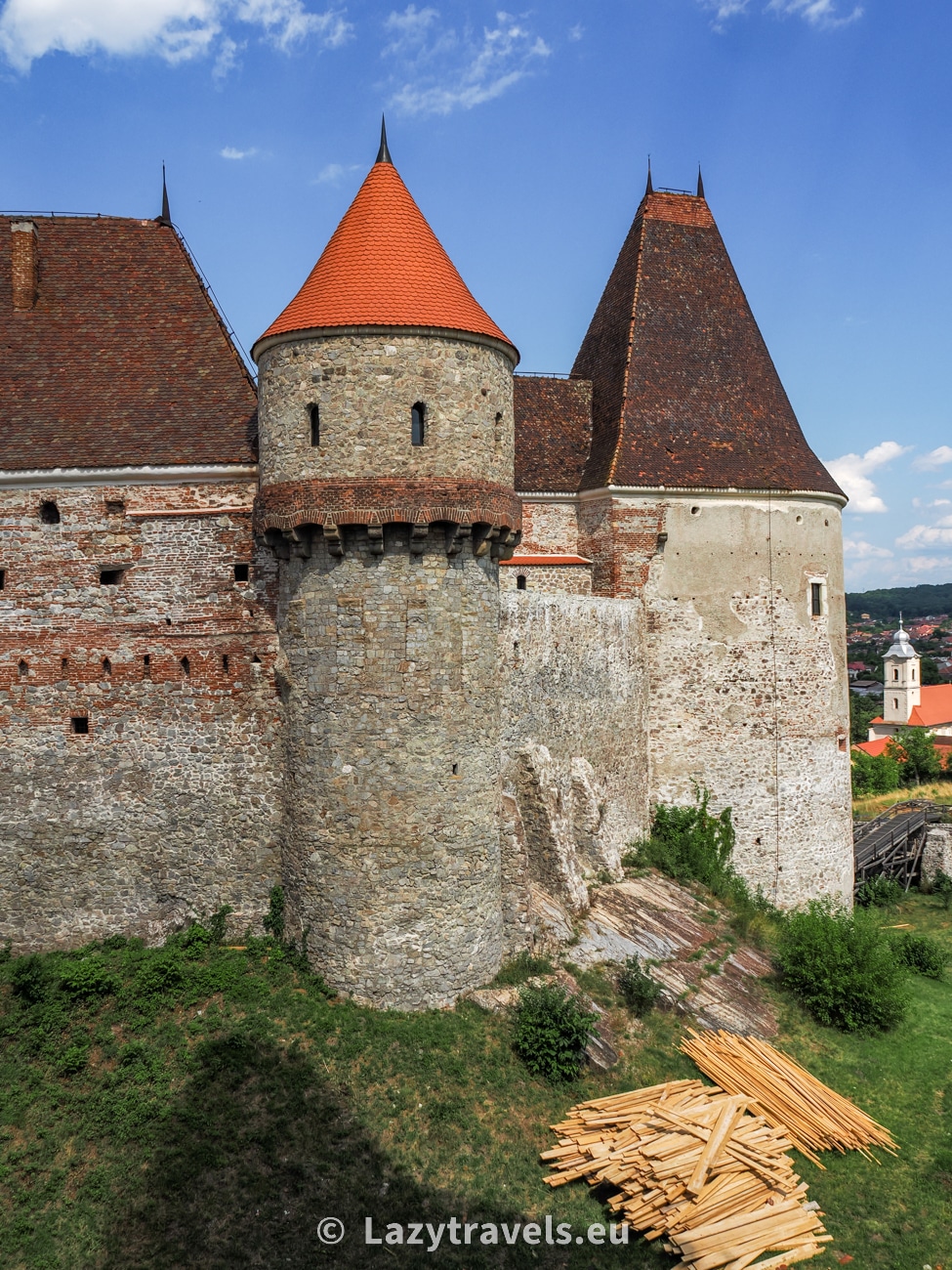
After the death of his father, the castle in Hunedoara became the property of his son, Matthias Corvinus, also King of Hungary, who left his mark on the fortification and rebuilt it in the Renaissance style. In the following years, the castle changed hands several times and was rebuilt by different families. Military developments and the widespread use of artillery brought about a significant change. Gabor Bethen invested in the construction of a platform for the artillerymen, built the White Tower and added the Gate Tower.
The year that had the greatest impact on the castle was 1854, when a great fire consumed almost the entire structure, leaving only stone. The fire consumed all the wooden ceilings, which collapsed and pulled down some of the walls. The castle lay in ruins. Fortunately, reconstruction began in 1870 and only 10 years later the castle emerged from the scaffolding. Today it attracts thousands of tourists every year, just like the castle in Hunedoara.
Hunedoara – how to get to the castle
Finally, it is worth mentioning how to get to Hunedoara and the castle. I took the morning train from Timisoara to Deva, where buses leave every half hour from the bus station to Hunedoara. The ride takes about half an hour and then you have to walk about two kilometers. It is important to check the return connections before going to the castle. I wanted to go to Alba Iulia the same day. Unfortunately, there are no direct public buses. However, there is a notice at the station that there are two private buses and a phone number for reservations. Since I couldn’t get through on the phone, a very nice lady at the station information desk booked me on the bus that left from the nearby gas station.