Krzemionki Opatowskie is a silent witness to history from several thousand years ago. At a time when the Egyptians were building their pyramids, valuable raw material – banded flint – was being mined in the area of present-day Poland. To be clear, the Egyptians also valued flint, as it is a material that is quite easy to work with.
Long, long ago, when Krzemionki Opatowskie were not yet known as Krzemionki, and no one had even dreamed of Poland as the concept. At that time, flint was worth its weight in gold! Welcome to the Stone Age, where flint was used for almost everything! Fragments of rock were chipped off from large flint concretions to create weapons and tools.
Flint – a valuable Neolithic material
The material was so precious, that deep mines, almost several meters deep, were built in search of it. The flint extracted was traded within a radius of up to 200 km! Although it sometimes happened that flint tools were found even 600 km from the extraction site. So you can see that it must have been a very profitable business. Unfortunately, not much has survived from these powerful extraction complexes to our times. While the remains of the mines are well-preserved and easy to excavate, what is on the surface is a different story. Wood burns, rots, and disintegrates. And in such a large and rich center, there must have been many houses and workshops at least initially processing flint. Yes, about 5,000 years ago, it must have been a fascinating place. One could say it was almost the economic center of Europe! Okay, maybe I’m exaggerating a bit… but just a bit!

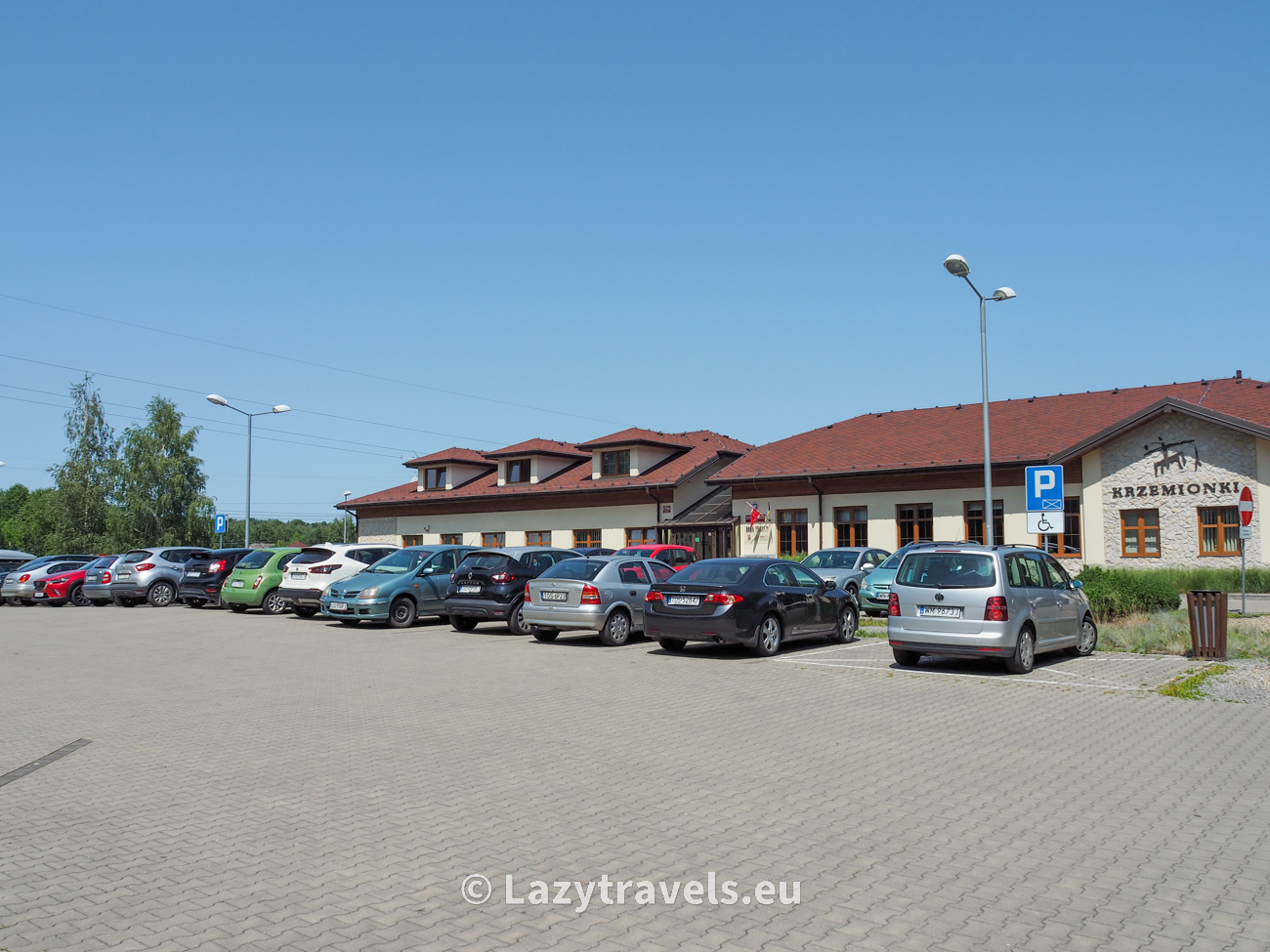
However, I only started having these thoughts on my way to Ponidzie, where I was heading after visiting Krzemionki Opatowskie. The main goal of this trip was the fascinating Wiślica and its orants’ plate. Krzemionki were simply on the way, and since they were recently inscribed on the UNESCO World Heritage List, I just had to visit them. So, on a certain summer day, just before noon, I turned onto an unassuming road marked as leading to the museum. Then came the surprise, as there was a sizable parking lot in front of the new building. As it turns out, everything was thought out when building a museum that seemed to be in the middle of a field. Perhaps they didn’t think about a restaurant, but since nature abhors a vacuum, stalls had set up next to the parking lot. You can have a coffee, but also enjoy cakes served by ladies from the local housewives’ circle. The cheesecake was top-notch!
Then, either right away or after that, you just need to go to the ticket office and purchase an entrance ticket. Well, now everything is in the hands of fate, as it is unknown how large the group we will join will be. And it is also uncertain whether we will get a passionate guide or a craftsman just coming to work. Well, I happened to get a guy without flair. Unfortunately, he couldn’t engage us with this fascinating place, as he was more of a formula reciter than an orator. What a pity. But anyway, what I was meant to see, I saw, and I went where I needed to go.
Krzemionki Opatowskie – the museum
I join a large group, and at the time indicated on the ticket, we enter the grounds of the historical and archaeological museum. First, the guide introduces us to the time and culture we are about to delve into. This helps to better understand the exhibits displayed in the museum. Because soon the doors open, and we can immerse ourselves in the world that existed in these lands nearly 5,000 years ago. A world of funnel beaker culture and spherical amphora culture. A world from which excavations remain, which tell a lot, but do not answer even more questions.
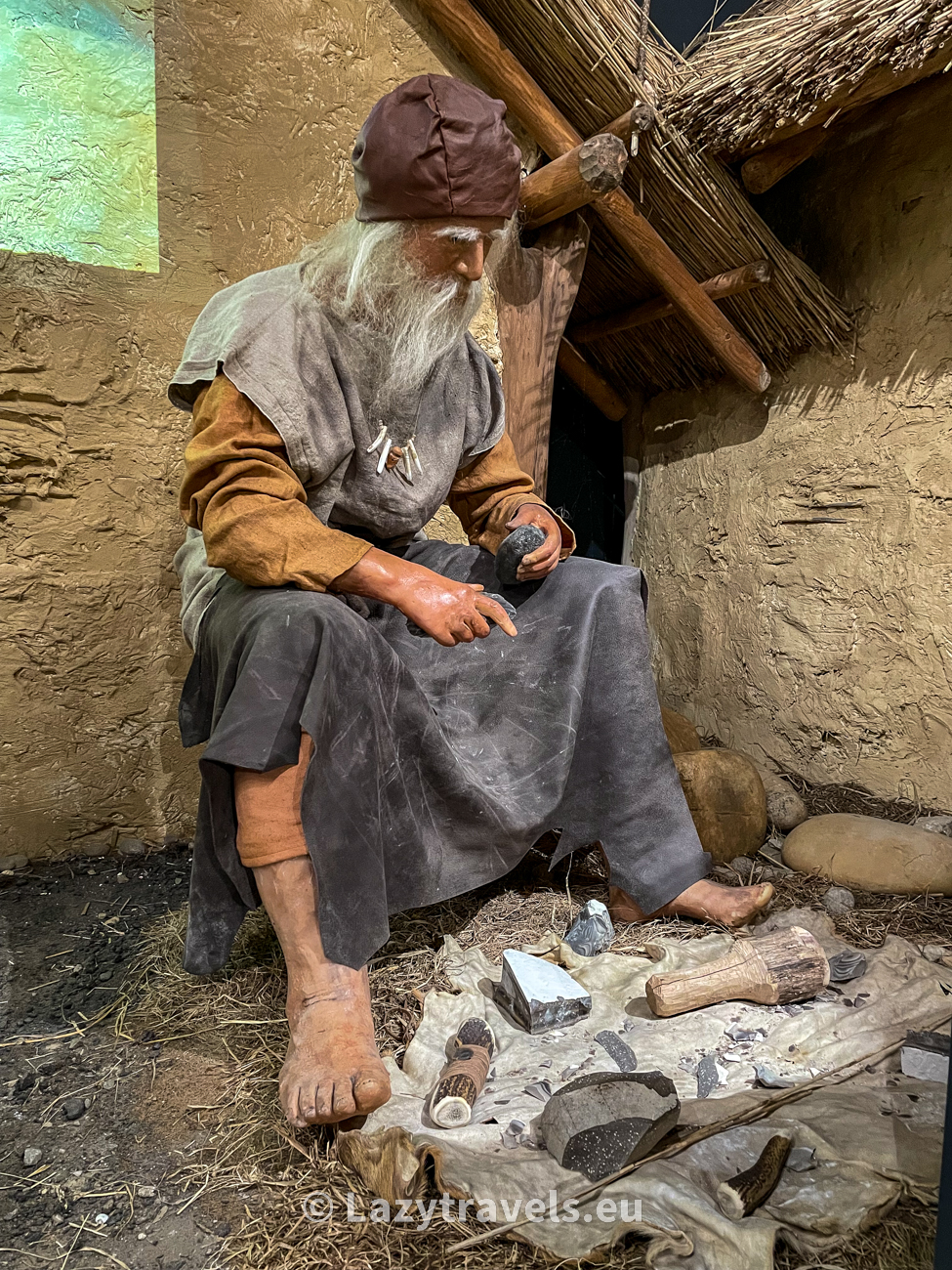
Anyway, before the museum visitors and exhibitions, there is fortunately no overcrowding of boring display cases with artifacts; instead, there is a strong emphasis on realism. Here, life-sized huts have been recreated based on excavations. Around the huts, activities that were once part of daily life are taking place. We have flint knappers’ workshops – specialists in flint processing – while nearby, a man and a woman are unpacking a cart filled with goods. Next to the house, a child is watching over a flock of sheep, and another couple is tending to their garden.
Since the museum area is small but there is much to show, not far away in a hollow lies a bound cow, presumably intended as a sacrifice to the gods. A few steps further, there is a dead man, with a bow and arrows beside him. Above him stands a grieving woman. Yes, even such emotions are expressed here. Interestingly, all the figures are life-sized. As you can easily guess, people back then were much shorter than they are today. This actually made it much easier when it came to building mining tunnels, as they could be lower than they would have to be today.
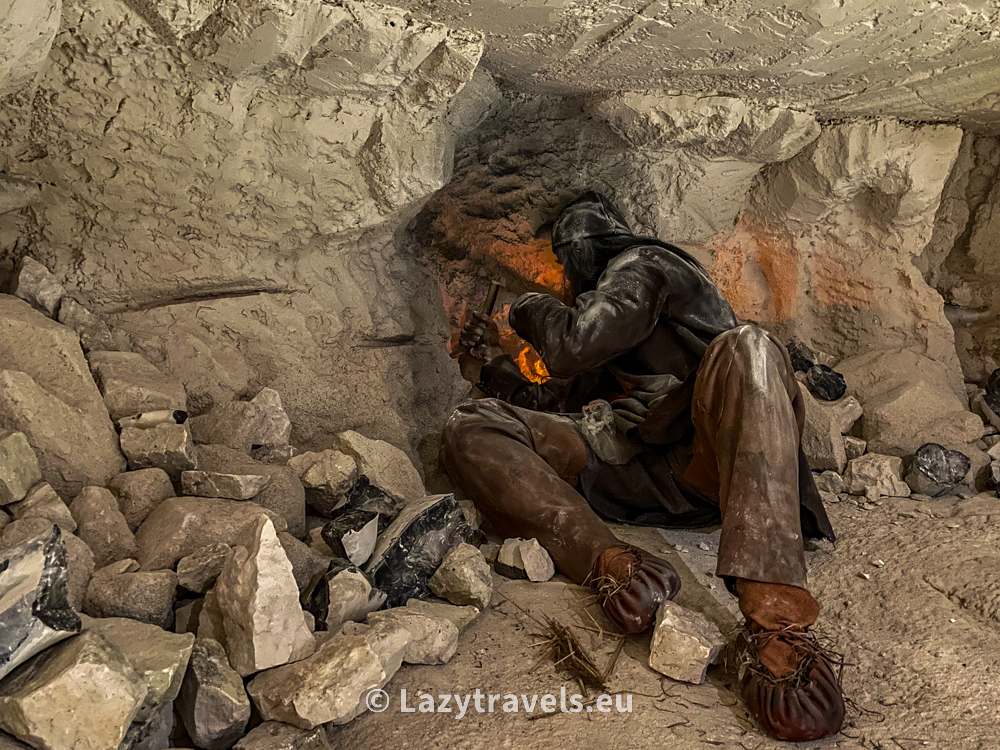
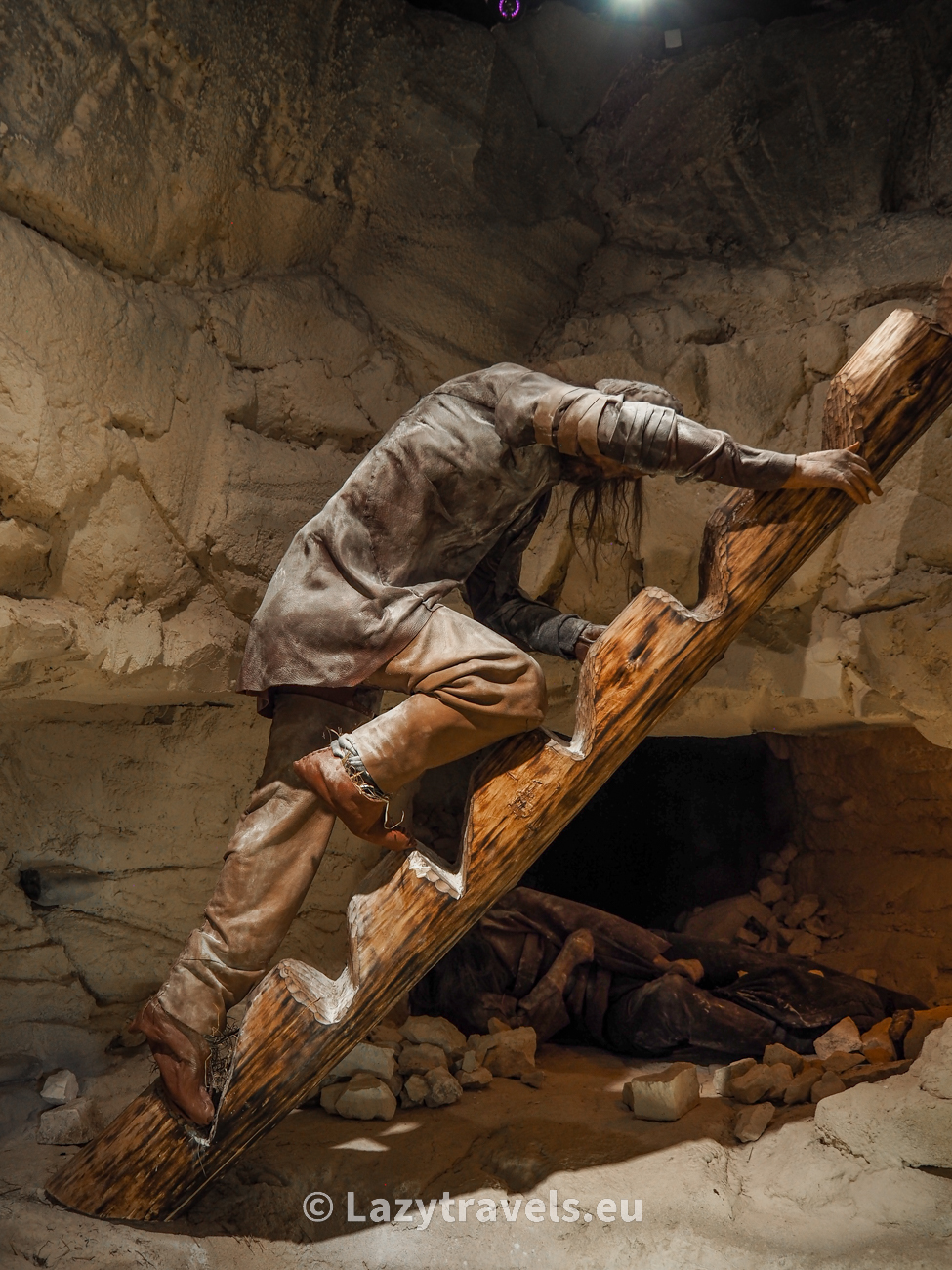
And here we come to the next part of the exhibition. Since the Krzemionki Opatowskie (by the way, I wonder what this place was called 5,000 years ago?) was the center of flint mining, there had to be an exhibition in the museum about how this flint was obtained. Of course, we have several mannequins climbing ladders or sitting in the recesses of corridors, working on extracting the valuable raw material. By the way, looking at them reminded me of the corridors in the salt mine in Wieliczka, where they showed how gas was burned off in the mine. The mannequins are similar 🙂 And without a hint of irony, I suggest you take a close look at these mannequins. Why? Because they show how people used to dress, in what attire miners went to work. Just look at the shoes of that individual in the photo!
Krzemionki Opatowskie – visiting the mine
And when we have finished viewing the permanent exhibition in the museum, it’s time to step outside into the fresh air. To the outdoors (as they say in Mazovia) or to the field (as they say in Lesser Poland). Here, another attraction awaits us, but we will have to walk a bit to get there. The march takes us through a beautiful forest, which is important because when Professor Jan Samsonowicz discovered these Neolithic mines in 1922, the area looked completely different. The geologist’s attention was drawn to the numerous pits and small hills that were clearly visible in the treeless landscape. A quick check showed that these hills were simply the places where prehistoric miners dumped the rock they had extracted from the ground. The earth and rubble they dug while building corridors and pits to find flint nodules.
And it must be said right away that the ancient miners were not ignorant; they knew where to dig and where to expect flint. The area where the mines were located covers 78.5 hectares, with a width ranging from 25 to 200 meters. The length is about 4.5 kilometers! And now the most important part: No one has accurately counted how many of these prehistoric mines were created, as it is impossible to do so. This is because their number is estimated to be over 4,000. The mines operated during the Neolithic period, from about 3900 BC, although their most intense exploitation occurred between 2900 and 2500 BC.
Flint mines
As we walk along the route with the guide, we see these types of hills from time to time. However, for tourism purposes, some of the old mines have been excavated. This allows us to stop on platforms next to them and peer into the interiors of the shafts and pits. Well, we probably wouldn’t notice much on our own, but fortunately, the guide explains how the various types of mines were created and how flint was extracted from them.
We will learn that the simplest were just ditches and pits dug into the ground to extract the flint that lay closest to the surface. These places are about 2 meters deep. Then there are niche mines, which were 2.5 to 4 meters deep. The lower part of these structures was wider because Neolithic miners extracted rock and earth within a radius of about 2 meters from the shaft. Further digging risked collapse.
Another type of mine is the tunnel mine. From the shaft, tunnels were dug radiating outwards up to a radius of 7 meters. The height of the tunnels was small, as flint occurs in layers up to one meter high. The next type is the pillar-and-chamber mine. It differs from the previous one in that natural rocks were used as pillars to protect against the collapse of the tunnels. The tunnels could be up to 8 meters long.
Going through the underground route
Finally, we reach the technological peak of underground engineering by Neolithic specialists in earth excavation. Here are the chamber mines! This marvel of contemporary technology was the most advanced. The depth of the shaft reached up to 9 meters, and the corridors branching off from it measured up to 20 meters and could be supported to protect miners from tunnel collapses. There could be many such corridors, allowing the working area to cover even several hundred square meters!
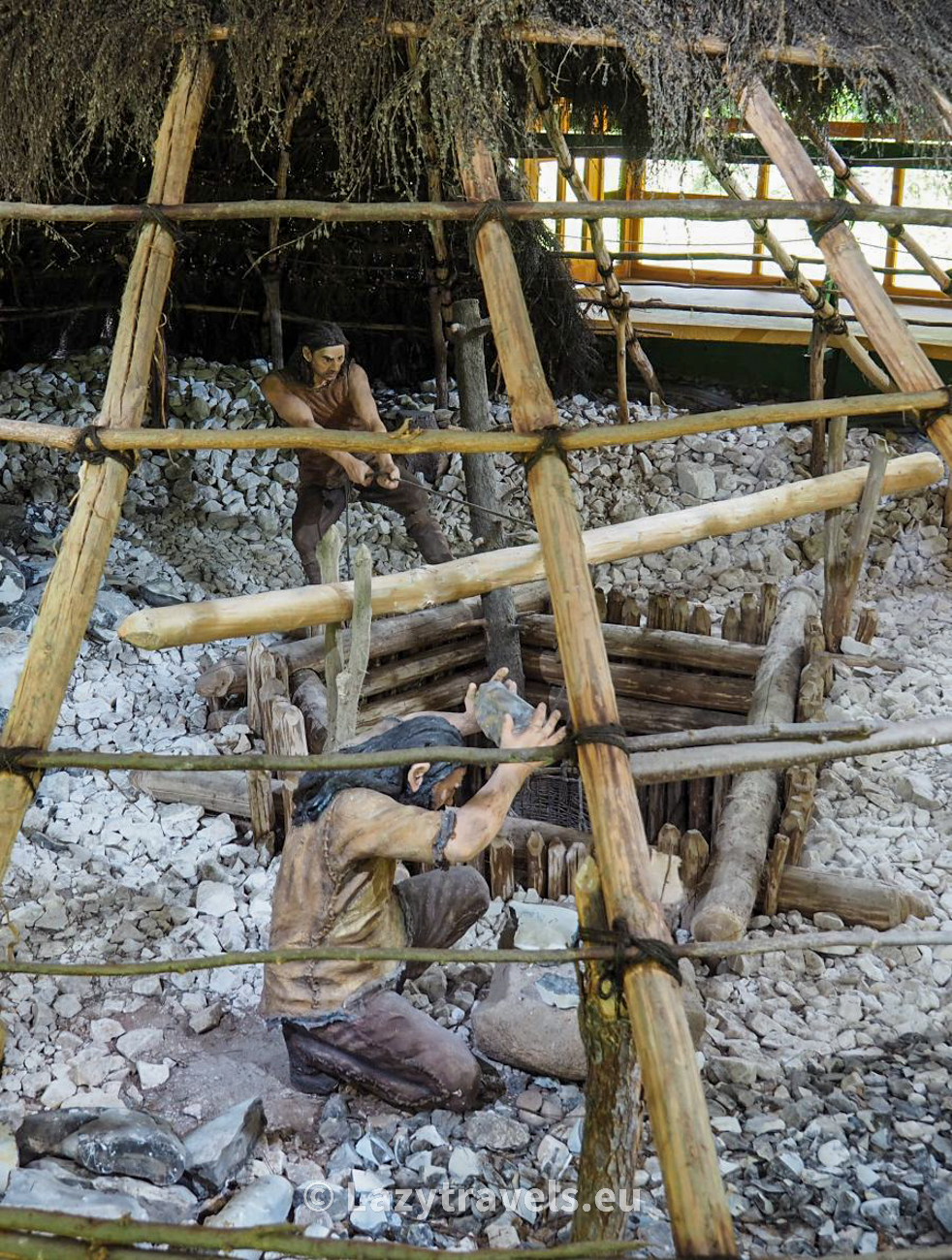
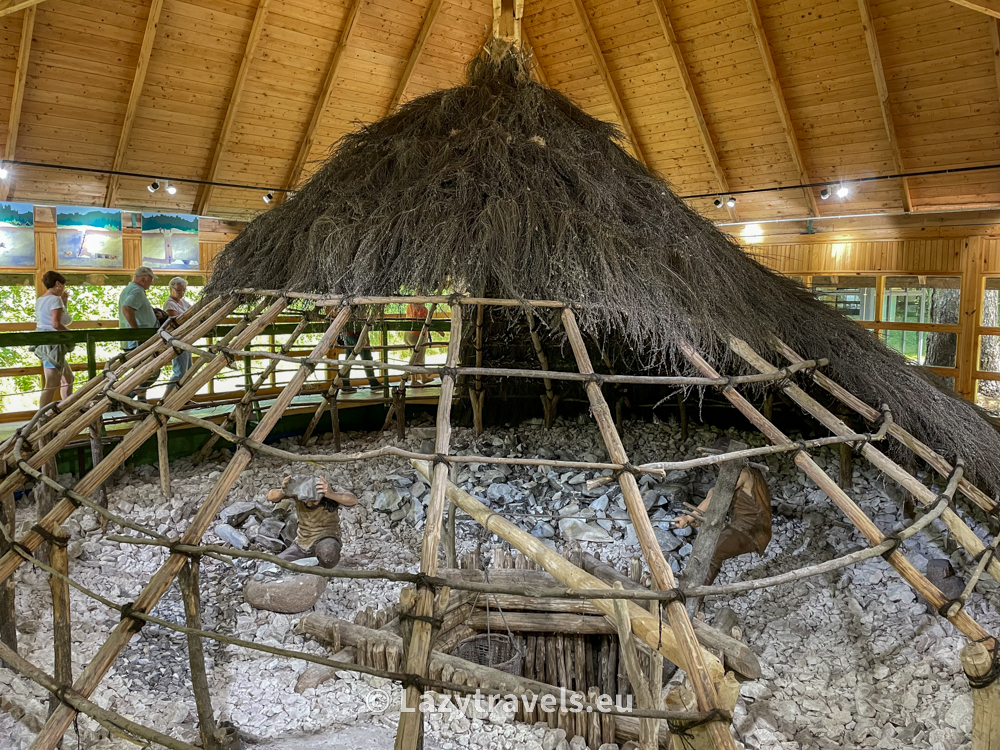
To demonstrate the scale of the ancient mine, archaeologists and staff from the Krzemionki Opatowskie museum uncovered one of the larger mines. Based on archaeological discoveries, they reconstructed not only the shaft itself but also what was above it. This was done to show that over parts of the largest mines, roofs were built to make them resistant to weather conditions. As a result, the corridors were not flooded by rainwater. Stylized mannequins were also placed by the shaft to show how ancient miners were dressed and what they did.
How flint was extracted from mines
And now we come to one of the most interesting topics: how flint was extracted, that is, how the mines were built and exploited. To find out, chamber mines were excavated, and an underground tourist route was built among them. Thus, all visitors have the chance to see what it was like to work at such depths in the past. Interestingly, when descending into the mine, the guide does not greet the tourists with the phrase „God bless,” as is customary in almost all mines, such as the oldest salt mine in Poland in Bochnia. Well, that would be a curious greeting, as the concept of the God we know from culture was not known at all nearly six thousand years ago. We have no idea what the ancient Neolithic miners believed in.
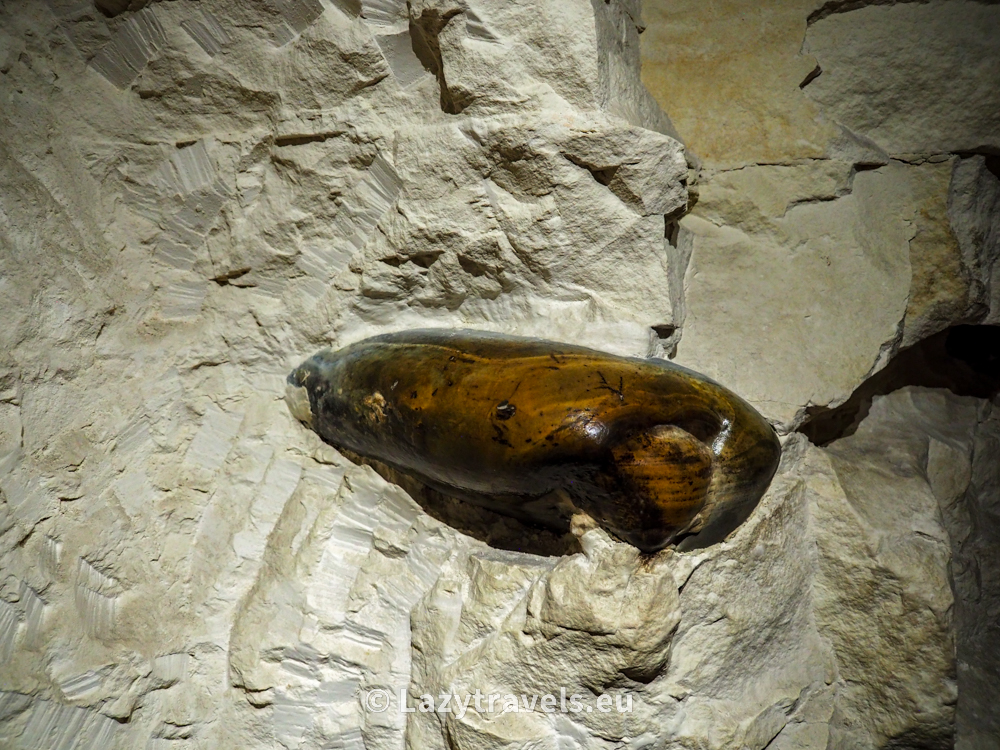
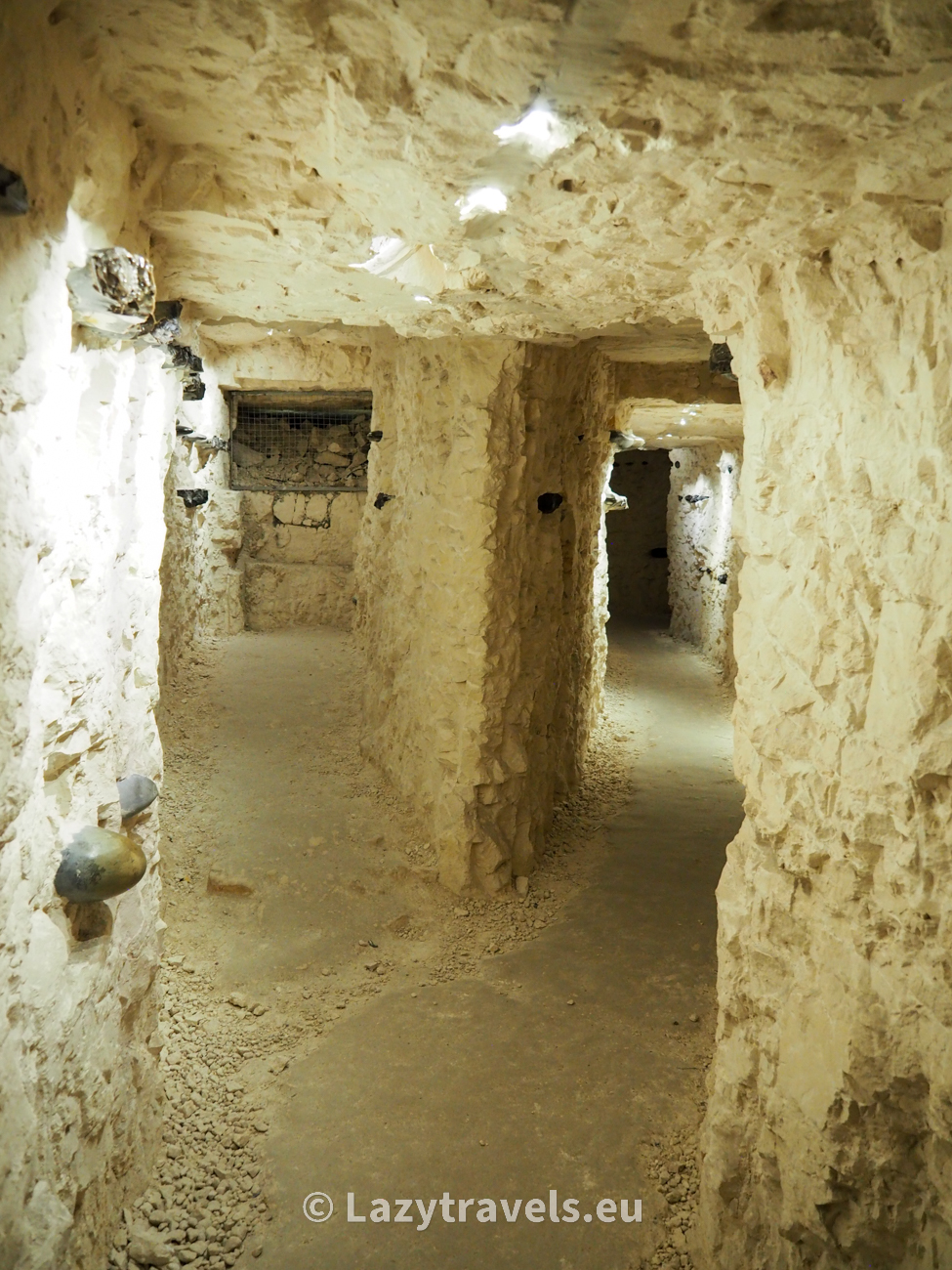
We descend to the underground tourist route via stairs. It is worth mentioning that one should dress warmly, as the temperature down there ranges from 7 to 9 degrees Celsius. The creators of these corridors tried to show how work was done in the past, so part of the route leads alongside several thousand-year-old excavations. However, the majority of the route consists of new tunnels with heights suitable for modern humans. To make the tour more interesting, flint concretions were embedded in the walls. Concretions are sizable chunks of flint, some of which were split open to show their color. Thanks to this, visitors can see for themselves what prehistoric miners were looking for. And of course, they can touch these flints and take photos.
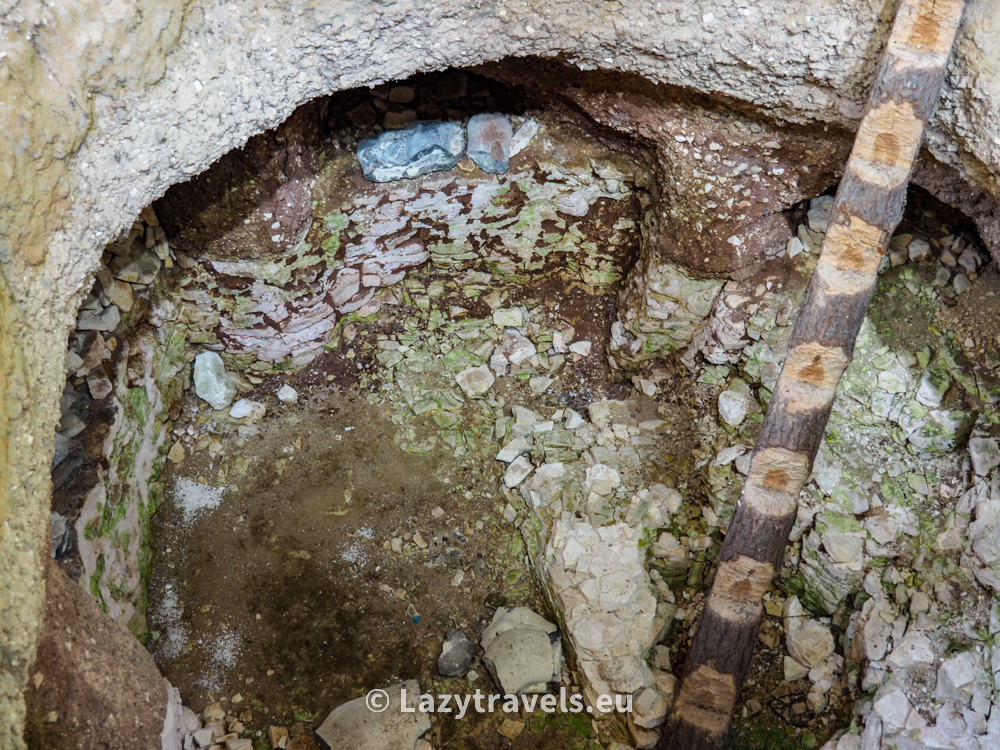
Naturally, it is not possible to enter the oldest parts of the mine, where people worked thousands of years ago, but we can view them behind bars. However, in these places, it is easiest to imagine how difficult the work of ancient specialists was, who performed their tasks by torchlight from resinous branches in the cold and high humidity. Well, it is no wonder that life expectancy in ancient times was not very long. And what tools did ancient miners use to extract flints from such depths, since it was not yet the Iron Age or even the Bronze Age, and such tools were unknown? Well, primarily wooden tools, but also stones and animal antlers. Therefore, it was not an easy job, as you can imagine trying to dig and excavate in the earth and rock without the use of metal!
Reconstruction of ancient settlements
After we emerge to the surface, there is one more attraction waiting for visitors to the Krzemionki Opatowskie nature reserve. It is the opportunity to visit an ancient settlement, or rather a reconstruction based on archaeological discoveries.
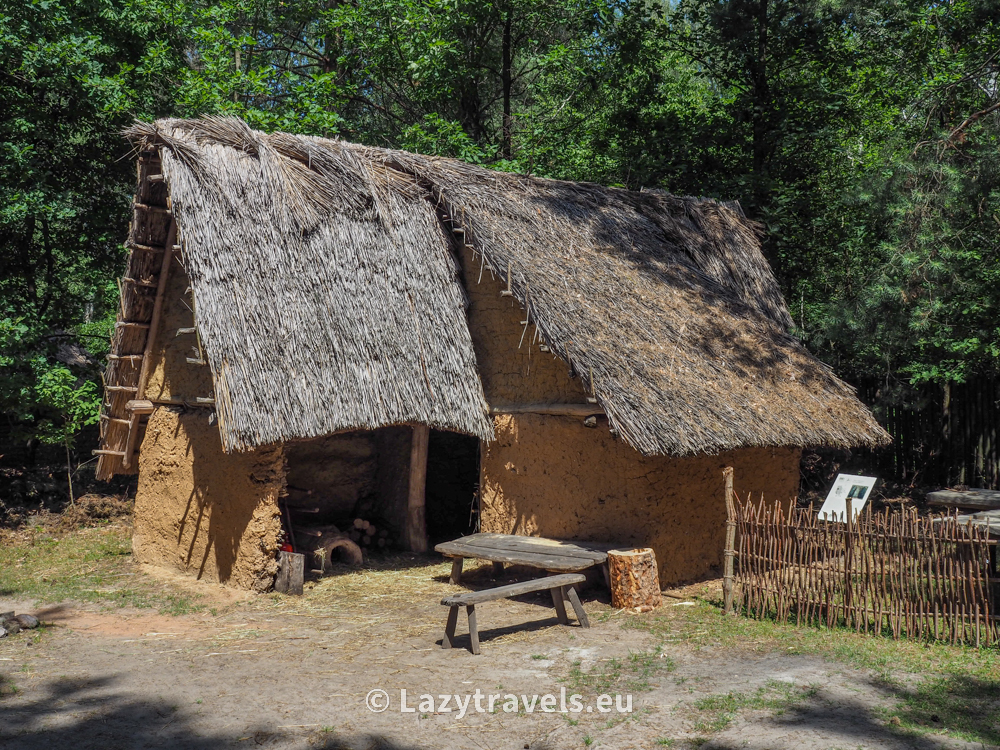
What I highly recommend paying attention to is the cart. Why the cart, you may ask? Well, because on a vase discovered in nearby Bronocice, there is an interesting decoration. There is no full agreement on what it is, but some archaeologists lean towards the conclusion that a symbol representing a cart was carved and fired into the clay vessel. A cart may seem like nothing special, but notice that the cart has wheels! And the wheel is considered an invention made in Mesopotamia around 3500 BC! Mesopotamia, in turn, was located several thousand kilometers from the areas of present-day Poland. Therefore, if the vase from Bronocice, which is dated to 3635–3370 BC, indeed features an image of a cart with wheels, it would mean that the wheel was invented independently in several regions of the world! An archaeological revolution!
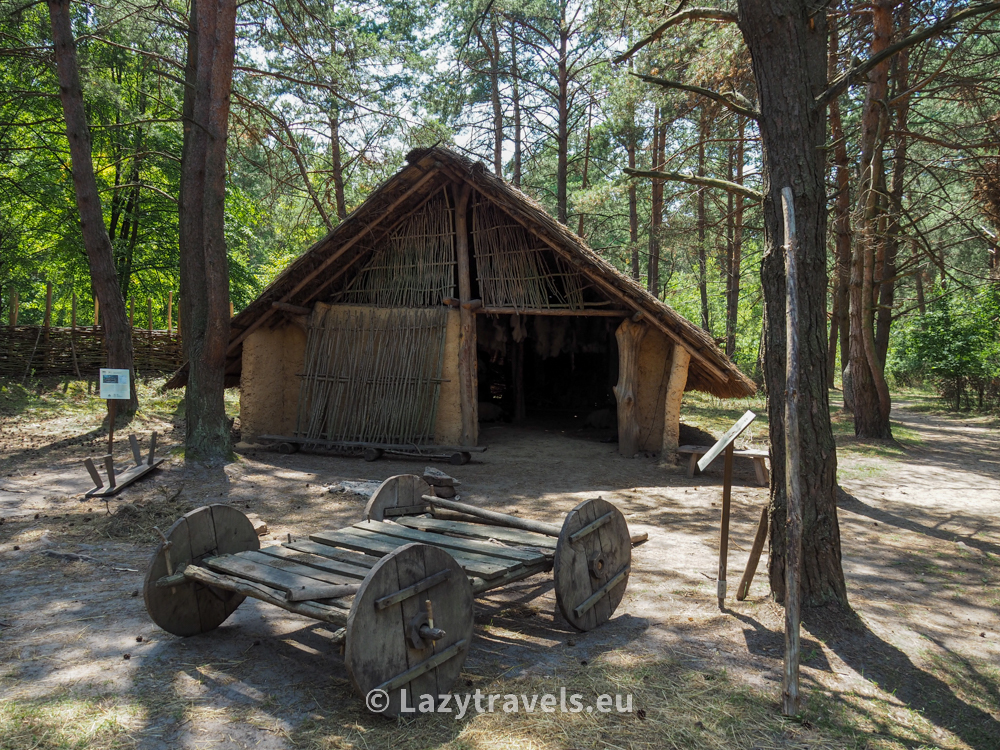
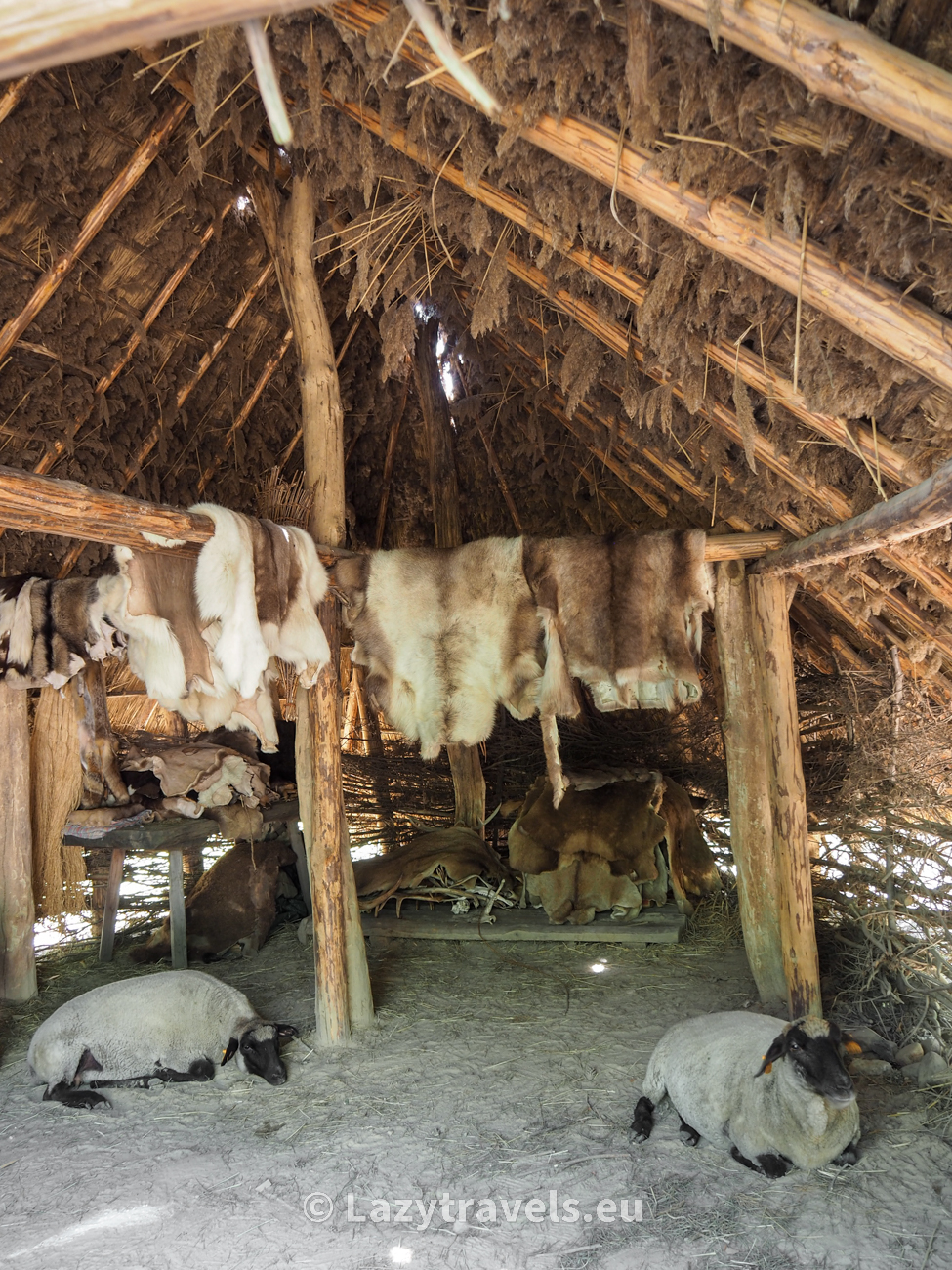
However, besides viewing the ancient cart, constructed based on the image from the vase, in this settlement surrounded by a wooden wall, we can also see and explore several houses. Thanks to their furnishings, we can get some idea of how people lived in ancient times. And believe me, it was not an easy life. It is also worth mentioning that to add realism to the reconstruction, these houses contain not only animal skins and quite primitive tools but also live livestock such as sheep. What I suggest is to take a look at the wooden beams and the roof. Imagine that these thick trees, from which the beams supporting the house were made, were cut down using flint axes!
Krzemionki Opatowskie Reserve and Museum – is it worth it?
I must admit that just after leaving Krzemionki Opatowskie, I wondered if it was worth it. Did I like the place? I admit I had mixed feelings. On one hand, it is a fascinating place, and the opportunity to see how nearly 6,000 years ago mines were created was captivating. Just like the chance to learn about ancient life, which was presented in the museum. But on the other hand, the times shown are so distant and so little has survived that you really need to have a very good guide who can vividly explain what is not visible. Unfortunately, I ended up in a large group, so during the tour of the mine, I often couldn’t hear the guide at all because he was at the front of the group, and I was at the back. Moreover, he spoke in a very boring way. To make matters worse, at one point he disappeared for fifteen minutes because he had to rush to the restroom… You understand, if it’s not charm, it’s a disaster! My bad luck.
Krzemionki Opatowskie – pricing, parking, and visiting time
The Archaeological Museum and Krzemionki Reserve in the village of Sudół near Ostrowiec Świętokrzyski features:
- The underground tourist route is about 500 meters long.
- The depth of the route is up to 11.5 meters below the surface.
- The temperature ranges from 7 to 9 degrees, depending on the season. Bring warm clothing!
- A regular ticket to Krzemionki Opatowskie costs 35 PLN, and a reduced ticket costs 22 PLN.
- The opening hours of this museum and archaeological park vary depending on the month.
May – September: Monday 10:00 AM – 4:00 PM; Tuesday – closed; Wednesday – Friday 9:00 AM – 6:00 PM; Saturday – Sunday 10:00 AM – 6:00 PM.
April and October: Monday 10:00 AM – 4:00 PM; Tuesday – closed; Wednesday – Sunday 9:00 AM – 5:00 PM.
November, December, January, February, March: Monday 10:00 AM – 4:00 PM; Tuesday – closed; Wednesday – Friday 8:00 AM – 4:00 PM; Saturday – Sunday 8:00 AM – 4:00 PM. - During the peak season, which is from May to September, entries to the museum and the underground mine are every half hour from the museum’s opening, but the last entry varies. Off-season, entries are only a few times a day – roughly every hour from opening. Therefore, I highly recommend making a reservation, as Krzemionki is very popular.
- Without a reservation, especially on weekends and holidays, it may be difficult to buy a ticket. Although I managed to get in without a reservation, but I was there on a Thursday morning.